

.svg)


.avif)



5 min read
Preparing Your Home's Air Quality for the Back-to-School Season
Why the August Back-to-School Transition Challenges Your Home's Air
The late-summer shift brings new schedules, new routines, and new biological challenges, making preparing your home's air quality for the back-to-school season a top priority before fall weather truly sets in. As kids return to the classroom during the August back-to-school transition, they inevitably bring home a fresh wave of seasonal germs, allergens, and dust. At the exact same time, many homeowners start sealing up their houses to trap cool air, inadvertently locking those new contaminants inside.
In our experience serving local families, this combination creates a perfect storm for poor indoor air quality. According to the Environmental Protection Agency (EPA), the air inside your house can be two to five times more polluted than the air outside. This spike in indoor pollution is especially noticeable during seasonal transitions. When you close the windows while outside humidity is still high, you trap excess moisture indoors. That trapped moisture acts like a sponge, holding onto respiratory droplets, pet dander, and dust mites.
Taking a proactive approach to managing your home's humidity and filtration is the most effective way to protect your family's health. Instead of waiting for the first wave of fall colds to sweep through your household, you can adjust your home's environment right now. By controlling airborne moisture and upgrading your filtration strategy, you create an indoor climate where germs struggle to survive and your family can breathe easier.
The Hidden Link Between Lingering Late-Summer Humidity and Indoor Germs
There is a direct scientific relationship between the amount of moisture in your air and the survival rate of airborne viruses. As local HVAC professionals, our team at 3D Heating and Cooling knows firsthand that in Taylorsville, KY, late-summer humidity frequently lingers heavily into August and September. This sticky, heavy air makes moisture control critical long before the major fall cool-down arrives. If you seal up your home while that humidity is still high, you create an indoor environment that actually helps biological contaminants thrive.
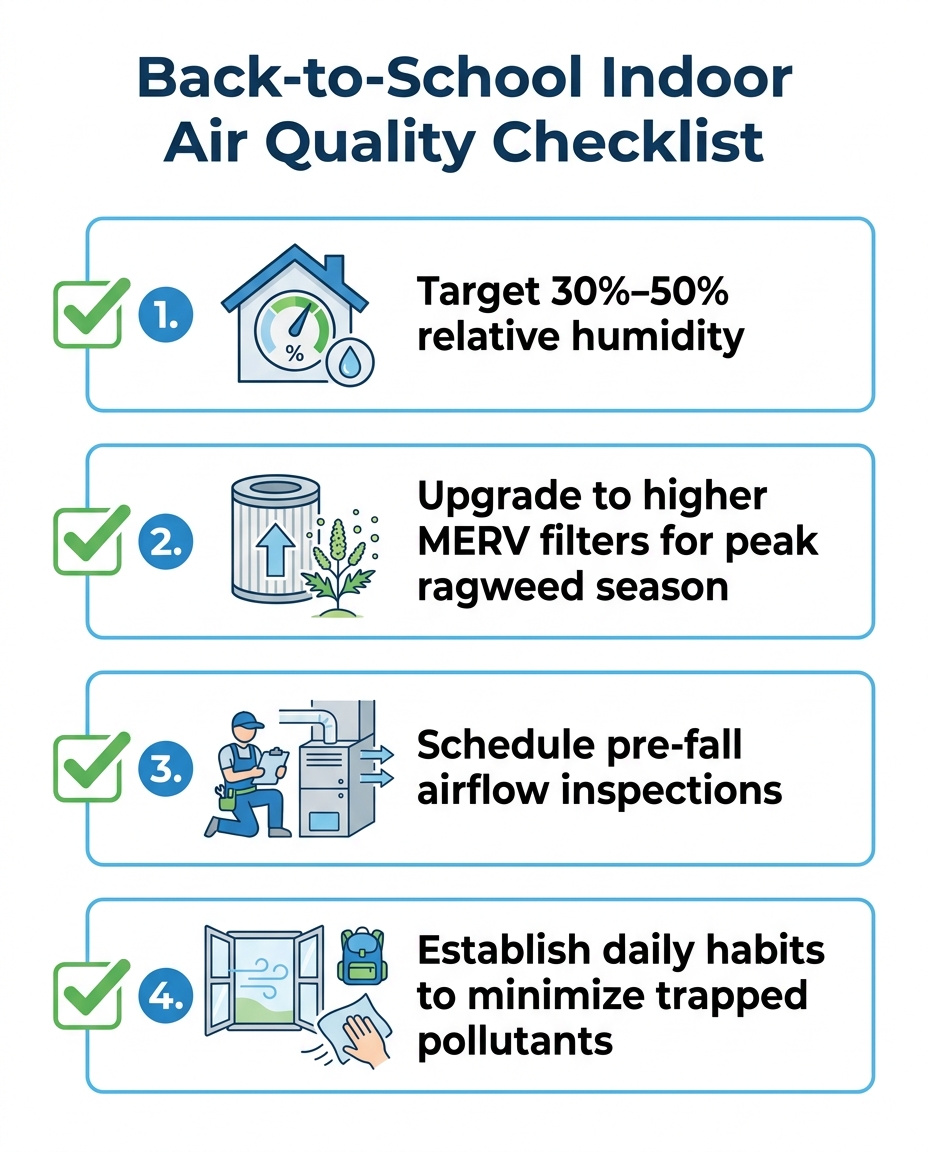
Airborne viruses, mold spores, and dust mites all have specific moisture preferences. When the relative humidity inside your home rises above 50%, the air becomes a breeding ground for these irritants. Conversely, if the air drops below 30%, it dries out your nasal passages, making your family more susceptible to the germs brought home from the classroom. The sweet spot for minimizing the survival rate of school-brought illnesses is a relative humidity range between 30% and 50%.
• Low (Under 30%) — Impact on Home Environment: Dry skin, static electricity, cracking wood. — Viral & Bacterial Survival Rate: High. Dry air allows viruses to travel further and stay airborne longer.
• Ideal (30% to 50%) — Impact on Home Environment: Comfortable breathing, balanced moisture. — Viral & Bacterial Survival Rate: Low. Most biological contaminants struggle to survive in this balanced zone.
• High (Over 50%) — Impact on Home Environment: Clammy air, condensation on windows, musty odors. — Viral & Bacterial Survival Rate: High. Mold, dust mites, and bacteria multiply rapidly in damp conditions.
How Moisture Traps Pollutants
When the air inside your home is saturated with water vapor, it behaves differently than dry air. Heavy, humid air physically holds onto particles instead of letting them settle or pass through your HVAC filter.
• Suspended droplets: High humidity allows microscopic respiratory droplets (which carry germs) to remain suspended in your breathing zone for longer periods.
• Biological breeding grounds: Damp areas around vents, bathrooms, and basements give mold and mildew the exact conditions they need to rapidly reproduce.
• Visible warning signs: Condensation forming on the inside of your windows or around your metal air vents is a clear signal that your indoor moisture levels are too high.
Step 1: Upgrading Your HVAC Filtration Strategy
Standard fiberglass air filters—the cheap, see-through ones you can buy in bulk—are designed to do one thing: protect your HVAC equipment from large debris like hair and heavy dust. They are completely insufficient for capturing microscopic back-to-school germs or the heavy ragweed pollen that peaks during the August back-to-school transition. To actively improve your air quality, you need a filtration strategy that targets smaller particles.
This is where MERV (Minimum Efficiency Reporting Value) ratings come into play. The MERV scale measures how effectively a filter traps tiny particles. However, you cannot simply buy the highest-rated filter on the shelf. Filters with very high MERV ratings are dense, and if your system is not designed to push air through that density, you will restrict airflow, strain your blower motor, and potentially freeze your coils.
In our years of maintaining residential systems across our service area, we've found that finding the right balance is key. Our technicians typically recommend upgrading to a pleated filter in the MERV 8 to MERV 11 range as the safest and most effective choice for local homes. If you want to understand exactly how to weigh these options for your specific system, comparing MERV 8 vs. MERV 11 filters for back-to-school allergen control will help you strike the perfect balance between capturing irritants and maintaining healthy airflow.
The Back-to-School Filter Schedule:
1. Inspect bi-weekly: During peak ragweed season and the start of the school year, pull your filter out every two weeks just to check its color.
2. Replace monthly: If you have pets, multiple children, or live in a high-dust area, swap a standard 1-inch pleated filter every 30 days.
3. Upgrade media cabinets: If your system uses a thicker 4-inch or 5-inch media filter, these can typically last 3 to 6 months, but you should still inspect them as the seasons change.
Step 2: Managing Whole-Home Moisture Levels
Your existing air conditioning system is actually your home's primary dehumidifier. As warm indoor air blows over the icy evaporator coils, moisture condenses into water droplets and drains away outside. However, a pattern we see often during the late-summer transition in Taylorsville, KY, is that temperatures drop just enough that your AC doesn't run as frequently, yet the outdoor humidity remains incredibly high. This results in short cycling—your house cools down fast, but the system shuts off before it has time to extract the moisture.
Many homeowners try to solve this by purchasing portable room dehumidifiers. While these units are fine for a single damp basement corner, they cannot manage the moisture load of an entire house. Whole-home dehumidifiers, which integrate directly into your existing ductwork, measure the moisture in every room and pull water out of the air before it circulates back into your living spaces.
• Coverage Area — Portable Dehumidifier: Single room or small open area. — Whole-Home Dehumidifier: Entire house, managed through ductwork.
• Maintenance — Portable Dehumidifier: Requires daily manual emptying of water buckets. — Whole-Home Dehumidifier: Drains automatically into your home's plumbing.
• Efficiency — Portable Dehumidifier: Uses significant electricity for limited results. — Whole-Home Dehumidifier: Highly efficient, working alongside your HVAC blower.
Supporting Your Cooling System's Dehumidification
Even without adding new equipment, you can take safe, non-DIY-dangerous steps to help your current system remove moisture more effectively:
• Keep interior doors open: Closed doors restrict return airflow. Open doors promote cross-ventilation, allowing humid air to reach the return vents and travel back to the cooling coils.
• Utilize exhaust fans: Run your bathroom exhaust fans for at least 20 minutes after showering, and use your kitchen hood vent while boiling water to remove localized moisture at the source.
• Check the drain line: Ensure the PVC condensate drain line outside your home is dripping water when the AC runs. Late-summer algae buildup can clog this line, causing moisture to back up into the system.
Step 3: Scheduling Pre-Fall Ductwork and Airflow Inspections
Throughout the long summer cooling season, microscopic dust, pet hair, and moisture inevitably settle inside your ductwork. As you approach the August back-to-school transition, that hidden buildup becomes a liability. When you eventually switch from cooling to heating, the sudden change in temperature and airflow can blast months of settled allergens directly into your living spaces.
Based on the ductwork inspections we perform every fall, proper air distribution is your best defense against stagnant air. Germs and viruses concentrate in pockets of still air. If certain rooms in your house always feel stuffy or have weak airflow from the vents, those rooms are more likely to harbor airborne contaminants. Inspecting and correcting airflow issues is a critical part of heating preparation before you officially switch your thermostat over to heat for the winter.
What an airflow inspection looks for:
1. Blocked returns: Ensuring furniture or rugs haven't been pushed over your return grilles, which starves the system of air.
2. Duct leaks: Identifying loose connections in the attic or crawlspace that might be pulling dusty, unconditioned air into the circulation loop.
3. Blower motor performance: Checking that the fan is pushing the correct volume of air (measured in cubic feet per minute) to keep air moving vigorously through the filter.
Step 4: Daily Household Habits to Minimize Trapped Pollutants
Technology and equipment upgrades are powerful, but daily habits play an equally massive role in your home's air quality. The August back-to-school transition means more foot traffic, more backpacks tossed on the floor, and more opportunities for outside irritants to enter your controlled indoor environment. Implementing a few simple routines can drastically reduce the volume of pollutants your HVAC system has to filter out.
The Daily Air Quality Checklist:
• Establish a strict "drop zone": Designate an area right inside the front door or mudroom for shoes, backpacks, and jackets. This stops kids from tracking playground dust, pollen, and locker room germs throughout the house.
• Vacuum with HEPA filtration: Standard vacuums often exhaust fine dust back into the air. Use a vacuum equipped with a true HEPA filter to permanently capture settled dander and dust mites from carpets and upholstery.
• Manage indoor plants carefully: Overwatering houseplants is a common mistake that adds unnecessary humidity to your indoor air and promotes topsoil mold. Water plants only when the top inch of soil is dry.
• Wipe down high-touch surfaces: Doorknobs, light switches, and thermostat faces are transfer points for germs. Wiping them down daily reduces the biological load in the house.

When to Consult a Professional for Advanced IAQ Solutions
Basic filter changes and daily habits are excellent first steps, but they cannot solve severe air quality issues on their own. If you notice persistent musty odors, lingering condensation on your windows in the morning, or find that your family is passing the same cold back and forth for weeks, it is time to look beyond DIY maintenance.
In the Taylorsville, KY homes our team services, we frequently find that local properties require a more robust approach to handle the drastic seasonal swings. Advanced solutions like ultraviolet (UV) germicidal lamps can be installed directly inside your ductwork to neutralize airborne bacteria and mold spores before they circulate. Whole-home air purifiers go a step further than standard filters, using electronic polarization to capture microscopic virus-sized particles that slip through traditional pleated media.
At 3D Heating and Cooling, our dedication to keeping local families comfortable and healthy drives us to provide professional indoor air quality solutions that actually make a difference. We don't just guess at the problem; we evaluate your entire system's performance. Having a professional assess your home's ventilation and moisture control before harsh winter weather locks you indoors is one of the smartest investments you can make. Integrating these checks into a comprehensive HVAC maintenance plan ensures your equipment runs efficiently while actively protecting your family's health.
Frequently Asked Questions About Fall Air Quality Prep
How do I reduce germs in my house when kids go back to school?
The most effective strategy is a combination of moisture control and filtration. Maintain your indoor humidity between 30% and 50%, upgrade to a higher MERV-rated pleated filter, and ensure continuous HVAC airflow to keep air moving. Establishing a "drop zone" for backpacks and shoes also prevents outdoor contaminants from spreading through your living spaces.
What is the best indoor humidity level for fall?
The ideal indoor humidity level for fall is between 30% and 50%. Staying within this balanced range is critical because it prevents mold growth, stops wood from cracking, and significantly reduces the survival rates of airborne viruses associated with the back-to-school season.
How often should I change my air filter during the school year?
During the heavy-traffic school months, standard 1-inch pleated filters should be replaced every 30 to 90 days. However, if you have multiple pets, suffer from severe fall allergies, or keep your windows open frequently, you should inspect the filter every two weeks and replace it monthly to ensure peak performance.
Does indoor air quality actually affect sickness?
Yes, the quality of your indoor air has a direct impact on respiratory health and sickness transmission. Poor ventilation, stagnant air pockets, and high humidity allow airborne viruses to linger longer and spread more easily from person to person within the household.
Should I open windows to improve air quality in the fall?
You should only open windows on days with low humidity and low pollen counts. During the August back-to-school transition, opening windows can actually invite excess moisture and heavy ragweed pollen indoors, which ultimately makes your HVAC system work harder to clean the air.
Creating a Healthier Home Environment for the School Year
Managing your home's air quality doesn't have to be a guessing game. By understanding how late-summer humidity in Taylorsville, KY interacts with the germs your kids bring home, you can take control of your indoor environment. Proactive humidity management and a smart filtration strategy are the foundation of a healthy home.
The steps are clear and actionable: upgrade your filters, support your system's dehumidification process, check your airflow, and build daily habits that keep pollutants at the door. If you are ready to take your home's health to the next level, exploring professional maintenance options will give you the confidence that your system is fully prepared to handle whatever the school year brings.
Financing

Now Offering Financing Options with Affordable Monthly Payments
where we operate
Service Areas
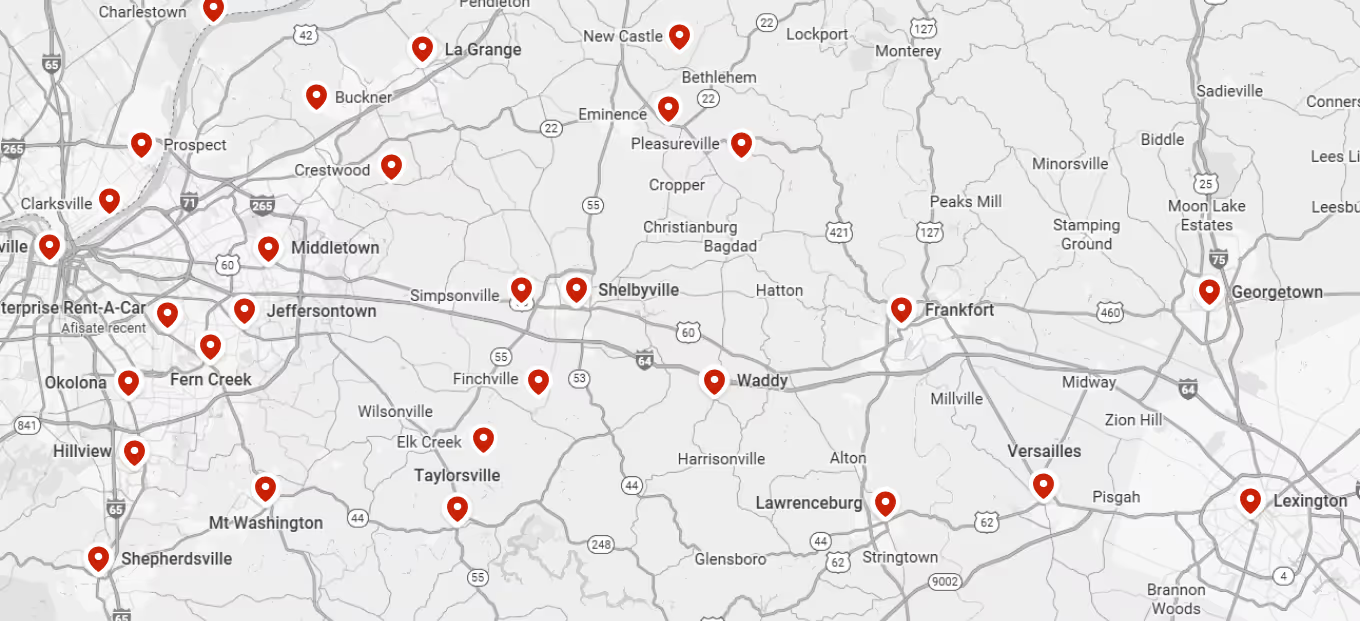
Proudly serving Spencer county, Jefferson county, Bullitt county, and the surrounding areas
Short Heading Goes Here
Sed iaculis aenean sit sed risus arcu vitae integer elit.

