

.svg)


.avif)



5 min read
Can a Clogged Condensate Drain Cause Water Damage in My Basement?
Finding Water Near Your HVAC: Is Your Basement at Risk?
Are you staring at a growing puddle near your indoor unit, asking yourself: Can a clogged condensate drain cause water damage in my basement? The short answer is an absolute yes. At 3D Heating and Cooling, our team receives frantic calls about this exact issue every late summer. When you run your air conditioning systems during the hottest parts of the year, they don't just cool the air—they extract massive amounts of moisture from it. That moisture has to go somewhere, and when the exit path is blocked, it ends up on your floor. While routine HVAC maintenance is the most effective way to prevent these backups, discovering an active leak means you are already in a race against time to protect your home's interior.
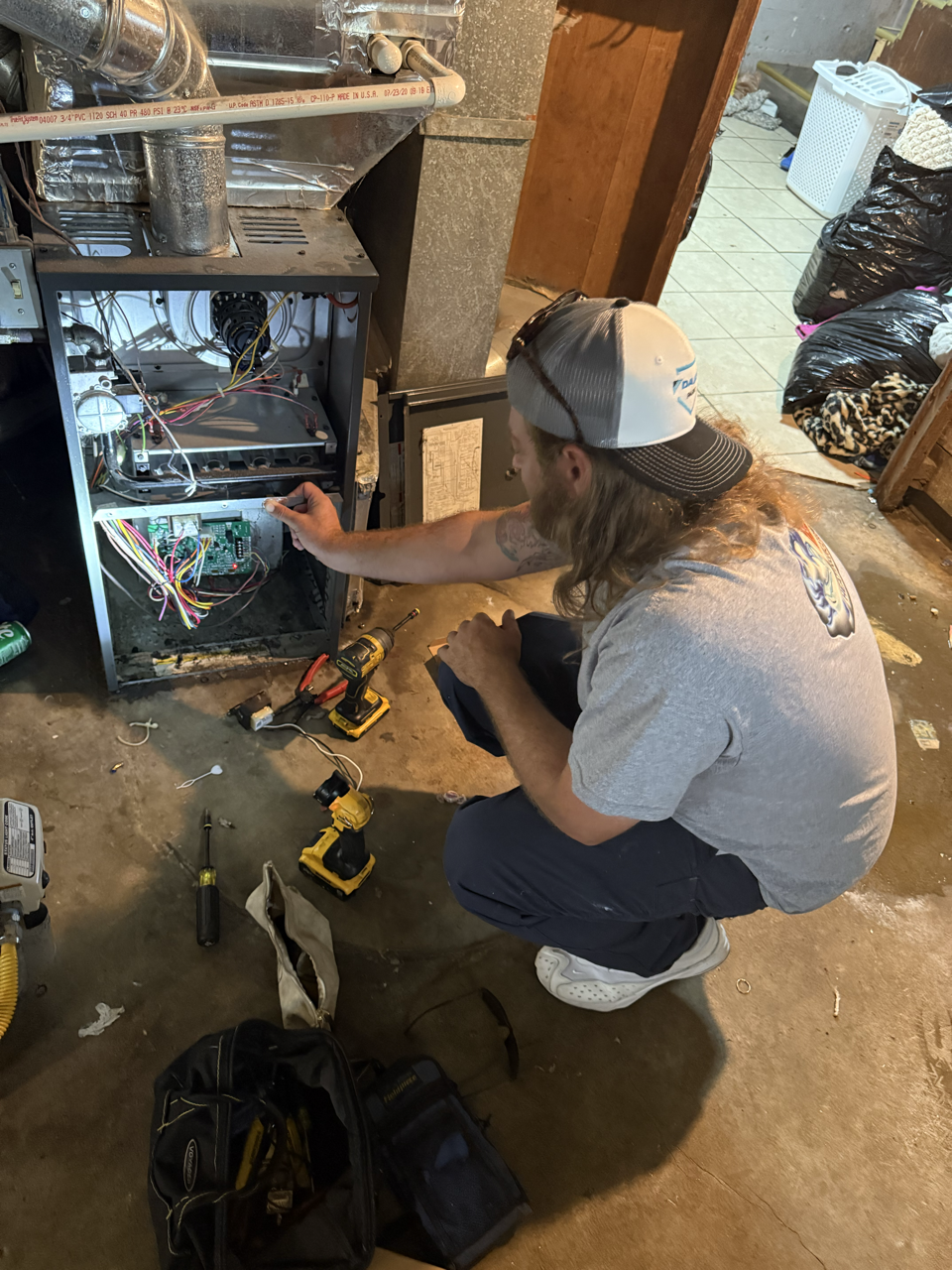
Finding unexpected water pooling around your indoor unit often triggers immediate panic, especially in finished Taylorsville KY basements where drywall and flooring are highly vulnerable. The sight of water creeping toward your baseboards is a clear signal that something within the system's drainage network has failed. In most cases that our technicians encounter, this is the result of an unchecked algae blockage that has finally caused the internal drain pan to overflow.
The immediate threat: A condensate leak is not like a small, isolated spill that you can simply wipe up and forget about. Because the system continuously generates water as long as it is running, a clogged line will keep pouring water into your basement until the unit is shut down. Understanding the mechanics of this overflow is critical for making the right decisions to protect your property and stop the damage from spreading.
Why AC Condensate Lines Clog During Peak Cooling Season
To understand why this happens, you have to look at the sheer volume of water your system handles. A standard residential AC system can produce anywhere from 5 to 20 gallons of condensate water every single day. In our years of servicing equipment throughout the region, we've seen how Taylorsville KY's severe summer humidity forces AC units to extract massive amounts of moisture from the indoor air, significantly increasing the volume of water flowing through that small PVC pipe. This accelerated moisture removal is great for your comfort, but it puts a heavy burden on the drainage system.
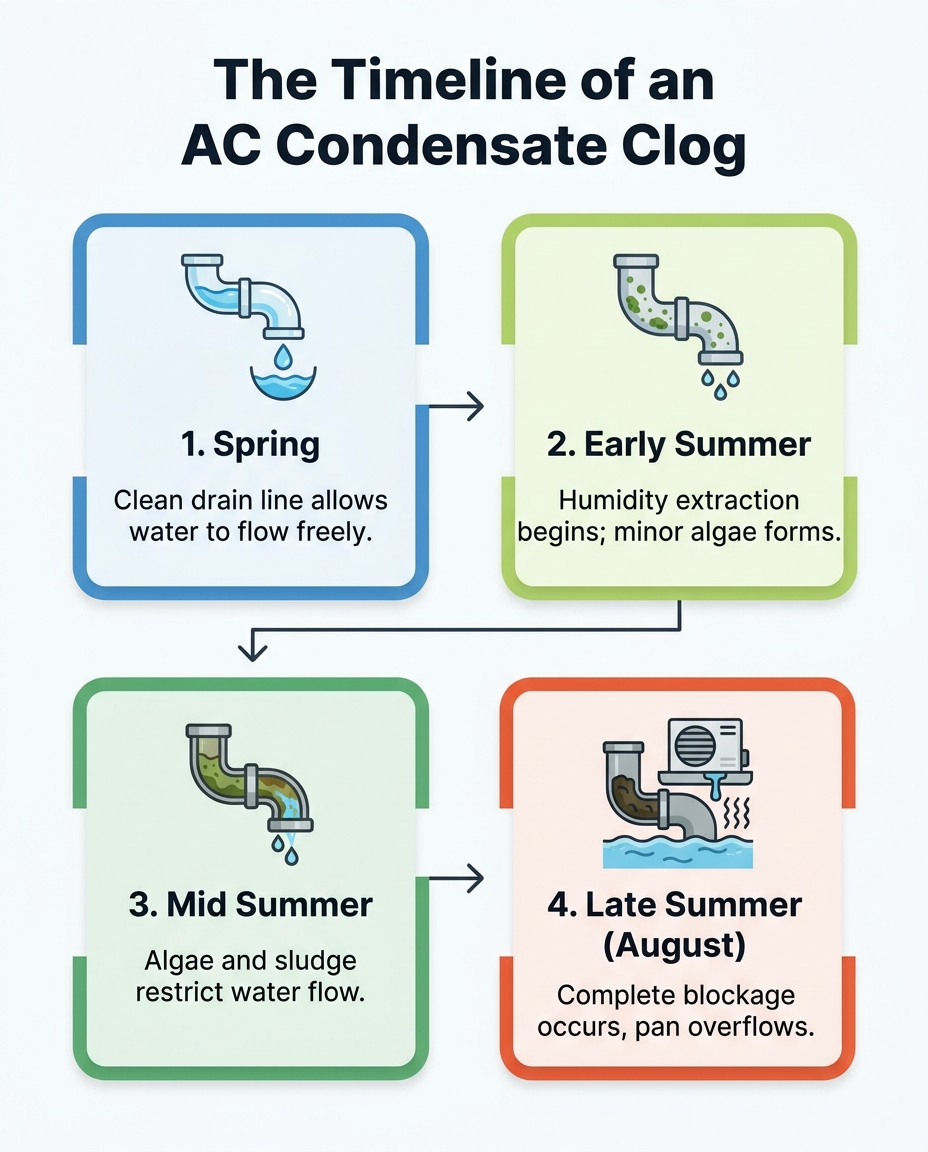
The interior of a condensate drain line is a dark, damp environment that typically hovers between 60 and 80 degrees Fahrenheit. This creates the perfect breeding ground for biological growth. A pattern we see often is the gradual, predictable progression from a clean pipe to a complete backup, which usually culminates during the August late-summer peak humidity.
• The Problem: Continuous moisture extraction creates a constantly wet environment inside the PVC drain line, carrying airborne dust and microbial spores into the pipe.
• The Cause: Over months of continuous running, these spores thrive in the dark, temperate pipe. They grow into a thick, gelatinous biological slime—often referred to as algae or sludge—that clings to the walls of the drain.
• The Solution: Professional clearing and preventative algaecide treatments break down this biological buildup before it can form a solid mass and block the flow of water.
By the time late summer arrives, the cumulative effect of this growth reaches a tipping point. What started as a minor restriction in June becomes a complete blockage by August. The water backs up into the drain pan, and if the safety float switch fails or is improperly calibrated, the pan overflows directly into your basement. It is a gradual buildup that suddenly results in an overflow emergency.

How an Overflowing Drain Pan Damages Finished Basements
When up to 20 gallons of water a day escapes the HVAC unit, the structural integrity of your home is immediately at risk. Finished Taylorsville KY basements are particularly susceptible because the materials used to finish them are highly reactive to standing water. The longer the water sits, the more extensive and invasive the necessary restoration becomes.
Drywall acts exactly like a sponge. Through a process called capillary action, drywall wicks standing water upward from the floor. Even a shallow puddle can result in moisture climbing a foot or more up the wall. Once drywall becomes saturated, it loses its structural integrity, crumbles, and often must be cut out and replaced to prevent structural decay.
Flooring materials suffer equally devastating effects. Laminate flooring will rapidly absorb moisture at the seams, causing the planks to swell, warp, and buckle permanently. Hardwood floors will cup and distort. Carpeting and the thick padding underneath it will soak up hundreds of pounds of water, becoming impossible to dry out effectively without professional extraction equipment.
• Drywall — Vulnerability to Standing Water: Wicks water upward, losing structural integrity and crumbling. — Timeline for Permanent Damage: Hours to Days
• Laminate Flooring — Vulnerability to Standing Water: Absorbs water at the seams, causing irreversible swelling and buckling. — Timeline for Permanent Damage: Minutes to Hours
• Carpet & Padding — Vulnerability to Standing Water: Traps massive volumes of water, preventing subfloor drying. — Timeline for Permanent Damage: Immediate saturation
• Wood Framing — Vulnerability to Standing Water: Absorbs moisture, leading to warping and eventual wood rot. — Timeline for Permanent Damage: Days to Weeks
Beyond the immediate structural ruin, there is a severe secondary threat to your indoor air quality. Damp basements provide the ideal environment for rapid mold growth. Mold spores can begin colonizing saturated drywall and carpet padding within 24 to 48 hours of the initial leak. Once mold takes hold in the basement, the HVAC system can easily circulate those spores throughout the rest of the house, compromising the breathing environment for your entire family.
Immediate Steps to Take When You Spot a Puddle
If you discover water pooling around your basement unit, your immediate goal is mitigation. You need to stop the source of the water and protect your flooring without putting yourself at risk or causing further damage to the sensitive components inside the HVAC cabinet. Knowing what constitutes a true 24-hour HVAC emergency is vital, and active water pouring into a finished living space definitely qualifies.
1. Turn off the AC system at the thermostat immediately. This is the single most important step. Because the water is a byproduct of the cooling process, shutting off the system stops the production of new condensate. Do not simply raise the temperature; switch the system entirely to the "Off" position.
2. Clean up the standing water. Use thick towels, a mop, or a wet/dry shop vacuum to remove the standing water from your floor. The faster you get the water off laminate, wood, or carpet, the better chance you have of saving the flooring.
3. Set up air circulation. Once the visible puddle is gone, place floor fans in the area to blow air directly across the damp surfaces. This helps accelerate evaporation and slows down the wicking process in the drywall.
4. Do not attempt dangerous DIY repairs. Never try to open the sealed evaporator coil cabinet, and do not pour harsh chemical drain cleaners into the unit. High-pressure air or chemicals used improperly can rupture the PVC line, damage the delicate aluminum fins of the coil, or crack the primary drain pan, turning a clogged line into a major component replacement.
5. Call for professional emergency dispatch. Active water pouring into a basement requires immediate intervention. Our team at 3D Heating and Cooling provides 24/7 emergency response capabilities to ensure that a late-summer backup doesn't permanently ruin your finished basement.
Just before the back-to-school transition this past summer, our technicians responded to a local homeowner who discovered a growing puddle caused by a combination of a unit leak and a faulty coil. We quickly diagnosed the root cause and fixed both issues on the same day. By acting fast and calling our team for professional help rather than ignoring the symptom, the homeowner prevented the water from reaching their finished flooring and had their system running properly before the August heat became unbearable.
Frequently Asked Questions About Leaking AC Units and Water Damage
What happens if my AC condensate drain is clogged?
When the condensate drain is clogged, water backs up directly into the indoor drain pan instead of exiting the home. If the pan overflows or the secondary safety switch fails to shut the system down, the water spills out of the cabinet and onto your floor. This constant dripping results in potential damage to surrounding drywall, flooring, and the electrical components of the HVAC unit itself.
How much water can a clogged AC drain line leak?
A standard residential system can produce up to 20 gallons of water a day during heavy usage. During periods of peak humidity, this volume of water can flood a basement area very quickly if the drain line is completely blocked. Because the system runs continuously on hot days, that water accumulates much faster than most homeowners realize.
Should I turn off my AC if it's leaking water?
Yes, you must immediately shut off the system at the thermostat. Running the AC continues to pull humidity from the air, creating more condensation that will add to the leak. Turning the system off stops the water production at the source, giving you time to clean up the puddle and wait for a professional repair.
Can a leaking AC cause mold in the basement?
Yes, standing water and damp drywall create an ideal environment for mold spores to thrive. Mold can begin growing within 24 to 48 hours of the initial water exposure in a dark, poorly ventilated basement. Prompt water removal and professional drain clearing are required to prevent this secondary damage.
Why does my AC leak more in late summer?
Months of continuous operation allow biological slime and algae to build up slowly inside the dark, damp drain line. By late summer, this partial buildup finally forms a complete, solid blockage. The system is also running at its maximum capacity during this time, producing the highest volume of water just as the pipe becomes fully restricted.
Preventing Future Blockages Before They Start
Dealing with an overflow in the middle of the August late-summer peak humidity is stressful, but it is also entirely preventable. There is a significant difference between emergency mitigation—stopping the active leak—and preventative care that keeps the line clear year-round. When our 3D Heating and Cooling technicians arrive for an emergency call, our primary goal is to clear the immediate algae clog using specialized suction equipment or safe, regulated pressure, restoring the flow of water.
However, simply clearing the blockage does not guarantee the algae won't return. This is where proactive maintenance changes the equation. Treating the line during routine tune-ups prevents the biological slime from taking hold in the first place. We flush the line, verify that the PVC pipe has the correct downward pitch for gravity drainage, and apply specialized algaecide treatments that inhibit future microbial growth.
Proactive spring check-ups catch early sludge buildup before it becomes a late-summer emergency. By addressing the drainage system before the heavy humidity arrives, you ensure that the up to 20 gallons of water your system produces daily always has a clear, unobstructed path out of your home.
Stop the Leak and Protect Your Home
A clogged condensate line is a serious, active threat to any finished living space, especially in Taylorsville KY basements where water can quickly ruin drywall, warp expensive flooring, and introduce hazardous mold. The moment you notice water pooling near your indoor unit, the clock starts ticking on potential structural damage.
Do not wait to see if the puddle dries up on its own. Turn off the unit at the thermostat immediately to stop the flow of new water, dry the affected floor, and get a professional to clear the line properly. Contact our team at 3D Heating and Cooling today to resolve the overflow, clear the blockage safely, and restore your system to safe, reliable operation.
Financing

Now Offering Financing Options with Affordable Monthly Payments
where we operate
Service Areas
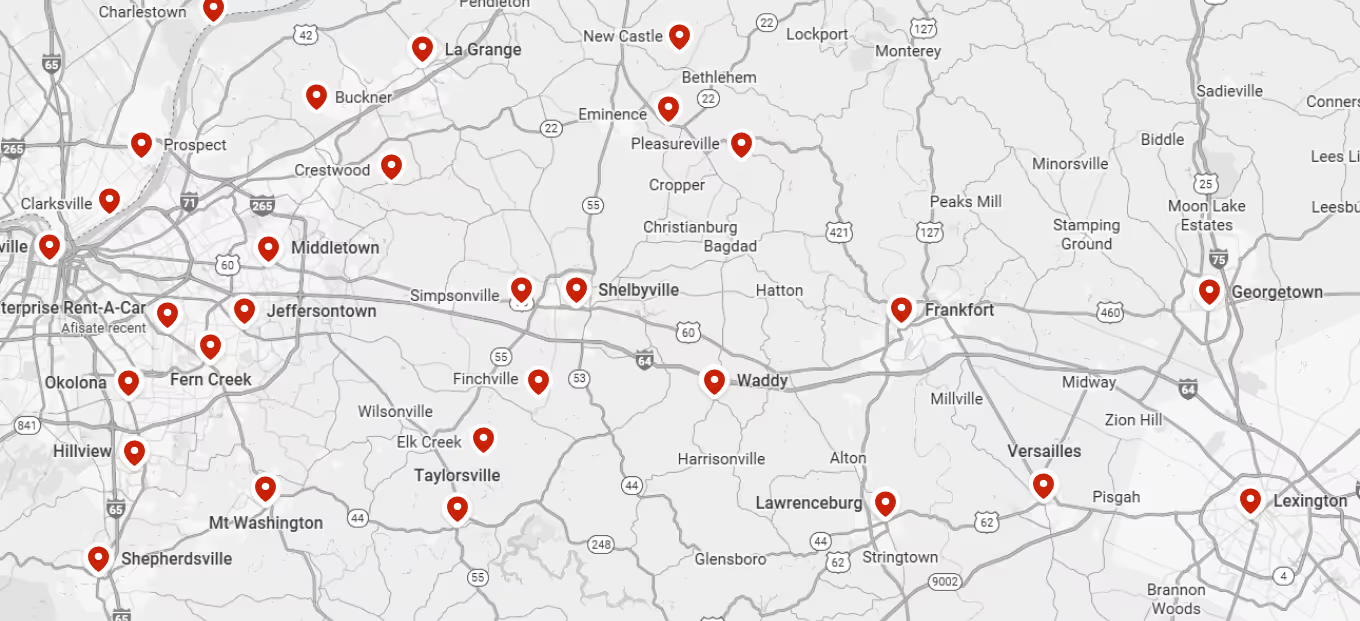
Proudly serving Spencer county, Jefferson county, Bullitt county, and the surrounding areas
Short Heading Goes Here
Sed iaculis aenean sit sed risus arcu vitae integer elit.

