

.svg)


.avif)


5 min read
Upgrading to a Whole-Home Humidifier vs. Portable Units for Fall
Are You Ready for Another Season of Constant Humidifier Maintenance?
Are you already dreading the chore of pulling those calcified, high-maintenance portable humidifiers out of storage? As the weather begins to shift, homeowners face a familiar dilemma: endure another winter of manual refilling and cleaning, or look for a permanent solution. If you are weighing the benefits of upgrading to a whole-home humidifier vs. portable units for fall, the upcoming transition to heating systems serves as the critical deadline for this decision. Making the right choice now determines whether you will spend the next six months battling dry air room by room or enjoying automated, house-wide comfort.
The daily physical labor of maintaining standalone units quickly becomes a burden. You have to carry heavy water tanks across the house, constantly monitor water levels, and scrub out mineral deposits to prevent bacterial growth. This constant loop of chores is exactly why many homeowners start exploring how their existing HVAC systems can take over the heavy lifting. By taking action during the September pre-heating season, you can integrate a seamless moisture solution before the harsh, dry air takes over your living spaces.
The core decision comes down to this:
• Option A: Continue the daily cycle of localized, manual humidification that requires constant supervision.
• Option B: Upgrade to an inline system that operates silently in the background, requiring attention only once a year.
To make an informed choice, it helps to understand exactly what happens to your home's indoor air quality the moment your furnace kicks on for the first time.
The Impact of Fall Heating on Your Home's Moisture Levels
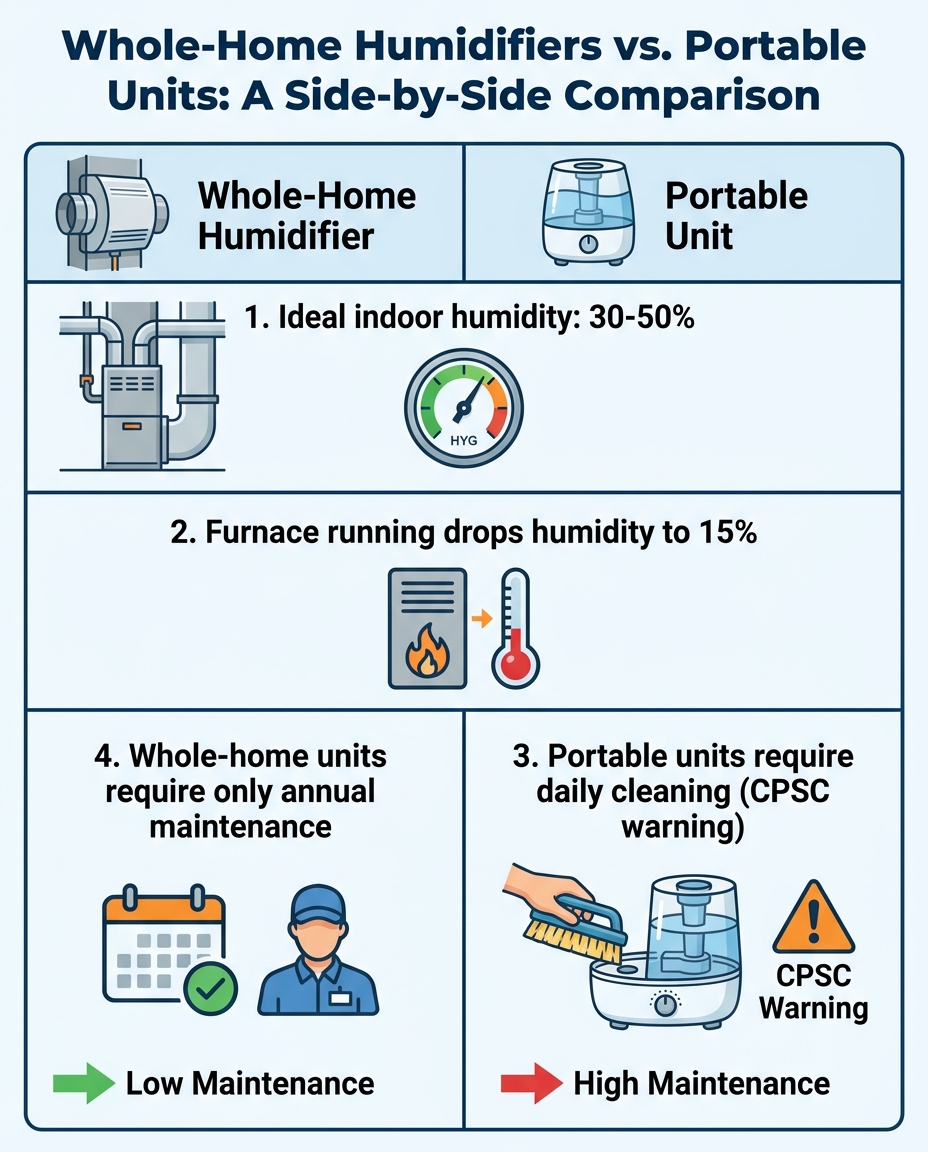
According to the Environmental Protection Agency (EPA), the ideal indoor relative humidity sits between 30% and 50%. In this zone, your home feels comfortable, wood fixtures remain stable, and airborne viruses struggle to survive. However, Kentucky's specific early fall transition to heating systems drastically and suddenly drops indoor humidity, creating an immediate need for automated intervention. When the outside air gets cold, it loses its ability to hold moisture. As that cold, dry air enters your home and is rapidly warmed by your furnace, its relative humidity plummets.
The sudden moisture drop: Running a furnace without proper humidification can drop indoor humidity levels to 15% or lower. That is drier than the Sahara Desert. This sudden shift acts like a sponge, pulling moisture out of everything in the house—including hardwood floors, wooden furniture, houseplants, and your own skin and respiratory system. For Taylorsville KY area homes, this rapid depletion of moisture is what causes the classic winter symptoms of static shock, dry throats, and cracking woodwork.
Because the furnace distributes this dry air throughout the entire ductwork network, relying on small, localized units often falls short. A single room humidifier simply cannot produce enough moisture to combat the continuous cycle of dry air being pumped out by your heating systems. You might achieve 40% humidity right next to the machine, but the rest of the house remains a parched 15%. This creates an unbalanced environment that requires a more comprehensive approach to moisture control.
The Hidden Hassles of Portable Humidifiers
While portable room humidifiers offer a quick, inexpensive fix for a single bedroom, their hidden costs become apparent over a long winter. The localized, high-maintenance nature of these units often turns them from a comfort solution into a daily nuisance. If you are preparing your home during the September pre-heating season, reviewing a humidity control checklist will quickly reveal how much manual labor is involved in keeping standalone units running safely and effectively.
The Physical Labor Loop
Portable humidifiers demand daily attention. A standard unit running continuously will empty its tank in 12 to 24 hours. This means carrying heavy, sloshing water tanks from the sink to the bedroom every single day. If you have multiple units to cover different areas of the house, this chore multiplies. Furthermore, because these units do not have a dedicated drain, standing water becomes a significant issue if left unmonitored.
The "Wet Spot" Phenomenon
Because portable units lack a distribution system, they force all their moisture into one localized area. This frequently results in:
• Oversaturated zones: Condensation building up on windows, damp carpets, and a clammy feeling within a six-foot radius of the machine.
• Dry zones: Rooms just down the hall receiving absolutely no benefit, remaining harsh and dry.
• Draft conflicts: Ceiling fans or open doors blowing the localized moisture away before it can properly condition the room.
Health Risks and CPSC Warnings
Perhaps the most significant hidden hassle is the strict cleaning requirement. The Consumer Product Safety Commission (CPSC) warns that portable humidifiers require daily cleaning to prevent the growth of mold and bacteria. Because the water sits stagnant in a warm room, it becomes a breeding ground for microbes. If you skip the daily scrubbing and disinfecting, the unit will aerosolize those bacteria and mold spores directly into your breathing air. This constant maintenance loop becomes a heavy burden throughout the colder months, leading many homeowners to abandon the units entirely by January.
How Inline Whole-Home Humidifiers Transform Indoor Comfort
An inline whole-home humidifier takes a completely different approach. Instead of trying to condition one room at a time, it leverages your home's existing infrastructure to provide even, automated moisture distribution. By connecting directly to your HVAC system, these units treat the air before it ever reaches your living spaces.
The Mechanics of Whole-Home Moisture
Understanding how these systems work reveals why they are such powerful indoor air quality solutions. The process follows a seamless, automated path:
1. Direct Water Supply: The inline unit connects directly to your home's plumbing. There are no tanks to fill; the water is supplied continuously as needed.
2. Integration with Ductwork: The humidifier is mounted directly onto your furnace's return or supply duct.
3. The Evaporative Process: Inside the unit, water flows over a specialized water panel (or evaporator pad).
4. Blower Motor Distribution: When the furnace blower engages, it forces warm, dry air through this water-soaked panel. The air absorbs the moisture as a vapor.
5. Even Delivery: The now-humidified air travels through your ductwork, reaching every single square foot of your home simultaneously.
Automated control: Unlike portable units with manual dials, inline systems are controlled by a hygrometer or a smart thermostat. You simply set your desired humidity level (e.g., 40%), and the system monitors the air. When the humidity drops, the unit automatically activates alongside your furnace. When the target is reached, it shuts off. For Taylorsville KY area homes, this means you can set the system once in the fall and completely forget about it until spring.
Side-by-Side Comparison: Whole-Home vs. Portable Units
To make the best decision for your household during the September pre-heating season, it helps to look at the objective differences between the two primary humidification methods. The table below breaks down the long-term impact of each choice across four key categories.
• Maintenance Requirements — Whole-Home Inline Humidifiers: Requires only an annual water panel/pad replacement and a basic system check during your fall HVAC tune-up. — Portable Room Humidifiers: Requires daily refilling, daily wiping down, and weekly deep-cleaning with disinfectants to prevent mold growth.
• Square Footage Coverage — Whole-Home Inline Humidifiers: Comprehensive, even distribution across the entire house using existing ductwork. — Portable Room Humidifiers: Limited to a single room or small open area; often creates localized "wet spots."
• Convenience & Control — Whole-Home Inline Humidifiers: Fully automated via a humidistat or smart thermostat; turns on and off exactly when needed. — Portable Room Humidifiers: Manual operation; requires constant monitoring to ensure tanks aren't empty and rooms aren't over-humidified.
• Aesthetics & Space — Whole-Home Inline Humidifiers: Hidden away in the basement, utility closet, or attic; operates out of sight. — Portable Room Humidifiers: Takes up floor or table space in living areas; uses electrical outlets; creates background fan noise.
The contrast is clear: while portable units offer a lower initial barrier to entry, they demand a high ongoing cost in time and labor. Whole-home systems require an upfront installation but pay dividends in seamless, invisible comfort year after year.

Installation Requirements and Avoiding DIY Risks
While the benefits of an inline system are substantial, achieving those benefits requires precise technical execution. Unlike a portable unit that you simply unbox and plug into a wall, an inline humidifier is a permanent modification to your home's mechanical systems. These systems require precise plumbing taps to supply the water, dedicated drainage lines to handle excess flow, and careful sheet metal modifications to mount the unit to your ductwork securely.
The risks of DIY installation: Attempting to install a whole-home humidifier without professional training can lead to severe consequences. If the plumbing tap is installed incorrectly, it can cause slow, hidden water leaks that damage your utility room. If the unit is not properly sealed to the ductwork, it will restrict vital airflow to your furnace, causing the system to overheat and shut down. Furthermore, an improperly sized unit can introduce too much moisture into the ducts, leading to internal condensation, rust, and mold growth inside your ventilation system.
Proper sizing is critical. The humidifier must match your home's total square footage and the specific airflow capacity of your existing furnace. This is why having a professional evaluate the home's layout prior to installation is essential. 3D Heating and Cooling provides expert local assessments to ensure safe, seamless integration of inline units into existing ductwork without the risks of DIY. For Louisville homeowners and residents of Taylorsville KY area homes, this professional evaluation guarantees that the system will operate efficiently and safely from day one.
Frequently Asked Questions About Whole-Home Humidification
Is a whole house humidifier better than a portable one?
Yes, for long-term convenience and even coverage, a whole-house unit is significantly better. They eliminate the daily chore of refilling heavy water tanks and scrubbing away mineral deposits. Instead of providing single-room relief that leaves the rest of the house dry, an inline system uses your ductwork to maintain a balanced, comfortable moisture level in every room simultaneously.
What is the maintenance on a whole home humidifier?
The maintenance is minimal and typically requires only an annual replacement of the humidifier pad or water panel. During your standard fall furnace tune-up, a technician will swap out the pad, check the water lines for proper flow, and verify the humidistat is communicating correctly. This once-a-year service is a fraction of the daily cleaning required by portable models.
Do whole house humidifiers run all the time?
No, they are highly efficient and only run when necessary. They are controlled by a humidistat and only activate when the indoor humidity drops below your target set level. Furthermore, they typically only distribute moisture when the HVAC blower is actively running, ensuring that the vapor is properly carried through the ductwork rather than settling in one place.
Can a whole house humidifier cause mold?
When professionally installed and properly maintained, they do not cause mold. These systems are explicitly designed to keep humidity within the safe 30-50% range, preventing the excess condensation that leads to mold growth. Problems only arise if the humidistat is set too high for the outdoor temperature or if a DIY installation results in water leaking directly into the ductwork.
When is the best time of year to install an inline humidifier?
Early fall, right before the heavy heating season begins, is the optimal time for installation. For Taylorsville KY area homes, installing before the furnace runs consistently prevents the initial extreme drop in indoor humidity. Getting the system in place during the fall ensures your home's wood fixtures and your family's respiratory health are protected from the very first cold snap.
Make the Switch Before Winter Arrives
The clear objective benefits of whole-home systems make them a vastly superior choice for long-term comfort. By upgrading to an inline system, you eliminate the daily dread of hauling water tanks, scrubbing plastic parts, and dealing with localized wet spots. Instead, you gain automated, even moisture distribution that protects your home and your health silently in the background.
If you are tired of the constant upkeep required by portable units, the September pre-heating season is the perfect window to make a change. Don't wait until the deep winter dry air has already set in. Schedule a professional assessment today to upgrade your system, and enjoy a seamless, comfortable indoor environment all winter long.
Financing

Now Offering Financing Options with Affordable Monthly Payments
where we operate
Service Areas
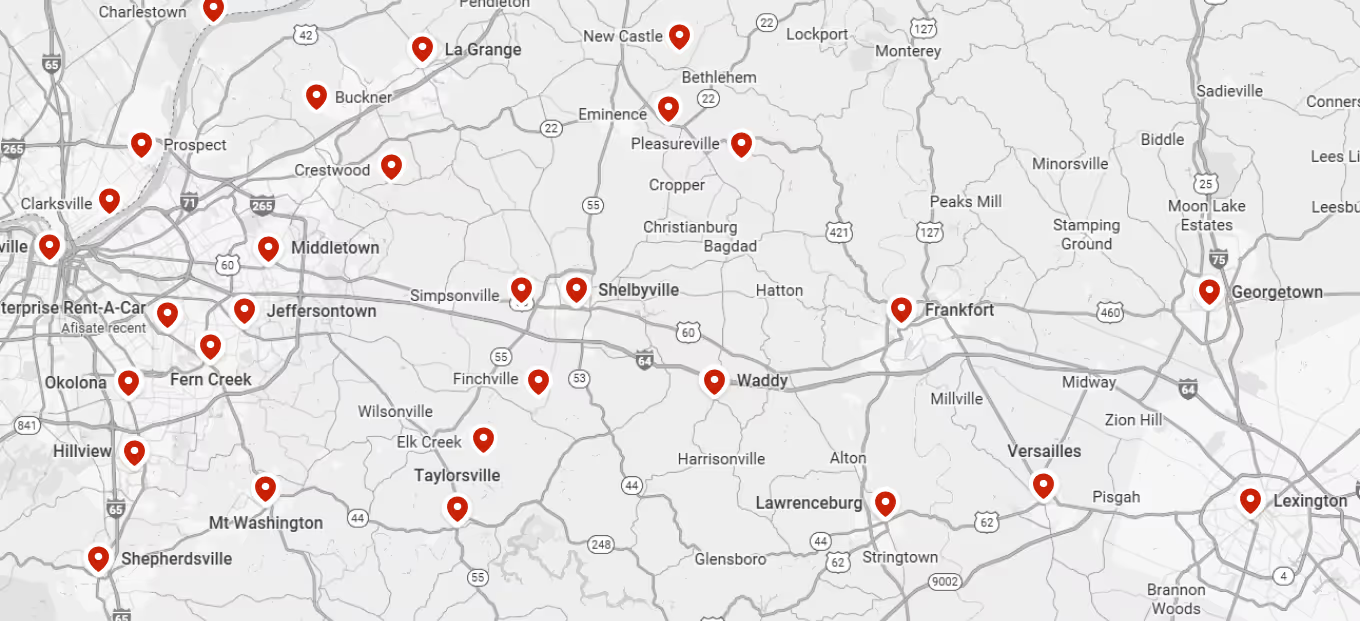
Proudly serving Spencer county, Jefferson county, Bullitt county, and the surrounding areas
Short Heading Goes Here
Sed iaculis aenean sit sed risus arcu vitae integer elit.