

.svg)


.avif)



5 min read
Why Setting Your Thermostat to 60 Degrees Won't Cool Your House Faster
Beating the Heat: The Temptation to Crank the Thermostat Down
You walk through the front door at 5:00 PM, and the house is sweltering, prompting the immediate question of why setting your thermostat to 60 degrees won't cool your house faster. The indoor air feels heavy, the living room is stifling, and you want immediate relief. In that moment of intense discomfort, the natural human reaction is to walk straight to the wall and push the temperature down as low as it will go. You punch in 60 degrees, hoping the system will kick into high gear and blast freezing air to rescue your afternoon.
Here is the thing: that dramatic adjustment does absolutely nothing to speed up the cooling process. During a July peak summer heatwave, our technicians at 3D Heating and Cooling see this behavioral reaction constantly, but it is based on a fundamental misunderstanding of how cooling equipment operates. Dropping the target temperature drastically is often referred to as the "gas pedal" approach, and it is a complete myth. Your home is not going to reach a comfortable temperature any faster just because you demanded a much lower one.
To achieve real comfort without causing mechanical failures, our team believes it is vital to understand how residential HVAC systems actually function. When your equipment is pushed beyond its physical limits, you are not getting faster cooling—you are setting the stage for a breakdown. If you find yourself constantly fighting the thermostat and losing the battle against the heat, it might be time to look into professional air conditioning services to see if a deeper issue is at play. But first, let's break down exactly why cranking the dial down fails to deliver the instant freeze you are hoping for.
The Gas Pedal Myth: Why Your Thermostat Isn't a Throttle
The core of the problem lies in how we interact with everyday machines. When you press the gas pedal in your car harder, the engine revs higher, and the vehicle accelerates faster. When you turn the knob on a faucet further to the left, the water pressure increases. We are conditioned to believe that asking a machine for more output results in faster, stronger performance. It is completely logical that homeowners apply this same thinking to their thermostats.
However, your thermostat is not a throttle, a volume dial, or a pressure valve. It is simply a temperature-activated switch. Its only job is to measure the current temperature of the room and compare it to the target temperature you have set. If the room is warmer than the target, the switch flips "on." If the room reaches the target, the switch flips "off."
When we install or service a standard single-stage cooling system, the thermostat sends a basic 24-volt electrical signal to the control board in your furnace or air handler, and another out to the compressor sitting in your yard. That signal translates to a simple command: "Start cooling." It does not say, "Cool harder," or "Cool faster."
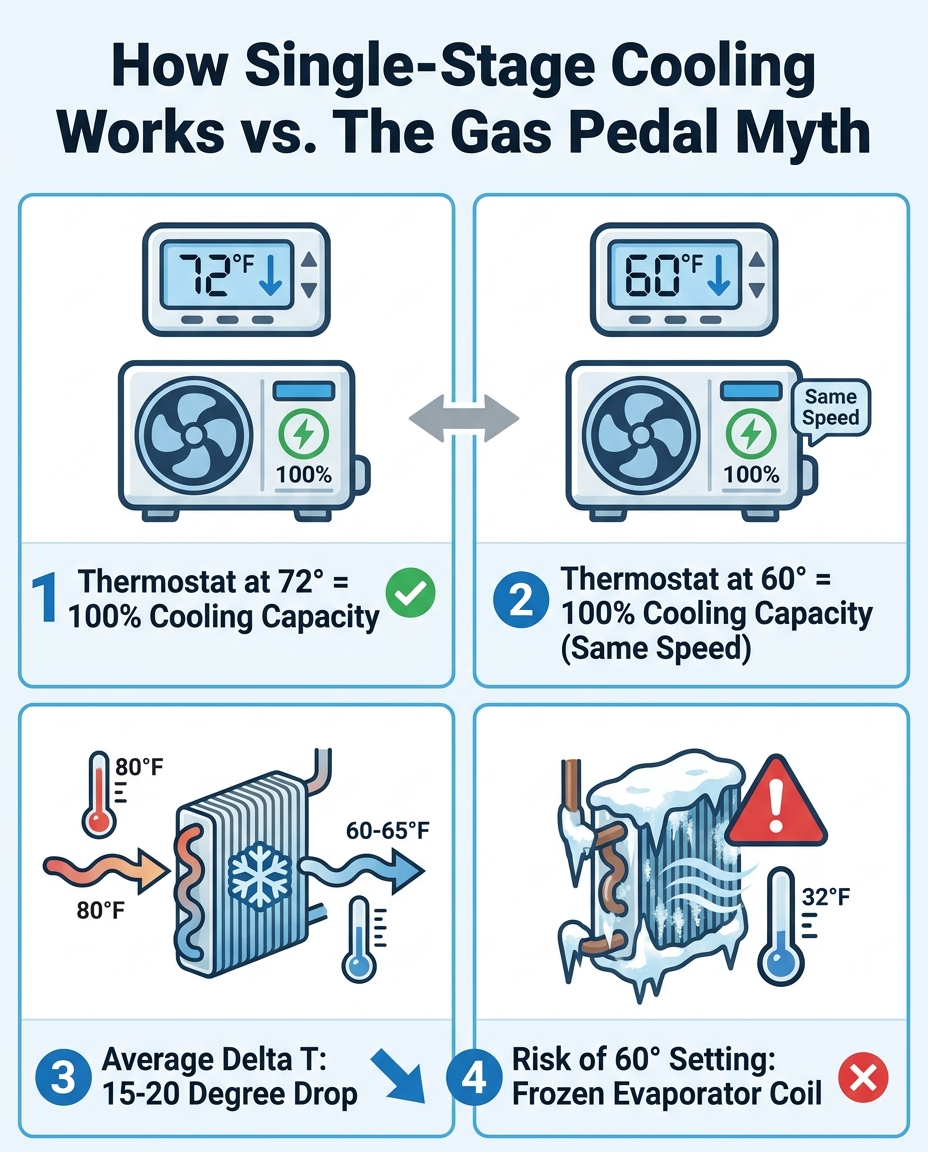
• The illusion of speed: Setting the dial to 60 degrees does not change the velocity of the air leaving your vents.
• The illusion of temperature: Setting the dial to 60 degrees does not make the air coming out of the vents any colder than if you set it to 72 degrees.
• The reality of the destination: Lowering the setting only changes the finish line. It tells the system to keep running until the house reaches 60 degrees—a destination it may never actually reach.
By forcing the system to chase an impossible target, you are not speeding up the journey. You are simply refusing to let the machine rest, which leads directly to the mechanical realities of how air conditioning works.
Mechanical Reality: How a Single-Stage Air Conditioner Operates
To truly understand why the gas pedal myth fails, you have to look at the machinery itself. The vast majority of residential homes utilize a single-stage cooling system. This means the compressor—the engine of your air conditioner—has exactly one gear. It operates at 100% capacity when it is turned on, and 0% capacity when it is turned off. There is no "medium" or "high" setting for the cooling cycle.
The 100% On or Off Rule
When your thermostat calls for cooling, the single-stage compressor powers up fully. The refrigerant begins to flow through the lines, absorbing heat from inside your home and releasing it outside. Because the system only has one speed, the air blowing out of your supply vents will be the exact same temperature regardless of what number you typed into the thermostat.
Some newer, high-efficiency models feature variable-speed or two-stage compressors, which can run at lower capacities to save energy and maintain even temperatures. But even these advanced systems cannot exceed 100% capacity. They can slow down, but they cannot "hurry up" beyond their maximum designed output to accommodate a 60-degree thermostat setting.
Understanding Delta T (Temperature Drop)
Air conditioners are bound by the laws of thermodynamics. In the HVAC industry, the cooling capacity of a system is measured by a concept called Delta T (ΔT), which simply means the temperature difference between two points. For a residential air conditioner, Delta T measures the difference between the warm return air being pulled into the system and the cold supply air being pushed out of the vents.
When our technicians measure airflow during a summer tune-up, a healthy, properly functioning AC unit typically achieves a Delta T of 15 to 20 degrees. This means the system can cool the air passing over its coils by a maximum of about 20 degrees at a time.
• 80°F — Expected Supply Air Temperature (From Vents): 60°F - 65°F — Cooling Result: Normal 15-20° drop
• 75°F — Expected Supply Air Temperature (From Vents): 55°F - 60°F — Cooling Result: Normal 15-20° drop
• 70°F — Expected Supply Air Temperature (From Vents): 50°F - 55°F — Cooling Result: Normal 15-20° drop
• 90°F (Extreme Heat) — Expected Supply Air Temperature (From Vents): 70°F - 75°F — Cooling Result: System must run multiple cycles to catch up
If your house is currently 82 degrees, the air coming out of your vents will be roughly 62 to 67 degrees. The system has to slowly cycle that air through the house over and over, gradually lowering the overall indoor temperature degree by degree. Setting the thermostat to 60 degrees does not change this physical 20-degree limit; it just forces the system to run continuously, which introduces a severe risk to your equipment.

The Hidden Danger: Freezing Your Evaporator Coil
When you understand that an air conditioner can only blow air that is about 15 to 20 degrees cooler than the ambient room temperature, you can see why setting the thermostat to 60 degrees is problematic. During a hot summer afternoon in Taylorsville KY, our field experience shows it is highly unlikely that your home will ever reach 60 degrees. The heat radiating through your roof, windows, and walls is simply too great.
Because the thermostat never reads 60 degrees, it never tells the system to shut off. The air conditioner runs continuously for hours on end. This continuous operation leads directly to one of the most common mid-summer mechanical failures we encounter: a frozen evaporator coil.
The freezing process:
1. Condensation forms: As warm indoor air blows over the cold indoor evaporator coil, moisture is pulled out of the air. This condensation normally drips down into a drain pan.
2. Kentucky humidity: Kentucky's subtropical summer climate brings incredibly high humidity. This means there is a massive amount of moisture constantly condensing on the coils.
3. Temperature drops too low: When the system runs non-stop without a break, the temperature of the refrigerant inside the coil can drop below freezing (32°F).
4. Ice accumulation: The heavy condensation on the outside of the coil begins to freeze. Within a few hours, the entire coil can become encased in a solid block of ice.
Once the coil freezes, the ice physically blocks the air from passing through the system. You will notice that the airflow from your vents has slowed to a trickle, and the air coming out is actually warm. At this point, the cooling process has completely stopped. You must turn the entire system off for several hours to let the ice thaw before it can be evaluated. If you are dealing with this exact scenario, reaching out for cooling services in Louisville or the surrounding areas is the safest next step to ensure the compressor hasn't been damaged.
Why Your Home Might Still Feel Stuffy and Warm
Sometimes, the urge to crank the thermostat down to 60 degrees happens because the air conditioner is running, but you still feel incredibly uncomfortable. If your thermostat says it is 72 degrees inside, but you are still sweating, the issue usually isn't a lack of cold air. The culprit is almost always humidity.
Air conditioners actually perform two distinct jobs simultaneously: they lower the sensible temperature (the number on the thermometer), and they remove latent heat (humidity) from the air. Working in a humid climate like Taylorsville KY, our installers know that managing that moisture is just as important as managing the temperature.
The Dehumidification Process
When indoor humidity levels rise above 50%, your sweat cannot evaporate easily from your skin. This makes the air feel sticky, heavy, and significantly warmer than the actual temperature reading. You might feel perfectly comfortable at 75 degrees if the humidity is low, but absolutely miserable at 75 degrees if the humidity is high.
Your air conditioner removes this humidity by passing the moist indoor air over the cold evaporator coil, wringing it out like a sponge. However, this process requires proper cycling. If your system is oversized and short-cycles (turning on and off too quickly), it cools the house down fast but never runs long enough to extract the moisture. Conversely, if your system is struggling with airflow issues, it cannot process enough air to keep the home dry.
If your home consistently feels damp and uncomfortable regardless of the temperature setting, you likely have an indoor air quality or ventilation issue. Understanding why your home feels stuffy even when the AC is running is often the first step to achieving real comfort without abusing your thermostat.
The True Cost of Overworking Your Cooling System
Leaving your thermostat set to an impossibly low temperature during a July peak summer heatwave does more than just risk a frozen coil. It places an immense mechanical strain on every moving part of your HVAC system. July heatwaves already place maximum thermal load on the equipment, making it incredibly vulnerable to continuous-run failures.
When an air conditioner runs for six, eight, or ten hours straight without cycling off, the internal components are pushed to their breaking points. The compressor—the most expensive part of the entire system—can overheat. The blower motor works continuously, increasing the risk of bearing failure or electrical shorts. The contactors and capacitors are subjected to sustained electrical loads that shorten their lifespans significantly.
Beyond the mechanical wear and tear, the financial impact is immediate. Continuous operation leads directly to spiked utility bills. You are paying for the system to run non-stop, but you are not receiving any extra comfort in return.
At 3D Heating and Cooling, after years of replacing overworked compressors, a major focus of our team is educating homeowners on proper system usage precisely to prevent these unnecessary emergency repair calls. Extending equipment lifespan is about working with the machine's natural rhythms rather than fighting against them. Proactive care and smart thermostat habits are always vastly superior to reactive, stressful mid-summer repairs.
Smart Thermostat Habits for Maximum Comfort
Now that you know the "gas pedal" approach is a myth, our HVAC experts recommend a reliable strategy to keep your home comfortable during the hottest months of the year without destroying your single-stage cooling system. Safe, efficient cooling requires a bit of patience and a few smart adjustments.
1. Set the actual target you want: If you want the house to be 72 degrees, set the thermostat to exactly 72 degrees. The system will work just as hard to get there as it would if you set it to 60, but it will safely cycle off once the goal is reached.
2. Follow Department of Energy guidelines: For an optimal balance of comfort and energy efficiency, the DOE recommends a summer thermostat setting of 78 degrees when you are home. While that may feel warm to some, keeping the setting in the mid-70s prevents system overwork.
3. Utilize programmable schedules: Do not let the house bake at 85 degrees all day and then expect the AC to magically cool it down by 5:00 PM. Use a programmable or smart thermostat to begin pre-cooling the house a few hours before you get home. Gradually lowering the temperature is much easier on the system.
4. Create a wind-chill effect: Use ceiling fans in the rooms you are actively occupying. The moving air evaporates moisture from your skin, making the room feel up to 4 degrees cooler without requiring you to touch the thermostat dial at all.
5. Block out the sun: Close blinds, curtains, and shades during the hottest parts of the day. Preventing solar heat gain from entering the home drastically reduces the thermal load your air conditioner has to fight against.
Frequently Asked Questions About Thermostat Settings
Does turning the AC down make it cool faster?
No, turning the AC down to a lower temperature does not make it cool faster. A standard single-stage cooling system only operates at one speed—100% capacity. Lowering the thermostat only tells the system to run longer to reach a lower destination, but the air coming out of your vents remains the exact same temperature.
Can setting the AC too low cause it to freeze?
Yes, setting the thermostat extremely low can absolutely cause your AC to freeze over. When the system runs continuously without cycling off, the indoor evaporator coil gets too cold. The natural condensation on the coil freezes into a solid block of ice, which blocks airflow and completely stops the cooling process.
Why is my thermostat set to 60 but the house is 75?
If your thermostat is set to 60 but the house is stuck at 75, your system has reached its physical cooling limit. Air conditioners can typically only cool a home about 15 to 20 degrees below the outdoor temperature or the return air temperature. Extreme outdoor heat, poor insulation, or a frozen coil can all prevent the house from dropping any further.
What is the fastest way to cool down a hot house?
The fastest way to cool a hot house is to set the thermostat to a reasonable target (like 72 degrees), turn on ceiling fans to circulate the air, and close all blinds to block out the sun. Ensure your air filters are clean so the system has maximum airflow. Dropping the thermostat to 60 degrees will not speed up this process.
What is Delta T in air conditioning?
Delta T (Temperature Drop) is the difference in temperature between the warm return air going into your AC system and the cold supply air blowing out of your vents. A healthy residential air conditioner typically has a Delta T of 15 to 20 degrees, meaning it cools the air by a maximum of 20 degrees per cycle.
Keep Your System Running Smoothly All Summer Long
Surviving a July peak summer heatwave requires patience and an understanding of your equipment's physical limits. Remember that your thermostat is a target, not a gas pedal. Set the temperature you actually want to achieve, utilize your ceiling fans, and let the system do its job at its own pace. Proper usage is the absolute best way to prevent frozen coils, avoid massive utility bills, and stop mid-summer breakdowns before they happen. If you follow these guidelines and your home still struggles to cool down properly, it is time to seek professional guidance to ensure your system is operating at peak performance.
Financing

Now Offering Financing Options with Affordable Monthly Payments
where we operate
Service Areas
Proudly serving Spencer county, Jefferson county, Bullitt county, and the surrounding areas

Short Heading Goes Here
Sed iaculis aenean sit sed risus arcu vitae integer elit.

