

.svg)


.avif)



5 min read
The Hidden Cost of Skipping Late-Summer AC Filter Changes
Surviving the August Heat: Why Your AC Is at Its Breaking Point
As we push into the hottest weeks of the year, the hidden cost of skipping late-summer AC filter changes becomes a serious threat to your home's comfort. August brings relentless temperatures, forcing your air conditioning system to run at maximum capacity just to keep the indoor environment bearable. By this point in the season, your equipment has likely been running daily since May. That means all the early-summer dust, pollen, and pet dander have been steadily accumulating inside your ductwork and across your filter media.
If your system is already showing signs of strain, exploring professional air conditioning services is the best way to prevent a total breakdown before the season ends.
Right now, you are facing a critical decision point. You can either push through the final weeks of summer with an old, saturated filter, or you can make a quick change to protect your equipment. At 3D Heating and Cooling, we often see homeowners view a filter replacement purely as an air quality preference—something to help with seasonal allergies. However, in the peak of summer, our technicians know firsthand that a clean filter is a vital mechanical safeguard. The August late-summer wear on your system leaves zero margin for error. When the barrier protecting your blower motor reaches critical mass, the resulting strain can bring your entire cooling system to a grinding halt.
How Summer Dust Creates a Compounding Airflow Restriction
To understand why a dirty filter is so destructive, you have to understand a basic mechanical concept called static pressure. Think of static pressure as the resistance your HVAC system must overcome to push and pull air through your home. Your ductwork, your vents, and your filter all create a certain amount of natural resistance. When the system is clean, the blower motor is perfectly calibrated to handle that resistance.
The Problem: Throughout June and July, pet dander, microscopic dust, and airborne debris continuously pack into the tight fibers of your filter. By August, that filter is no longer a breathable net; it is a solid wall. This drastically reduces the physical space available for air to flow into the return duct.
The Cause: Because your thermostat is still calling for cool air, the blower motor does not simply slow down. Instead, it works exponentially harder to pull the exact same volume of air through a heavily restricted barrier. The static pressure spikes well beyond the motor's safe operating limits.
The Solution: Removing the blockage immediately lowers the static pressure, allowing the motor to breathe. While you might initially look into comprehensive indoor air quality solutions to manage persistent dust, our team always recommends addressing the physical barrier choking your ductwork as the absolute first step. The longer you wait to relieve that compounding airflow restriction, the closer you push your equipment toward a catastrophic failure.
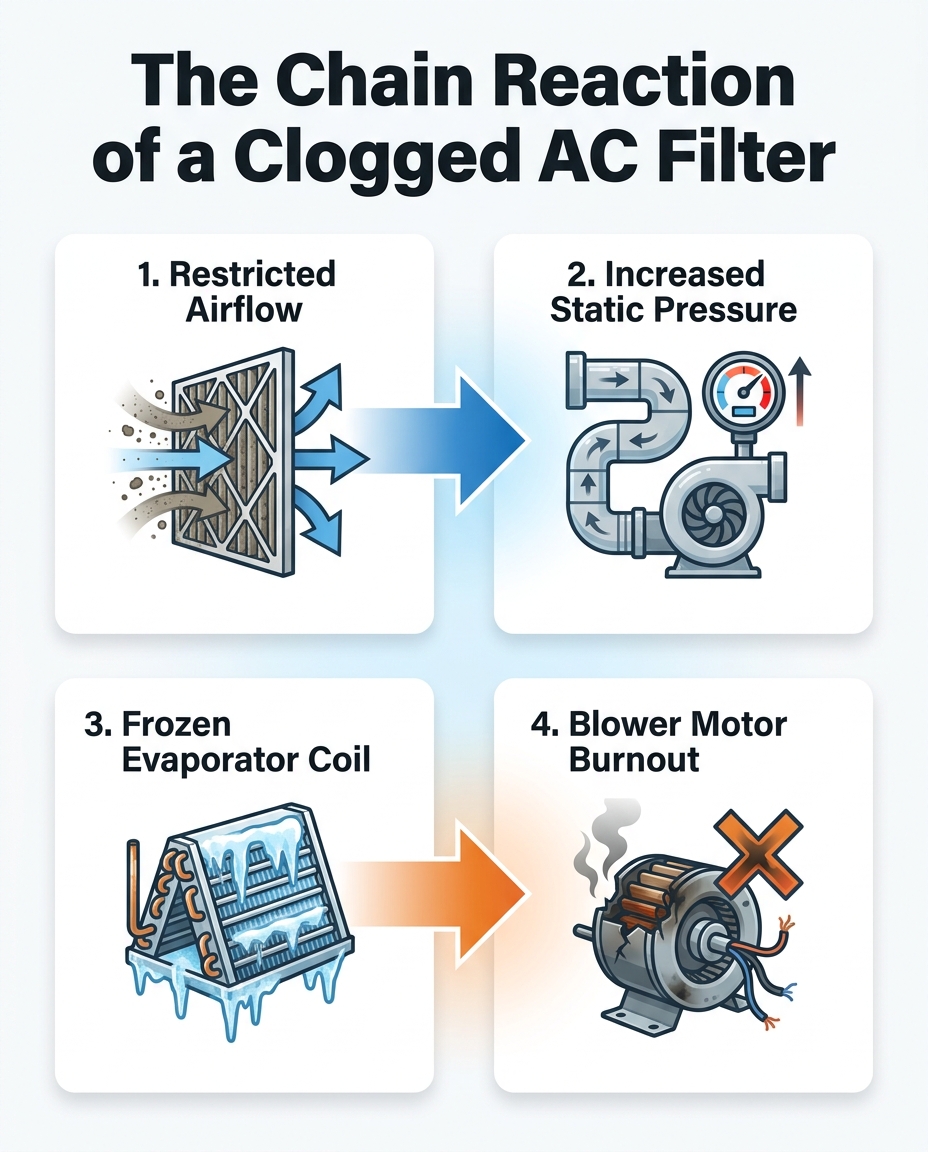
The Chain Reaction: From Clogged Filter to Blower Motor Burnout
A blower motor does not usually fail out of nowhere. It follows a highly predictable, step-by-step mechanical breakdown caused by elevated static pressure. For homeowners in Taylorsville KY, where the cooling season demands long run times, our 3D Heating and Cooling repair crews see this chain reaction happen rapidly during a late-summer heatwave.
Step 1: The Airflow Bottleneck
The process begins silently inside the return vent. As debris completely seals the microscopic gaps in the filter media, the return air volume plummets. The system is now starved for air. You might notice that the airflow coming out of your bedroom vents feels noticeably weaker than it did in June, even though the system sounds like it is running at full speed.
Step 2: Motor Overexertion
Because less cold air is reaching your living spaces, your home takes much longer to cool down. The thermostat detects this delay and forces the system to run continuously. The blower motor is now operating for hours on end, desperately trying to overcome the high static pressure caused by the bottleneck.
Step 3: Thermal Overload
Electric motors generate heat as they work. Normally, the steady stream of air passing over the motor helps keep it cool. However, with the airflow choked off by the dirty filter, that internal cooling effect disappears. The motor begins to operate outside of its safe temperature range. The internal wiring gets hotter and hotter, and the electrical insulation begins to degrade.
Step 4: Complete System Shutdown
Eventually, the heat becomes too much. The thermal overload causes the motor's internal components to literally burn out. You will likely hear a humming sound, smell a faint electrical burning odor, and then experience a total loss of airflow. This specific failure is expensive, frustrating, and entirely preventable with basic routine maintenance.

Why High Heat and Humidity Lead to Frozen Evaporator Coils
Blower motor burnout is not the only major consequence of restricted airflow. A clogged filter also directly threatens your evaporator coil—the component responsible for actually cooling the air. The evaporator coil sits inside your indoor unit, pumping freezing-cold refrigerant through a series of copper tubes. For the system to work properly, warm unconditioned air from your home must blow across that coil. The refrigerant absorbs the heat, and the newly cooled air is pushed back into your rooms.
When a dirty filter blocks that warm air from reaching the coil, the temperature of the refrigerant drops rapidly. The coil becomes far too cold. This is where the local climate becomes a major factor. Taylorsville's late-summer high heat and humidity increase the latent heat load on the evaporator coil. There is an enormous amount of moisture in our August air. As that humid air hits the freezing coil, condensation forms instantly. Because there is no warm airflow to keep the temperature balanced, that condensation freezes. In our years of servicing local homes, this is one of the most common end-of-season issues our technicians encounter.
Signs your coil is freezing over:
• Warm air from vents: The system is running, but the air feels lukewarm or room temperature.
• Excessive water pooling: Ice is melting off the coil and overwhelming the condensate drain pan.
• Visible ice on refrigerant lines: You can actually see frost or a solid block of ice forming on the copper pipes near your indoor unit.
A solid block of ice completely halts the cooling process. Worse, it can cause liquid refrigerant to flow backward into the outdoor compressor—a failure that often requires replacing the entire outdoor unit. Changing your filter ensures the coil always receives the warm airflow it needs to function safely.
The Invisible Toll on Your Monthly Energy Consumption
Beyond the threat of catastrophic mechanical failure, running an air conditioner with a clogged filter quietly drains your wallet every single day. The financial cost of restricted airflow is significant, even if your system manages to survive the summer without breaking down.
According to the U.S. Department of Energy, replacing a dirty, clogged filter with a clean one can lower your air conditioner's energy consumption by 5% to 15%. When you consider how often your system runs during peak cooling degree days, that percentage represents a massive amount of wasted electricity.
The mechanics of energy waste:
• Endless Running: Because the system cannot push enough cold air into the home, it takes twice as long to satisfy the thermostat. A cycle that should take 15 minutes now takes 45 minutes.
• Short Cycling: In some cases, the system overheats and shuts itself off prematurely as a safety measure. It then turns back on a few minutes later, repeating the high-energy startup process over and over again.
The August late-summer wear leaves absolutely zero tolerance for this kind of inefficiency. The cost of a fresh, clean filter is negligible compared to the inflated utility costs generated by a struggling, suffocating air conditioner.
Selecting the Right Defense Against Late-Summer Debris
When it is time to replace your filter, it is important to understand that not all filters are created equal. You need to choose a filter that protects your equipment from dust without causing its own airflow restrictions.
Filters are rated using the MERV (Minimum Efficiency Reporting Value) scale. A higher MERV rating means the filter catches smaller particles. However, a pattern we see often is homeowners purchasing a filter that is too dense, which can actually mimic the effects of a clogged filter. This raises the static pressure and strains the blower motor right out of the box, a scenario that is especially dangerous for older systems already under heavy seasonal strain.
• Basic Fiberglass — MERV Rating: MERV 1-4 — Airflow Impact: Excellent (Very low resistance) — Best Use Case: Basic equipment protection; poor for allergies.
• Standard Pleated — MERV Rating: MERV 5-8 — Airflow Impact: Good (Balanced resistance) — Best Use Case: Most standard residential HVAC systems.
• High-Efficiency Pleated — MERV Rating: MERV 9-12 — Airflow Impact: Moderate (Requires strong blower) — Best Use Case: Homes with pets or moderate allergy concerns.
• Hospital Grade — MERV Rating: MERV 13+ — Airflow Impact: Poor (High static pressure risk) — Best Use Case: Only use if system is specifically designed for it.
If you are unsure where your system falls, learning about balancing airflow and allergen control with the right MERV filter is a critical next step. You want to catch the microscopic allergens, but you must allow the blower motor to breathe easily.
Professional Diagnostics: Catching Airflow Issues Before Failure
While changing a filter is a straightforward task you can handle yourself, measuring the actual strain on a blower motor requires professional tools and expertise. If you have run your system with a dirty filter for months, simply swapping it out might not reverse the wear and tear the motor has already endured.
This is where professional diagnostics make a massive difference. During a comprehensive inspection, our 3D Heating and Cooling technicians use a tool called a manometer to measure the exact static pressure inside your ductwork. By taking readings in the return and supply plenums, we can see exactly how hard the blower motor is working. If the static pressure remains dangerously high even after a filter change, it indicates deeper issues—such as collapsed ductwork, a failing motor capacitor, or a heavily soiled evaporator coil.
Enrolling in a routine HVAC maintenance plan ensures that a certified technician is proactively monitoring these vital signs. Having an expert evaluate your static pressure provides incredible peace of mind, knowing your system is mechanically sound heading into the final, punishing heatwaves of the year. A proactive plan prevents you from reacting to a sudden, catastrophic breakdown when you need cooling the most.
Protect Your System Through the Final Weeks of Summer
The end of summer is the absolute worst time to gamble with your home's comfort. The August late-summer wear has already pushed your equipment to its limits. Waiting until the fall to swap out your dirty air filter is a dangerous decision that directly threatens your blower motor, your evaporator coil, and your monthly energy budget.
As kids head back to school and families settle into new routines, a simple, inexpensive filter change is the ultimate mechanical safeguard against end-of-season breakdowns. Take five minutes today to check your filter. If you cannot see light through the media, it is time to replace it. By maintaining clear airflow, you ensure your system remains efficient, reliable, and ready to keep you comfortable through the final hot weeks of the year.
Frequently Asked Questions
Can a dirty filter ruin an AC motor?
Yes, a severely clogged filter can absolutely ruin an AC motor. When airflow is blocked, the motor works harder to pull air, causing it to overheat. Over time, this thermal overload melts the internal wiring insulation, leading to a complete and permanent motor burnout.
Why does my AC run constantly in August?
Your AC runs constantly in August because it is fighting peak outdoor temperatures, and restricted airflow makes it even harder to satisfy the thermostat. When a dirty filter reduces the volume of cold air entering your home, the system has to run twice as long to lower the indoor temperature. This endless running spikes your energy bills and wears down moving parts.
What causes high static pressure in HVAC?
High static pressure in an HVAC system is primarily caused by physical blockages in the airflow path. The most common culprit is a dirty air filter, but it can also be caused by crushed ductwork, closed room vents, or using a filter with a MERV rating that is too restrictive for the blower motor to handle.
What happens if you don't change your AC filter for a year?
Failing to change your AC filter for a year leads to severe mechanical strain, poor air quality, and a high likelihood of system breakdown. The compounding debris will choke off the airflow, causing the evaporator coil to freeze solid and the blower motor to overheat, ultimately resulting in an expensive repair bill.
How often should I change my AC filter in summer?
During the heavy usage months of summer, you should check your AC filter every 30 days and replace it at least every 60 to 90 days. If you have multiple pets, live in an area with high dust, or keep your system running constantly, you may need to replace the filter every single month to protect the equipment.
How can I tell if my AC evaporator coil is frozen due to bad airflow?
The most common sign of a frozen evaporator coil is your system blowing warm air while the indoor unit sounds like it is running normally. You may also notice excessive water pooling around the base of the indoor unit as the ice melts, or you might see visible frost forming on the copper refrigerant lines outside.
Financing

Now Offering Financing Options with Affordable Monthly Payments
where we operate
Service Areas
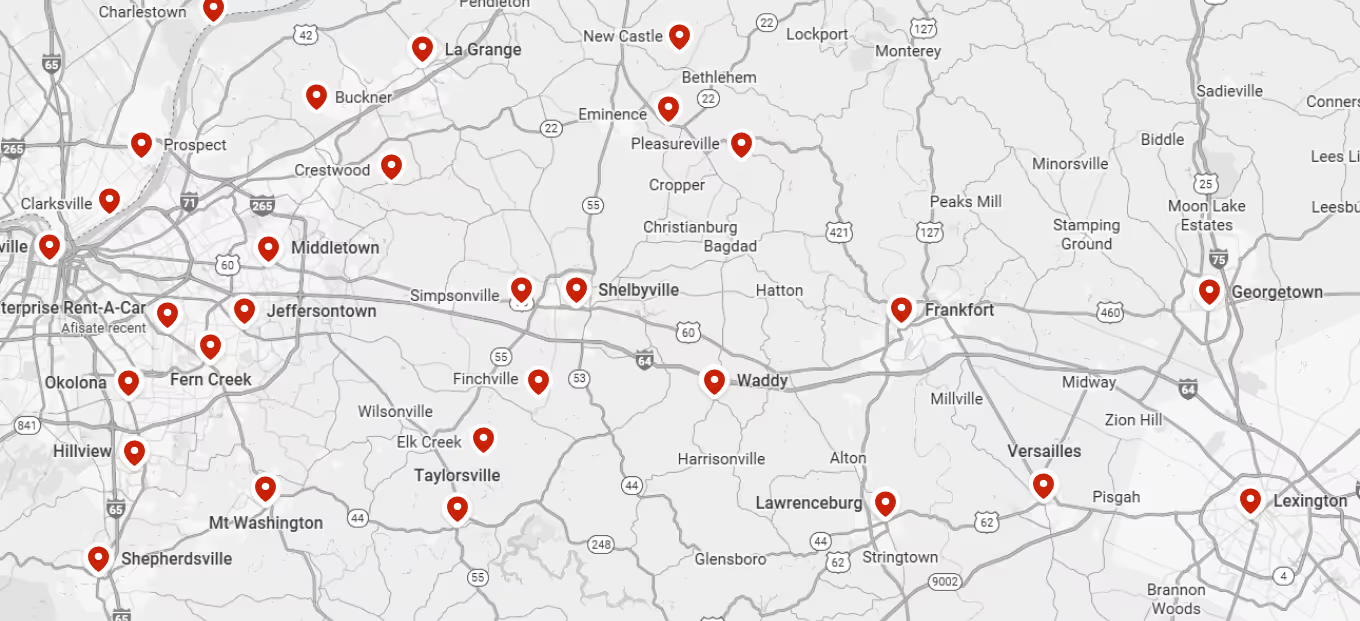
Proudly serving Spencer county, Jefferson county, Bullitt county, and the surrounding areas
Short Heading Goes Here
Sed iaculis aenean sit sed risus arcu vitae integer elit.

