

.svg)


.avif)



5 min read
How Dust and Pet Dander from Summer Shedding Clog Your AC Coils
The Late-Summer Cooling Myth: Low Refrigerant vs. A Suffocated System
A persistent myth among homeowners is that a system running constantly without cooling the house simply needs a quick refrigerant recharge, but understanding exactly how dust and pet dander from summer shedding clog your AC coils reveals a much more mechanical culprit. By the time the late August and back-to-school transition arrives, your cooling equipment has been running non-stop for months. If the air coming from your vents feels weak or lukewarm, your first instinct might be to assume the system has sprung a leak and lost its cooling power. However, in homes with shedding pets, a lack of refrigerant is rarely the root cause of this specific late-summer performance drop.
For comprehensive air conditioning services and advanced indoor air quality solutions, professional diagnostics are the key to restoring your system's efficiency.
The mechanical reality is often hidden out of sight inside your indoor air handler. Over the course of the season, cumulative dust, airborne debris, and copious amounts of summer pet shedding have quietly bypassed your air filter. Instead of a chemical shortage, your system is suffering from physical suffocation. The indoor evaporator coil—the crucial component responsible for actually cooling the air—has become choked by a thick layer of grime. At this point, you face an important decision point: recognizing that simply pulling out a dirty filter and sliding a clean one into the rack will not fix an already suffocated coil. The damage to your airflow has already been done, and the system requires targeted intervention to breathe freely again.
Why Cheap Filters Fail Against Heavy Pet Shedding
To understand how your system reached this state of suffocation, you have to look at the primary line of defense: the air filter. Many homeowners operate under the assumption that any clean-looking filter is doing its job. However, the basic 1-inch fiberglass filters commonly found in hardware stores are mechanically limited. They are designed primarily to protect the indoor blower motor from large, catastrophic debris—like stray pebbles, large insects, or heavy lint—not to purify the air you breathe or protect the delicate micro-components of your cooling system.
The Illusion of Protection
When you pull out a standard filter and see a visible mat of pet hair clinging to the fibers, it provides a false sense of security. It looks like the filter is working perfectly. But visible pet hair is not the real threat to your evaporator coil. The true danger lies in microscopic pet dander—tiny flecks of skin shed by cats, dogs, and other animals with fur or feathers. While a strand of pet hair is large enough to get caught in a cheap fiberglass weave, dander is nearly invisible to the naked eye.
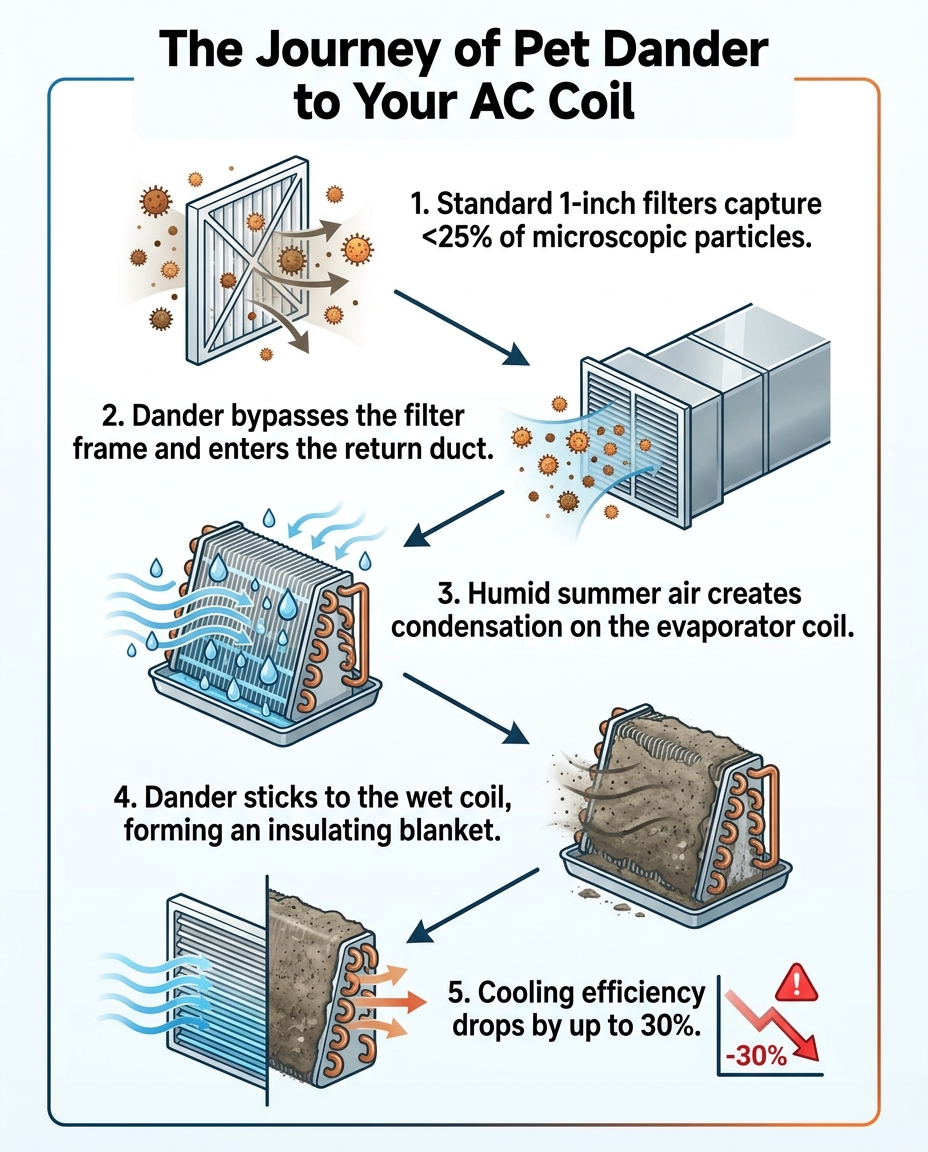
Data from indoor air quality studies shows that standard filters capture less than 25% of particles in the 3.0 to 10.0 micron range. To put that in perspective, human hair is about 70 microns thick, while pet dander can be as small as 2.5 microns. These microscopic particles pass straight through the wide gaps in basic 1-inch fiberglass filters as if the filter wasn't even there.
Airflow Dynamics and Bypass
Beyond the inadequate filter media itself, cheap filters suffer from weak structural integrity. The cardboard frames on bargain filters easily buckle, warp, or bend under the intense pressure of a powerful HVAC blower motor pulling thousands of cubic feet of air per minute. Once that cardboard frame bends even a fraction of an inch, it creates a gap between the filter and the return grille housing.
Air follows the path of least resistance. Instead of pushing through the restrictive filter material, a significant volume of unfiltered air—carrying all that microscopic summer shedding—rushes through the gaps around the buckled frame and enters the return plenum completely unfiltered.
• Particle Capture Rate — Basic 1-Inch Fiberglass Filter: Captures <25% of microscopic particles — High-Efficiency Media Filter: Captures up to 99% of microscopic dander
• Structural Integrity — Basic 1-Inch Fiberglass Filter: Flimsy cardboard frame, prone to buckling — High-Efficiency Media Filter: Rigid housing, maintains a tight seal
• Primary Protection — Basic 1-Inch Fiberglass Filter: Protects blower motor from large debris — High-Efficiency Media Filter: Protects evaporator coil and purifies indoor air
• Lifespan — Basic 1-Inch Fiberglass Filter: Requires replacement every 30 days — High-Efficiency Media Filter: Can last 3 to 6 months depending on usage
The Journey to the Evaporator Coil: A Sticky Situation
Once that microscopic dander bypasses the basic 1-inch fiberglass filters, it is pulled deep into the ductwork, traveling through the return plenum until it reaches the heart of your cooling system: the indoor evaporator coil. This coil is a complex web of copper tubing surrounded by hundreds of tightly packed, paper-thin aluminum fins. Its normal function is to absorb ambient heat from your home's air and extract excess humidity, sending cooled, dehumidified air back through your supply vents.
The Role of Summer Humidity
The environment inside the air handler is what makes bypassed dander so destructive. Taylorsville KY's hot, humid summer climate requires continuous AC operation, generating constant, heavy coil condensation that acts like glue for airborne particulates compared to drier climates. As warm, moist air blows across the freezing cold copper tubing of the evaporator coil, condensation forms rapidly—just like water droplets forming on the outside of a glass of iced tea on a hot July afternoon.
This high indoor humidity translates to gallons of water condensing on the coil daily. When the dry, microscopic pet dander hits this soaking wet metal surface, a physical reaction occurs. The condensation acts as an industrial-strength adhesive. The dander sticks instantly to the wet aluminum fins. Because the late August and back-to-school transition period demands that the AC run almost continuously to combat the heat, the coil never gets a chance to completely dry out. This creates a permanent, sticky trap that continuously collects more dust, more dander, and more debris hour after hour.

The Insulating Blanket Effect: How Grime Kills Efficiency
The accumulation of dander on the wet coil is not just a cosmetic issue; it triggers a severe scientific consequence that directly kills your system's efficiency. As layers of wet dander, human skin cells, and household dust continue to build up on the aluminum fins, they eventually dry during the system's brief off-cycles. When they dry, they compress. Over months of continuous operation, this mixture forms a dense, felt-like blanket that completely covers the metal.
Loss of Heat Transfer
The fundamental mechanics of air conditioning rely on heat transfer. The cold liquid refrigerant pumping through the copper tubing must be able to absorb heat from the warm air blowing over it. However, the felt-like blanket of grime acts as a powerful physical insulator. It traps the cold inside the copper tubing and prevents the refrigerant from interacting with the warm indoor air. Data shows that a dirty evaporator coil can reduce cooling efficiency by 30% or more. The air blowing past the coil simply doesn't get cooled down, which is why your vents start blowing lukewarm air even though the system is running.
Severe Airflow Restriction
In addition to insulating the coil, the blanket of dander causes severe airflow restriction. The microscopic gaps between the aluminum fins are designed to let air pass through smoothly. When those gaps are plugged with debris that bypassed your basic 1-inch fiberglass filters, the blower motor has to work twice as hard to push air through a solid wall of dirt. This sets off a destructive chain reaction: the system runs longer, consumes significantly more electrical energy, fails to reach the thermostat set point, and puts massive strain on the blower motor, drastically shortening its lifespan.
Warning Signs Your AC Coil is Suffocating
Identifying a suffocated coil early can save you from a complete, catastrophic system failure during the hottest weeks of the year. Because the symptoms of a dirty coil often mimic other HVAC problems, it is crucial to know exactly what to look for as you enter the late August and back-to-school transition period. If you notice these warning signs, it is time to look into professional AC coil cleaning before the system locks up entirely.
• Continuous operation with weak output: The most common symptom is an air conditioner that runs for hours without cycling off, yet the air coming from the supply vents feels weak, anemic, or barely cool to the touch.
• Unexplained energy bill spikes: If your late-summer energy bills suddenly skyrocket despite no changes to your thermostat settings or daily routine, your system is likely running longer cycles to compensate for the 30% drop in efficiency caused by the insulating blanket.
• Ice formation on the indoor coil: If you open your air handler and see a block of solid ice, or notice ice creeping along the outdoor copper refrigerant lines, your coil is suffocating. Because the grime prevents the refrigerant from absorbing ambient heat, the coil temperature drops below freezing. The heavy summer condensation then freezes directly onto the metal, turning the entire unit into a block of ice.
• Excessive indoor humidity: A clogged coil cannot extract moisture from the air effectively. If your home suddenly feels clammy, sticky, or smells unusually musty despite the AC running, the coil is likely failing to dehumidify the space.
Why Evaporator Coil Cleaning is Not a DIY Project
When homeowners realize their coil is covered in a blanket of pet dander, the immediate temptation is to grab a brush and some household cleaner to scrub it off. However, attempting to clean an evaporator coil yourself is highly dangerous to the equipment and is strictly a job for licensed HVAC professionals.
The Risk of Fin Damage
The aluminum fins on an evaporator coil are incredibly fragile—often thinner than a piece of paper. They are designed this way to maximize surface area for heat transfer. If you attempt to scrub the felt-like blanket of dander off with a stiff brush, a vacuum attachment, or even a sponge, you will instantly crush and flatten the fins. Once the fins are bent flat against each other, airflow is permanently blocked, and the coil is ruined. Crushed fins require specialized, tedious combing tools to repair, and in severe cases, the entire coil must be replaced.
Chemical Reactions and Leaks
Furthermore, the grime that bypasses basic 1-inch fiberglass filters becomes deeply embedded in the metal. Removing it requires specialized, non-acidic foaming chemical cleaners that are formulated specifically for HVAC equipment. Using incorrect, corrosive household chemicals—like bleach, dish soap, or harsh garage degreasers—can initiate a chemical reaction that literally eats through the microscopic walls of the copper tubing. This creates irreversible refrigerant leaks. Additionally, accessing the coil requires opening the sealed air handler plenum, working around high-voltage electrical components, and managing the condensate drain line. Unauthorized tampering with these sealed components can instantly void your manufacturer warranties.
Restoring Airflow and Upgrading Your Defense
Surviving the end of summer requires a definitive, long-term fix. The solution lies in professional restoration and upgrading your home's air quality defenses so the problem never happens again.
Professional Coil Restoration
When you schedule routine AC maintenance or a dedicated coil cleaning, licensed technicians follow a strict, safe process. They carefully access the sealed plenum and apply a specialized, self-rinsing foaming agent. This chemical is designed to expand deep between the fragile aluminum fins, dissolving the stubborn blanket of pet dander and dust without damaging the metal or the copper tubing. As the foam breaks down the grime, it safely flushes the debris down the condensate drain line, restoring the system to its original factory cooling capacity and allowing heat transfer to occur naturally once again.
However, cleaning the coil is only half the battle. As local diagnosticians, the team at 3D Heating and Cooling identifies the root mechanical failure—the insulating blanket effect caused by inadequate filtration—rather than just blaming the homeowner for a dirty filter. To prevent the basic 1-inch fiberglass filters from failing you again, the filtration strategy must be upgraded. This often involves installing advanced indoor air quality strategies, such as thicker 4-inch media cabinets or higher MERV-rated filters specifically designed to capture microscopic pet dander before it ever reaches the coil. Proactive, scheduled system care is the only way to catch these bypass issues before they result in late-summer breakdowns.
Frequently Asked Questions About Pet Dander and AC Coils
Why is my AC running constantly but not cooling?
When an AC runs constantly without cooling, it usually indicates a severe airflow restriction or a lack of heat transfer. The most common culprit in late summer is an evaporator coil suffocated by dust and pet dander. This grime forms an insulating blanket that prevents the system from absorbing heat, forcing it to run continuously while only blowing lukewarm air.
Can pet dander cause my AC to freeze up?
Yes, heavy pet dander can absolutely cause your AC to freeze solid. When dander clogs the microscopic gaps in the evaporator coil, it blocks warm air from reaching the cold refrigerant. Without that warm air to absorb, the refrigerant drops below freezing, turning the natural condensation on the coil into a solid block of ice.
How does pet hair get past the air filter?
While visible pet hair is usually caught, microscopic pet dander easily bypasses standard filters. Basic 1-inch fiberglass filters have wide gaps designed only to catch large debris, allowing tiny dander particles to pass straight through. Additionally, weak cardboard filter frames often buckle under air pressure, allowing unfiltered air to slip around the edges.
What happens when AC evaporator coils get dirty?
When evaporator coils get dirty, they lose their ability to transfer heat effectively. The dirt acts as an insulator, trapping the cold inside the coils and preventing the system from cooling your home's air. This leads to a massive drop in energy efficiency, higher electrical bills, weak airflow, and eventual system freezing.
Is it safe to clean my own AC evaporator coil?
No, it is not safe to clean your own evaporator coil. The aluminum fins are paper-thin and easily crushed by household brushes or vacuums, which permanently ruins airflow. Furthermore, using the wrong household chemicals can corrode the copper tubing, causing expensive refrigerant leaks and voiding your manufacturer warranty.
What is the best way to keep pet dander out of my AC unit?
The best way to keep pet dander out of your AC unit is to upgrade from basic 1-inch filters to a high-efficiency media cabinet. High-MERV filters are specifically designed to capture microscopic dander. Combining better filtration with routine professional maintenance ensures your coil remains clean and your system operates efficiently.
Protect Your AC from Summer Shedding
Surviving the intense heat of the late August and back-to-school transition requires much more than just occasionally swapping out a basic air filter. If your system is running constantly but failing to keep you comfortable, a suffocated evaporator coil is likely the culprit. You need a clear, mechanical fix that addresses the root cause of the airflow restriction, safely removing the insulating blanket of dander without damaging your equipment.
Don't let summer shedding dictate your home's comfort or drive up your energy bills. Explore dedicated indoor air quality solutions to upgrade your filtration defenses, and rely on professional system care to keep your restored coil clean, efficient, and breathing freely all year long.
Financing

Now Offering Financing Options with Affordable Monthly Payments
where we operate
Service Areas
Proudly serving Spencer county, Jefferson county, Bullitt county, and the surrounding areas

Short Heading Goes Here
Sed iaculis aenean sit sed risus arcu vitae integer elit.

