
.svg)


.avif)



5 min read
Complete Heat and Air Services for Lexington and Taylorsville Homeowners
The Hidden Stress of Central Kentucky's 30-Degree Temperature Swings
At 3D Heating and Cooling, our team sees the hidden stress of September weather firsthand. Central Kentucky frequently features 30-degree temperature swings within a single 24-hour window, making reliable complete heat and air services for Lexington and Taylorsville homeowners an absolute necessity. When late-summer heat waves collide with early-winter chills, your HVAC system is forced to perform double duty. We often see homeowners running the air conditioning to combat 85-degree afternoon humidity, only to switch on the furnace when temperatures plummet into the low 50s overnight. This erratic demand places immense mechanical and electrical stress on blower motors, thermostats, and internal sensors that are not properly calibrated for rapid transitions.
If you are looking to protect your equipment with comprehensive HVAC services, you need a proactive strategy that goes beyond standard single-season checks. The decision point for homeowners during the September fall transition is simple: schedule a comprehensive dual-season diagnostic now, or risk a severe breakdown when the first major cold snap arrives.
The Daily Toll on Unprepared Systems:
• Thermostat confusion: Rapidly toggling between heating and cooling can cause older thermostats to short-cycle, sending conflicting signals to the control board.
• Blower motor fatigue: Pushing dense, cold air at night and lighter, conditioned air during the day requires constant torque adjustments that wear down unlubricated motor bearings.
• Condensation crossover: Lingering moisture from afternoon AC cycles can interact poorly with sudden furnace ignition, leading to unexpected internal corrosion.
To understand exactly how these extreme daily shifts impact your home's comfort system, our technicians often refer to the typical thermal profile of a Kentucky autumn day.
• 3:00 PM — Typical Outdoor Condition: 85°F with high humidity — HVAC System Mode: Cooling (High Stage) — Hidden Mechanical Stress Point: Compressor works overtime; condensate lines run at peak capacity.
• 8:00 PM — Typical Outdoor Condition: 65°F and dropping fast — HVAC System Mode: System Idle or Fan Only — Hidden Mechanical Stress Point: Thermostat sensors struggle to stabilize as indoor heat bleeds out.
• 3:00 AM — Typical Outdoor Condition: 45°F and damp — HVAC System Mode: Heating (Furnace/Heat Pump) — Hidden Mechanical Stress Point: Cold starts on the ignition system; blower motor pushes dense air.
• 10:00 AM — Typical Outdoor Condition: 70°F and rapidly warming — HVAC System Mode: System Idle — Hidden Mechanical Stress Point: Reversing valves (in heat pumps) must mechanically shift back.
Standard off-the-shelf tune-ups usually focus on shutting down one season and starting up the next. However, in our experience, the unique climate demands of our region require a transition strategy that leaves both sides of your system fully operational and balanced.
The Mechanics of a Dual-Season HVAC Diagnostic
A comprehensive dual-season diagnostic is technically distinct from a basic seasonal check. While a standard tune-up might just involve changing a filter and checking the furnace flame, our dual-season service evaluates the entire thermodynamic loop. This means a 3D Heating and Cooling technician is simultaneously testing the cooling capacity for lingering heat waves and verifying the heating safety protocols for impending freezes. If you need reliable Lexington heat and air services, securing this level of detailed calibration is the only way to ensure uninterrupted comfort across the Taylorsville to Lexington service corridor.
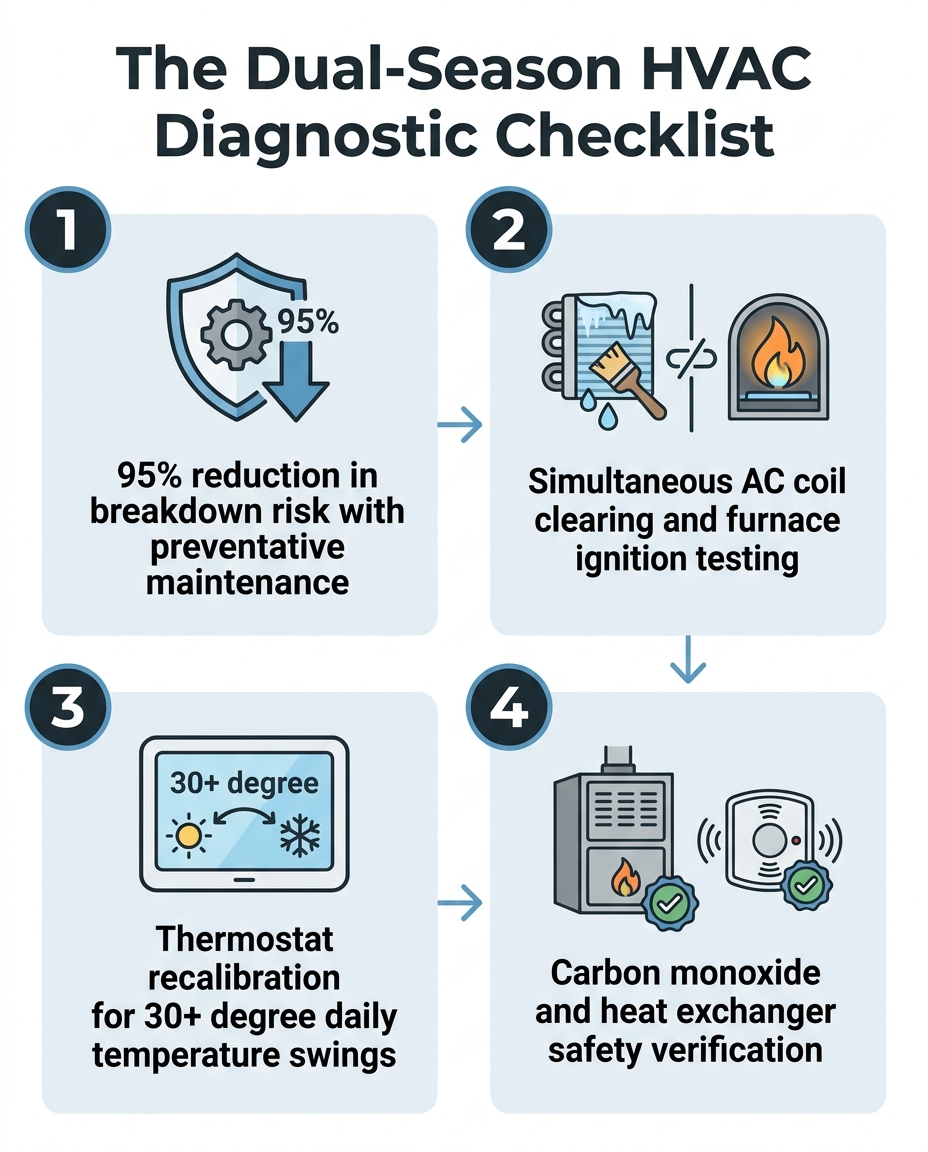
According to the U.S. Department of Energy, preventative maintenance can reduce the risk of costly breakdowns by up to 95 percent while significantly improving energy efficiency. We see this proven true every fall when discussing the complex calibration required for systems operating in volatile weather. Our technicians carefully measure the microfarad readings on dual-run capacitors to ensure they can handle the high-amp draw of an AC compressor in the afternoon, while also testing the millivolt output of the furnace thermocouple for safe nighttime heating.
Why Mode-Switching Stresses Your Equipment
Switching frequently between heating and cooling modes without proper system calibration increases wear and tear on almost every moving part inside your air handler. The strain is not just mechanical; it is deeply tied to the electrical communication between your thermostat and the main control board.
• Thermostat Recalibration Requirements: Mixed weather requires a thermostat to accurately read subtle indoor temperature shifts. If the anticipator circuit or digital temperature differential is not calibrated correctly, the system will short-cycle, turning on and off too quickly without actually conditioning the air.
• Blower motor strain: The blower motor acts as the lungs of your home. Pushing chilled air requires a different static pressure profile than pushing heated air. Continuous, alternating cycles without proper fan speed calibration force the motor to work against the ductwork's natural resistance, leading to overheating.
• Efficiency and Energy Consumption: An uncalibrated system wastes power every time it switches modes. The electrical surge required to start a compressor or ignite a furnace burner is the most energy-intensive part of the HVAC cycle. Minimizing these hard starts through precise calibration keeps utility bills manageable.
Why Mixed-Age Systems Struggle During Unpredictable Weather
Many homes we service operate with mixed-age equipment—perhaps a brand-new, high-efficiency air conditioner paired with a fifteen-year-old gas furnace, or a modern variable-speed furnace pushing air for an aging single-stage heat pump. While this is a common reality for homeowners managing budgets, mismatched component ages can lead to severe performance imbalances when the weather fluctuates rapidly during the September fall transition.
The primary issue lies in communication and airflow. Modern high-efficiency components are designed to run low and slow, maintaining precise temperatures over long cycles. Older components are typically single-stage, meaning they blast at 100 percent capacity until the thermostat is satisfied, then shut off completely. When an older furnace is forced to rapidly cycle alongside a modern AC unit, the shared blower motor takes the brunt of the abuse. The older control board may struggle to interpret the low-voltage signals required to smoothly transition between these drastically different operating modes.
To keep these hybrid systems running safely, homeowners need reliable heating solutions that focus on integration rather than just individual part repair. A 3D Heating and Cooling technician understands how to balance mixed-age systems, adjust blower motor speeds, modify thermostat differentials, and ensure that the older components are not acting as a bottleneck for the newer, high-efficiency parts.
The consequences of ignoring mixed-age system stress often surface at the worst possible times. For example, our team saw this firsthand when a local customer's HVAC system required a full replacement right in the middle of Thanksgiving evening. Because their 27-year-old system had been struggling to keep up with the fluctuating fall weather, it finally failed during a critical holiday gathering. Our technician arrived promptly that evening, explained the replacement options clearly, and successfully installed a quality new system to restore the home's comfort.
• New AC + Old Furnace — Primary Fall Transition Challenge: Blower motor in the old furnace struggles to push dense, cold air efficiently. — Professional Solution: Adjust fan speed taps and verify static pressure limits on the older air handler.
• Old AC + New Furnace — Primary Fall Transition Challenge: Modern furnace control board receives erratic signals from an aging thermostat/AC loop. — Professional Solution: Install an interface module or upgrade to a smart thermostat for better communication.
• Old Heat Pump + New Air Handler — Primary Fall Transition Challenge: Reversing valve gets stuck due to age when switching modes rapidly. — Professional Solution: Test reversing valve solenoids and check defrost board logic before winter hits.
Beyond Basic Upkeep: Executing a Holistic Fall Transition
Executing a holistic fall transition requires a systematic approach that addresses the unique vulnerabilities of both the indoor and outdoor equipment. Our professional technicians do not simply look at the furnace and ignore the air conditioner; we perform a synchronized evaluation that secures the entire HVAC footprint across the Taylorsville to Lexington service corridor. This thoroughness is what ultimately delivers that proven 95 percent reduction in breakdown risk.
If you have been relying on basic filter changes and hoping for the best, it is time to elevate your strategy. Proper air conditioning maintenance at the end of summer is just as critical as furnace prep at the start of winter. Here is how our team executes this dual-season transition:
1. Systematic Debris Removal: Late-summer storms blow leaves, dirt, and cottonwood directly into the outdoor condenser coil. We carefully clear this debris to ensure the AC can still breathe during unexpected October heat waves, preventing compressor overheating.
2. Refrigerant and Pressure Verification: Even in the fall, the AC side needs proper pressure. Our technicians check the subcooling and superheat levels to ensure the refrigerant charge is exact. Simultaneously, we verify the gas pressure at the furnace manifold to ensure the winter heating cycle will burn cleanly and efficiently.
3. Electrical Integrity Testing: The constant expansion and contraction of metal components during 30-degree temperature swings can loosen electrical connections. We torque all high-voltage lugs and test low-voltage control wires to prevent dangerous arcing or sudden power loss.
4. Drainage System Clearing: Summer cooling creates gallons of condensation, which often leads to algae growth in the primary drain line. If this line is not flushed and treated during the fall transition, that lingering water can back up, overflow, and cause severe water damage to your ceiling or floors when the system sits idle.
Cooling Optimization for Late-Season Heat
The cooling side of your system cannot be abandoned just because the calendar says September. Clearing the condenser coils and checking the refrigerant charge ensures that when a random 85-degree day strikes, your system responds efficiently. Furthermore, ensuring that the condensate drainage lines are completely clear of summer algae buildup prevents the risk of that moisture freezing in the pipes during the first hard frost.
Heating Preparation for Early Cold Snaps
On the heating side, our preparation is heavily focused on safety and mechanical reliability. Testing the ignition systems ensures the furnace will light smoothly on the first try, without dangerous gas buildup. For heat pump owners, verifying the reversing valve operation is critical—if this valve sticks, the system will blow cold air when you are calling for heat. Finally, verifying proper airflow and duct integrity guarantees that once the heat is generated, it actually reaches your living spaces without leaking into the attic or crawlspace.
Prioritizing Heating Safety Before the Winter Chill
While cooling failures are uncomfortable, heating failures can be genuinely dangerous. In our professional opinion, the most critical aspect of the September fall transition is uncovering hidden safety hazards that may have developed while the furnace sat dormant over the summer. The constant thermal expansion and contraction that a furnace undergoes over years of use takes a heavy toll on the metal components, specifically the heat exchanger.
The heat exchanger is the metal barrier that separates the toxic combustion gases (like carbon monoxide) from the clean air being blown into your home. Over time, the stress of heating up and cooling down can cause microscopic cracks to form in this metal. Because these cracks often develop out of sight, they can go completely unnoticed during the off-season. When the furnace fires up for the first time in the fall, those cracks expand as the metal gets hot, allowing deadly carbon monoxide to slip into the ductwork.
A comprehensive fall service from 3D Heating and Cooling prioritizes carbon monoxide testing and a visual or camera inspection of the heat exchanger. This proactive diagnostic catches severe safety hazards before the system is running constantly in the dead of winter. We recently responded to a local homeowner who discovered this the hard way during the fall season when their carbon monoxide detectors kept going off unexpectedly. Our thorough diagnostic revealed a cracked heat exchanger in their aging equipment. Our technician safely condemned the dangerous unit and replaced the old furnace and AC system, completely restoring the home's safety and peace of mind.
Critical Heating Safety Checks We Perform:
• Combustion Analysis: Ensuring the gas is burning cleanly and at the correct fuel-to-air ratio.
• Flue Pipe Inspection: Verifying that the exhaust venting is intact, properly sloped, and free of bird nests or debris.
• Limit Switch Testing: Confirming that the internal safety switches will properly shut down the furnace if it begins to overheat.
• Gas Leak Detection: Checking all valves, unions, and flexible gas lines for microscopic leaks that could pose a fire hazard.
Seamless Coverage Across Your Regional Footprint
Managing the complexities of dual-season weather requires more than just a quick tune-up; it requires a trusted local authority providing seamless, comprehensive all-season transitions across an expanded footprint. Utilizing a single, reliable HVAC contractor like 3D Heating and Cooling that services the entire region ensures that your equipment is held to a consistent standard of care. Whether you live on a rural property facing high winds or in a suburban neighborhood with specific zoning requirements, our unified service approach guarantees high-quality diagnostic work.
This regional consistency also allows our technicians to build comprehensive service records for your specific home. By tracking the exact pressures, voltages, and wear patterns of your system year over year, our professionals can accurately anticipate how the Taylorsville to Lexington service corridor's unique weather will impact your machinery. We know exactly when a blower motor is showing signs of fatigue before it actually fails, and we understand how the local humidity levels affect your specific brand of air conditioner.
If you are currently choosing an HVAC company in Taylorsville or the surrounding areas, prioritize a team that views your heating and cooling as a single, integrated ecosystem. A contractor with a strong regional footprint brings the parts, the training, and the localized expertise necessary to keep your home safe and comfortable, no matter how wildly the autumn temperatures swing.
Frequently Asked Questions
What does a complete heat and air service include?
At 3D Heating and Cooling, a complete heat and air service includes a comprehensive diagnostic of both the cooling and heating components during a single visit. Our technicians clear condenser coils, verify refrigerant levels, test furnace ignition systems, inspect heat exchangers for cracks, and recalibrate the thermostat. This holistic approach ensures the entire system is balanced and ready for fluctuating weather.
Why is dual-season HVAC maintenance important in fall?
Dual-season HVAC maintenance is important in the fall because Central Kentucky weather frequently swings between hot afternoons and freezing nights. Preparing only the furnace leaves the AC vulnerable to late-season heat waves, while ignoring the heating side risks a dangerous failure during the first cold snap. A dual-season tune-up secures both systems simultaneously.
When should I transition my HVAC from cooling to heating in Kentucky?
Our team recommends transitioning your HVAC from cooling to heating in Kentucky during the early fall, typically in September or October, before the first hard freeze occurs. However, because daily temperatures can fluctuate by 30 degrees, it is best to rely on a smart thermostat to manage the transition automatically once a professional has verified that both modes are safe to operate.
Why is it bad to switch from AC to heat constantly?
Constantly switching from AC to heat without proper system calibration places immense mechanical stress on the blower motor and electrical strain on the control board. It can confuse older thermostats, leading to short-cycling, which wastes energy and prevents the home from reaching a comfortable temperature. It also increases the wear and tear on components like reversing valves.
How do September temperature swings in Central Kentucky affect mixed-age HVAC systems?
September temperature swings in Central Kentucky force mixed-age HVAC systems to rapidly alternate between high-efficiency modern components and older, less adaptable parts. This mismatch can cause older blower motors to overheat as they struggle to keep up with the demands of a newer AC or furnace. Professional balancing by an experienced technician is required to ensure these hybrid systems communicate effectively and operate safely.
Secure Your Comfort for the Season Ahead
Navigating the unpredictable fall weather shouldn't be a source of stress for your family. By scheduling a comprehensive dual-season diagnostic with 3D Heating and Cooling, you ensure your system is perfectly calibrated to handle both late-summer heat and early-winter chills. Secure your comfort today with a professional tune-up, giving you the confidence that your home is safe, efficient, and fully prepared for whatever the forecast brings.
Financing

Now Offering Financing Options with Affordable Monthly Payments
where we operate
Service Areas
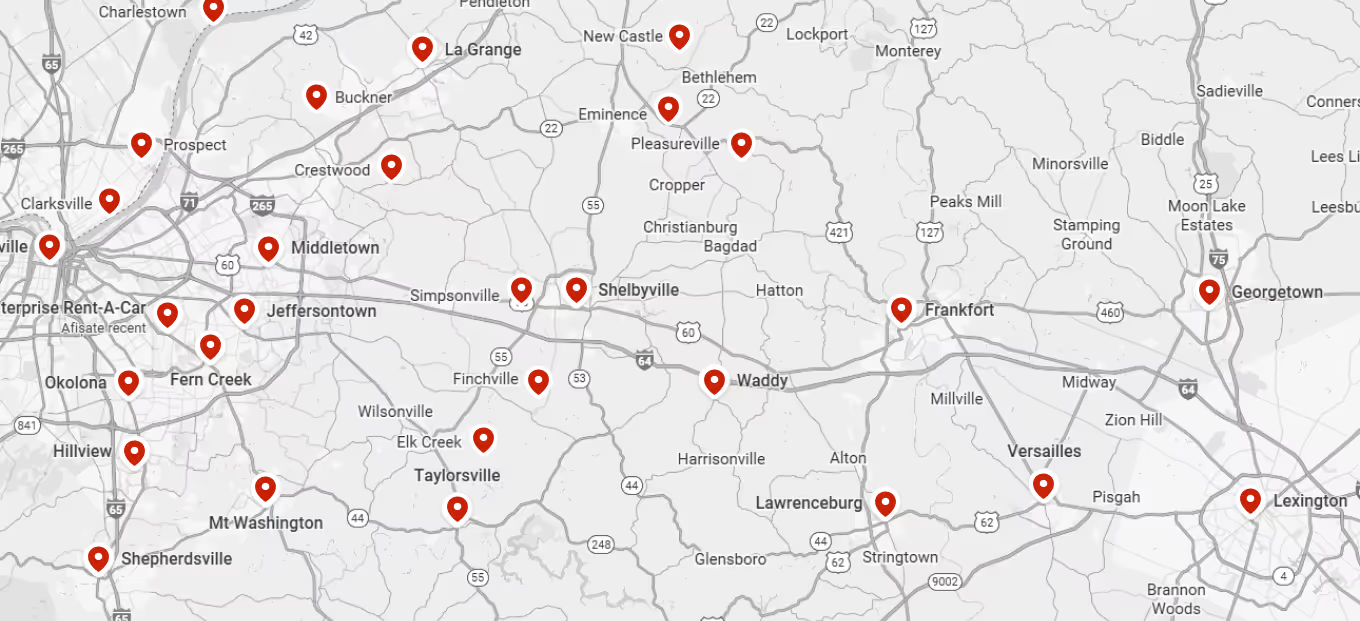
Proudly serving Spencer county, Jefferson county, Bullitt county, and the surrounding areas
Short Heading Goes Here
Sed iaculis aenean sit sed risus arcu vitae integer elit.

