

.svg)


.avif)



5 min read
Why AC Capacitors Fail Most Often in Late August
The End-of-Summer Cooling Crisis: Recognizing Cumulative Heat Stress
The late August back-to-school transition is finally here, but as you prepare for the busy fall schedule, you might find yourself wondering why AC capacitors fail most often in late August just as the worst of the summer heat seems to be breaking. You are not alone in this frustration. Right around the time school buses start rolling through Taylorsville KY, our team at 3D Heating and Cooling sees a massive spike in emergency calls from homeowners experiencing a sudden, unexpected cooling crisis. The air conditioner that has kept your home perfectly chilled since May suddenly starts humming aggressively, or worse, refuses to start entirely.
This end-of-summer breakdown is rarely a random stroke of bad luck. Instead, it is the direct result of cumulative heat stress. For months, your system has been battling relentless temperatures, and the electrical components inside your condenser unit have been absorbing that punishment day in and day out. The capacitor, a small but mighty electrical component, is usually the first part to surrender to the strain of constant cycling.
Recognizing the early warning signs of a struggling capacitor is one of the most important things you can do as a homeowner. When you understand what is happening inside your unit, you can make the critical decision to call a professional before a relatively simple electrical issue destroys your much more expensive compressor. By keeping a close eye on your air conditioning systems during this vulnerable late-summer window, you can prevent a minor hiccup from turning into a major mechanical disaster.
How Your AC Capacitor Operates Under Extreme Summer Loads
To understand why this specific breakdown happens, it helps to look at the heavy lifting going on inside your outdoor condenser unit. The capacitor acts as a heavy-duty battery or a powerful starter for the motors in your cooling system. When your thermostat calls for cool air, your household electrical current alone is not strong enough to get the heavy compressor and the large condenser fan moving from a dead stop. The capacitor stores energy and releases it in a massive, instantaneous jolt to jump-start the system.
This is not a gentle process. To get those heavy motors spinning, the capacitor often stores and delivers 300 to 500 volts of electricity. Every single time your system cycles on, the capacitor is subjected to this intense electrical demand. Once the motors are running, a secondary function of the capacitor (or a separate run capacitor, depending on your setup) provides a steady, continuous stream of optimized voltage to keep the motors spinning smoothly without pulling excessive power from your electrical panel.
The Hidden Heat Inside Your Condenser Cabinet
The electrical demand is only half of the battle. The physical environment where the capacitor lives is incredibly hostile. The capacitor is housed inside the metal cabinet of your outdoor condenser unit, sitting right next to the compressor, which generates a massive amount of its own heat while pumping refrigerant.
During a hot afternoon, the internal temperatures of that metal cabinet can easily exceed the ambient outdoor temperatures by 20 to 30 degrees. If it is 95 degrees outside in the shade, the environment surrounding your capacitor might be baking at 120 degrees or more. Most standard AC capacitors are engineered with a maximum thermal limit of around 150 degrees Fahrenheit. When the sun is beating down on the metal casing, the compressor is running hot, and the component is constantly discharging high voltage, the internal temperature of the capacitor is pushed dangerously close to—and sometimes past—its absolute thermal limit.
The Timeline of Thermal Degradation: Why Late August?
When an electrical component fails at the end of the summer, homeowners often blame the weather on that specific day. However, the failure is rarely about a single hot afternoon. It is about the concept of cumulative thermal stress. Your equipment has been running a marathon, and late August is simply the final mile where exhaustion overtakes endurance.
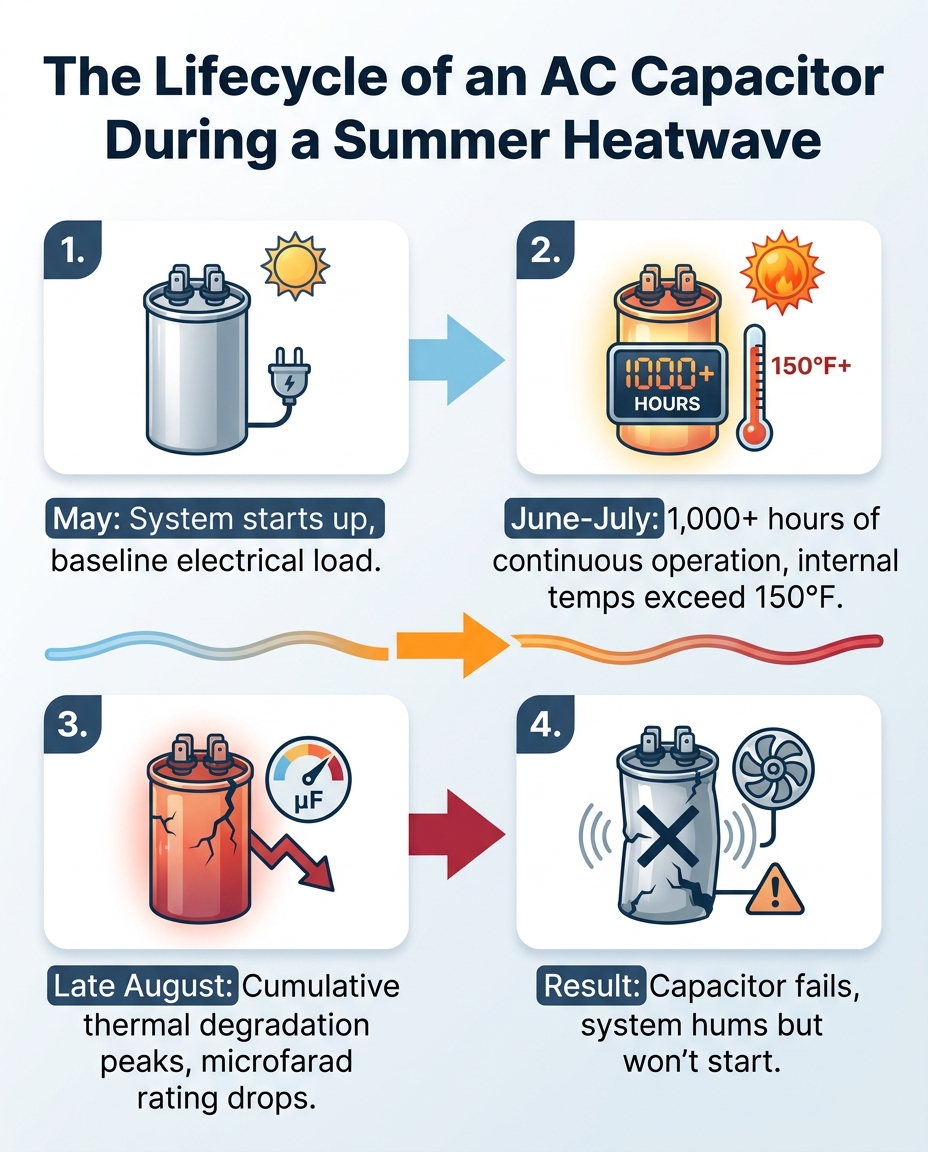
By the time the late August / back-to-school transition arrives, our technicians find that a typical residential cooling unit has endured over 1,000 hours of grueling operation since the cooling season began in May. Every hour spent running in the heat slowly degrades the chemical dialectric fluid inside the capacitor. This slow breakdown reduces the component's ability to store and release the proper amount of voltage, a measurement known as its microfarad rating.
The Heavy Burden of Kentucky Humidity
In our years of maintaining air conditioners across the region, we've seen firsthand how the timeline of degradation is accelerated by the reality of Kentucky's humid subtropical summer climate. Your air conditioner is not just lowering the temperature (sensible cooling); it is also working overtime to extract heavy moisture from the indoor air (latent cooling). Sustained high humidity forces your system to run in much longer, continuous cycles to effectively dehumidify the house.
Because the system is running AC running non-stop during heatwaves, the electrical components are subjected to relentless electrical load without adequate cool-down periods between cycles. The heat builds up, the oil inside the capacitor expands, and the internal components begin to physically warp and break down over the 60 to 90 days of peak summer.
• May to June — System Workload: Moderate cycling, managing early humidity spikes. — Capacitor Condition: Healthy baseline. Storing and discharging optimal voltage without excess heat retention.
• July — System Workload: Peak continuous operation. Managing heavy sensible and latent cooling loads. — Capacitor Condition: Experiencing cumulative thermal stress. Internal temperatures frequently push toward the 150-degree limit.
• Late August — System Workload: Surpassing 1,000+ hours of seasonal operation. Minimal cool-down periods. — Capacitor Condition: Thermal degradation peaks. Microfarad capacity drops significantly, leading to hard starting and eventual failure.

Signs Your AC Capacitor is Failing from Summer Heat Stress
Because a sudden failure can leave your home uncomfortably warm within hours, knowing what to look and listen for is incredibly helpful. Capacitors rarely fail silently. They usually exhibit a few distinct symptoms as their ability to hold a charge diminishes. If you notice any of these behaviors, your system is crying out for professional help.
• A distinct humming or buzzing sound: This is the most common early warning sign. If you stand near your outside condenser unit and hear a loud, aggressive hum but nothing is moving, the motors are trying to draw power, but the capacitor cannot deliver the necessary jump-start.
• The condenser fan is not spinning: You might hear the compressor running, but the fan blades at the top of the unit are completely still. Sometimes, homeowners notice the fan moving very sluggishly before stopping altogether.
• Hard starting and stuttering: The system struggles, stutters, or takes unusually long to turn on when the thermostat calls for cooling. You might even notice the lights in your house dimming slightly when the AC tries to kick on.
• Blowing warm air indoors: If the indoor blower is running but the outdoor compressor cannot engage without the capacitor's jump-start, your vents will circulate uncooled, room-temperature air throughout the house.
• Random or unexpected shut-offs: The system may short-cycle or shut down completely during peak afternoon heat because the overheating components trigger internal safety switches.
Why Catching Symptoms Early Matters
Many homeowners ignore a slight stutter or a temporary hum if the system eventually kicks on and cools the house. However, an air conditioner that is hard starting is pulling massive amounts of excess electricity to compensate for the weak capacitor. Catching these symptoms early and scheduling a service call prevents the electrical strain from traveling further down the line to more sensitive, expensive components.
The Chain Reaction: Protecting Your Compressor from Electrical Strain
Here is the thing most homeowners do not realize: a weak capacitor is not just an inconvenience; it is an active threat to the heart of your cooling system. Your air conditioner operates on a delicate balance of electrical resistance and mechanical force. When one part of the chain weakens, the other parts must work twice as hard to pick up the slack.
The Problem: As the capacitor degrades from summer heat stress, its microfarad rating drops. It can no longer supply the massive jolt of voltage required to get the compressor moving smoothly.
The Cause: Because the compressor still receives a signal from the thermostat to turn on, it tries to start anyway. Without the capacitor's help, the compressor is forced to pull an excessive amount of amperage directly from your home's electrical grid. This creates a condition known as "hard starting." The compressor strains, stutters, and pulls massive current, which generates intense, abnormal heat inside the compressor's motor.
The Solution: If a system is allowed to hard start repeatedly, the excess heat will eventually melt the insulation right off the internal copper windings of the compressor motor, causing a catastrophic electrical short. When this happens, the compressor is permanently destroyed. There is a massive difference in scale between a routine capacitor replacement and a catastrophic compressor failure. Replacing a burnt-out compressor is one of the most extensive and burdensome repairs in the HVAC industry, often prompting a full system replacement.
A critical safety warning: Because of the lethal high voltage stored inside a capacitor—even after the main power to the house has been shut off at the breaker—replacing this component is strictly not a DIY task. The component must be safely discharged using specialized tools before it can be handled. Always rely on a licensed professional to intervene and stop the chain reaction safely.
Psychological Relief: Diagnosing a Heat-Exhausted Capacitor vs. a Dead Compressor
When you walk outside in late August and find your AC unit completely silent, humming aggressively, or radiating heat without running, the immediate feeling is usually dread. Homeowners naturally assume the worst-case scenario: the entire unit is dead, the compressor has failed, and they are facing a massive end-of-summer financial burden.
Fortunately, the reality is often much less intimidating. At 3D Heating and Cooling, our field technicians replace more capacitors during this specific window of the year than any other part. When our service vans roll out to frantic no-cooling calls during the late August back-to-school transition across Taylorsville KY, we consistently find that the completely unresponsive unit is simply protecting itself. The system has recognized the electrical fault and shut down to prevent the exact chain reaction of compressor damage we discussed earlier.
Having a professional accurately diagnose the root cause provides immense psychological relief. A technician will safely open the cabinet, discharge the stored voltage, and test the microfarad reading using a specialized multimeter. If the reading is below the manufacturer's specified range, or if the top of the component is physically bulging outward like a swollen tin can, the diagnosis is clear.
What felt like a total system failure is often just a heat-exhausted electrical part that has finally succumbed to three months of cumulative heat stress. Whether you need help in Taylorsville or require Louisville area cooling services, having an expert confirm that your compressor is safe and sound is the best news you can get on a hot late-summer afternoon.
Proactive Steps to Prevent Late-Summer Cooling Failures
While you cannot control the intense summer weather, you can absolutely control how well your equipment is prepared to handle it. You do not have to wait for your system to break down to find out if your electrical components are suffering from heat stress. Preventative measures can catch a weakening component weeks or months before it leaves you sweating in your living room.
1. Schedule routine electrical testing: During a professional tune-up, our 3D Heating and Cooling technicians do more than just clean the unit. They use precise meters to test the microfarad rating of your capacitors. If a component is rated for 45 microfarads but is currently testing at 38, the technician knows it is actively degrading and can replace it proactively before it fails completely.
2. Prioritize early or mid-season tune-ups: Preparing your electrical components for the long haul ensures they are operating at peak efficiency. Tightening electrical connections and inspecting contactors reduces the overall electrical resistance in the system, which takes unnecessary strain off the capacitor.
3. Maintain proper system airflow: The harder your system has to work to pull air, the longer the compressor and fan motors have to run. Longer run times mean more heat buildup inside the cabinet. By simply changing your indoor air filters regularly and keeping the outdoor condenser coils free of grass clippings, dirt, and debris, you drastically reduce the overall workload on the electrical components.
4. Apply these principles to all equipment: These preventative steps apply across different cooling technologies. Whether you have a traditional central air conditioner or you rely on heat pump cooling systems, the electrical demands of jump-starting heavy motors remain the same.
Frequently Asked Questions About Late-Summer AC Failures
Can a bad capacitor ruin my AC compressor?
Yes, a weak capacitor forces the compressor to pull excessive amperage to start. When the compressor struggles to turn on without the proper electrical jump-start, it generates intense internal heat. Over time, this repeated overheating can melt the insulation on the internal windings, causing the compressor to burn out and fail permanently.
What are the signs of a bad AC capacitor?
The most common signs include a loud humming or buzzing sound from the outdoor unit, a condenser fan that won't spin, and warm air coming from your indoor vents. You may also notice the system struggling to start, stuttering, or shutting down unexpectedly during the hottest parts of the afternoon.
Why do AC capacitors keep blowing?
Repeated failures are often caused by extreme cumulative heat, power surges, or an underlying mechanical issue like a failing condenser fan motor. If the motors are drawing too much power, or if the unit is constantly short-cycling without adequate cool-down periods, the lifespan of the capacitor will be drastically reduced.
How hot is too hot for an AC capacitor?
Most standard capacitors are rated for a maximum operating temperature of around 150 degrees Fahrenheit. Because the internal operating temperatures of the condenser cabinet can easily exceed ambient outdoor temperatures by 20 to 30 degrees, intense summer heatwaves can push the component past this limit, leading to rapid thermal degradation.
How long do AC capacitors typically last?
Under normal, moderate conditions, a high-quality capacitor can last 10 to 20 years. However, in climates with severe heat and high humidity that require constant, heavy cycling throughout the summer, their lifespan can be significantly shorter, sometimes requiring replacement every 5 to 7 years.
Can I replace an AC capacitor myself?
No, replacing a capacitor is extremely dangerous due to the high voltage stored inside the component. Even after the main breaker to the AC unit has been turned off, the capacitor can hold a lethal electrical charge. You must always rely on a licensed HVAC professional to safely discharge, test, and replace the component.
Restore Your Home's Comfort with Expert Capacitor Replacement
Dealing with a sudden cooling breakdown at the end of a long, exhausting summer is incredibly frustrating, but it does not have to be a disaster. Understanding exactly why AC capacitors fail most often in late August gives you the power to act quickly and protect your system. A blown capacitor is a common, straightforward fix when handled by a trained professional, and getting it resolved quickly prevents a minor electrical issue from turning into a major mechanical failure.
You deserve the peace of mind that comes from knowing exactly why your system failed and having it properly, safely repaired. If your system is humming, hard starting, or completely unresponsive, do not wait for the heat to cause further damage. Reach out to the experts at 3D Heating and Cooling for a precise diagnostic check, and consider investing in preventative AC maintenance to catch these heat-exhausted components before they disrupt your comfort next season.
Financing

Now Offering Financing Options with Affordable Monthly Payments
where we operate
Service Areas
Proudly serving Spencer county, Jefferson county, Bullitt county, and the surrounding areas

Short Heading Goes Here
Sed iaculis aenean sit sed risus arcu vitae integer elit.

