

.svg)


.avif)



5 min read
Heat Pumps vs. Gas Furnaces for Kentucky's Mild Autumns
Why Do Kentucky Homes Overheat in Early Fall?
Have you ever woken up to a chilly September morning, bumped up the thermostat, and found yourself sweating by mid-afternoon? When evaluating Heat Pumps vs. Gas Furnaces for Kentucky's Mild Autumns, this familiar frustration is usually the first thing homeowners mention. In Taylorsville KY, our transitional fall seasons stretch out with unpredictable, intermittent heating demands. You need a burst of warmth before breakfast, but by 2 p.m., the sun has heated the house perfectly. Traditional high-capacity heating systems are often overkill for this transitional weather. They blast massive amounts of heat, causing the home to overheat rapidly and making indoor temperature control feel like a constant guessing game. This brings up an important decision point: whether to upgrade an aging system to a dual-fuel setup that handles both mild and freezing temperatures smoothly. By comparing heat pumps and gas furnaces, you can find the ideal balance for our specific regional weather.
If you are struggling with uneven temperatures, exploring your options for heating systems and services is the first step toward consistent comfort.
The Problem with Gas Furnaces During Moderate 50-Degree Fall Days
To understand why your home feels uncomfortable in September and October, we have to look at how traditional heating systems are designed. A standard gas furnace is built for one primary purpose: rapidly combating deep winter freezes. When you turn it on during moderate 50-degree fall days, you are essentially using a sledgehammer to drive a small nail.
The Problem: Excessive Heating Capacity
Gas furnaces generate heat through combustion, producing a massive, high-temperature blast of air. This is exactly what you want when there is snow on the ground. However, during early autumn, your home only needs a slight temperature bump to take the chill out of the air. When a high-capacity furnace fires up in 50-degree weather, it floods your living space with too much heat, too quickly.
The Cause: System Short-Cycling
Because the furnace produces heat so rapidly, your thermostat registers that the target temperature has been reached in just a few minutes and shuts the system down. Ten minutes later, the house cools slightly, and the massive furnace fires up again. This rapid on-and-off process is called short-cycling. Short-cycling is incredibly hard on your HVAC equipment. It puts excessive wear and tear on the blower motor, stresses the heat exchanger, and spikes your energy bills because starting a system requires more energy than keeping it running.
The Solution: Gentle, Consistent Warmth
The solution to this early-fall discomfort is finding a system that matches its output to the actual demand of the weather. Instead of a fiery blast of heat, moderate 50-degree fall days require gentle, consistent warmth that circulates evenly throughout your home without triggering an immediate shutdown.
How Heat Pumps Deliver Gentle Efficiency in Autumn
If gas furnaces are overkill for early fall, heat pumps are the perfect tool for the job. Instead of burning fuel to generate heat, heat pumps use electricity and refrigerant to move existing heat from one place to another. Even on moderate 50-degree fall days, there is an abundance of thermal energy in the outside air.
Here is how a heat pump operates to keep your home perfectly comfortable during the transitional season:
1. Absorbing ambient heat: The outdoor unit pulls in air and passes it over coils filled with cold refrigerant. The refrigerant absorbs the latent heat energy from the outside air.
2. Compressing for warmth: The system's compressor pressurizes the warmed refrigerant, significantly raising its temperature.
3. Transferring heat indoors: The hot refrigerant travels to your indoor unit, where the blower fan circulates the gentle, lower-intensity heat throughout your ductwork.
4. Running continuous, efficient cycles: Because the heat output is less intense than a furnace, the heat pump runs longer, steadier cycles. This eliminates short-cycling and keeps the indoor temperature perfectly balanced.
This heat transfer process makes air-source heat pumps incredibly efficient. In mild conditions, they can deliver up to three times more heat energy to your home than the electrical energy they consume. Performance is measured by SEER2 (cooling efficiency) and HSPF2 (heating efficiency) ratings. The higher the rating, the less electricity the system needs to keep you warm.
If you want to take advantage of this technology, professional heat pump services can help you size the right unit for your home.
Why Gas Furnaces Remain Essential for Deep Freezes
While heat pumps are the undisputed champions of the autumn shoulder season, they do have limitations. As temperatures drop below freezing, there is less ambient heat available in the outside air. Standard heat pumps begin to lose efficiency and have to work much harder to extract warmth, which can lead to higher electricity usage and cooler air coming from your vents.
This is where the gas furnace proves its worth. Modern gas furnaces are evaluated by their AFUE (Annual Fuel Utilization Efficiency) rating, which measures how efficiently they convert fuel into raw heating power. A high-efficiency furnace wastes very little fuel, turning almost all of it into the robust, high-capacity heat needed to combat harsh Kentucky winter freezes.
One local homeowner reached out to us on Thanksgiving evening when their 27-year-old heating system finally gave out during a cold snap. Our team arrived that same evening, explained their options, and replaced the old system so they could get back to enjoying the holiday with reliable warmth. When temperatures plummet, that kind of high-capacity heating power is exactly what you need.
For homes that need robust backup heat, proper gas furnace installation ensures you are ready for the worst winter storms.
System Performance Comparison
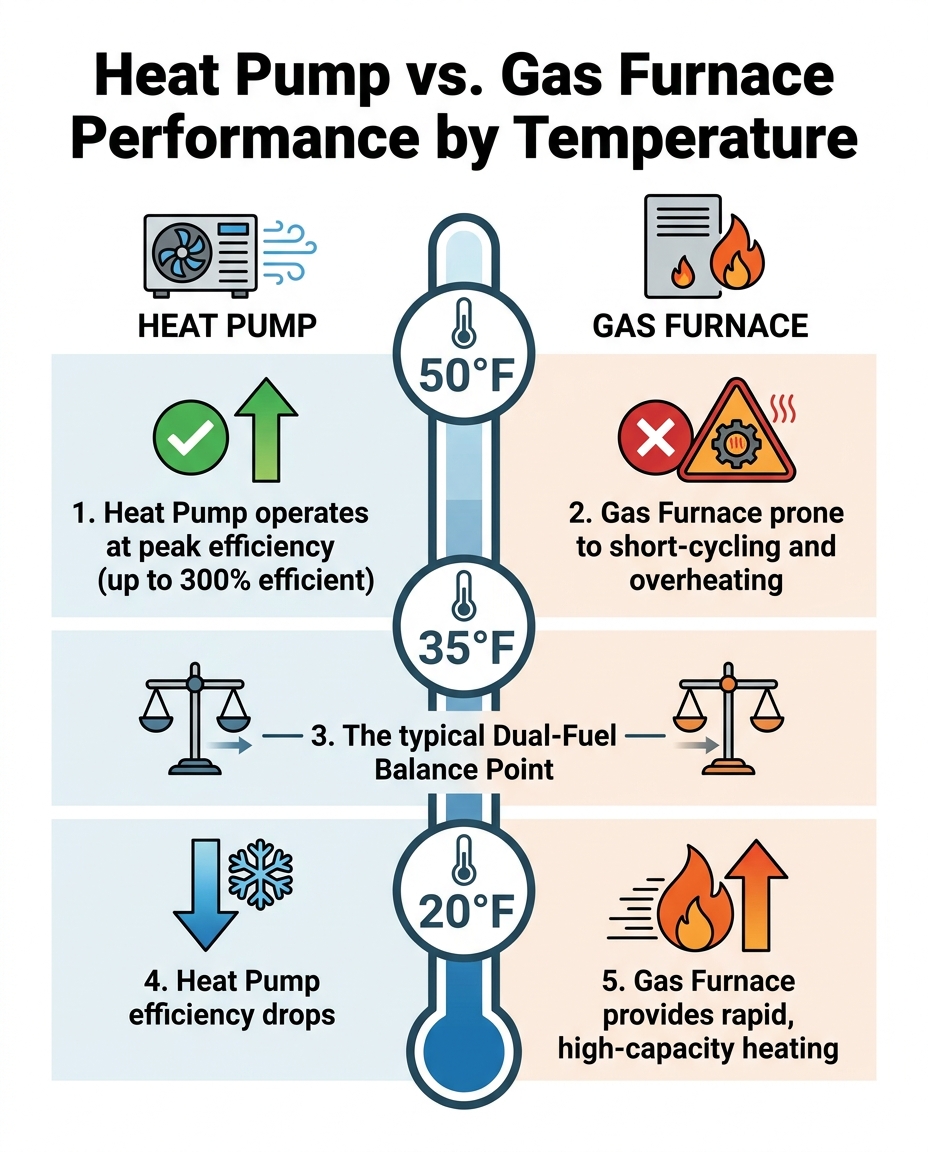
• Mild Autumn (40°F - 60°F) — Heat Pump Performance: High efficiency, gentle heat, long continuous cycles. Eliminates short-cycling. — Gas Furnace Performance: Prone to short-cycling. Overheats the space rapidly. Less efficient due to frequent starts.
• Deep Freeze (Below 32°F) — Heat Pump Performance: Efficiency drops. Struggles to extract enough heat from freezing air. — Gas Furnace Performance: High capacity, rapid heating. Ultimate safeguard against severe winter storms.

Dual-Fuel Systems: Bridging the Gap for Kentucky Winters
If heat pumps are best for the fall and gas furnaces are necessary for the winter, how do you choose? The most effective solution for our region is a dual-fuel system (also known as a hybrid system). A dual-fuel setup combines an electric heat pump with a high-efficiency gas furnace in one complete package.
The beauty of a dual-fuel system lies in its automated intelligence. The system uses an advanced thermostat equipped with an outdoor temperature sensor. During the mild weeks of September and October, the system relies entirely on the heat pump to provide gentle, highly efficient warmth. This completely eliminates the early fall short-cycling associated with gas furnaces.
As the season progresses and winter arrives, the outdoor temperature eventually drops to a point where the heat pump is no longer the most efficient option. At this exact moment, the thermostat automatically shuts down the heat pump and ignites the gas furnace. This seamless transition guarantees you always have the right type of heat for the weather outside, optimizing your long-term energy usage by utilizing the most efficient fuel source at all times.
Calibrating the Balance Point: A Job for Local Experts
The specific temperature at which a dual-fuel system switches from the heat pump to the gas furnace is known as the balance point or the economic changeover point. Typically, this point falls somewhere between 35 and 40 degrees Fahrenheit. However, setting this temperature correctly is not a guessing game.
Calibrating the exact balance point requires a deep understanding of local utility rates (the cost of electricity versus the cost of natural gas) and specific regional weather patterns. Generic national HVAC advice often recommends a flat changeover temperature that simply does not account for the nuances of Taylorsville KY weather.
At 3D Heating and Cooling, our deep understanding of Kentucky's specific climate swings allows us to recommend and calibrate the perfect dual-fuel setup for your home. Proper calibration by a professional prevents unnecessary gas usage during mild weeks and ensures your furnace only takes over when it is truly the most economical choice.
Whether you are in Taylorsville or looking for heating experts in Lexington, working with local professionals ensures your balance point is set correctly.
September Preparation: Transitioning Your System for Autumn
The best time to evaluate your heating strategy is long before the first frost arrives. Preparing your home in September gives you ample time to make thoughtful decisions about upgrades and maintenance. Here is an actionable checklist to help you transition your system for the upcoming seasonal shift:
• Schedule a professional system evaluation: Have a technician inspect your current equipment in early September. Finding a cracked heat exchanger or a failing blower motor now is much better than discovering it during a November freeze.
• Review available incentives: If you are considering upgrading to a dual-fuel setup, generic federal tax credits and utility incentives may apply to qualifying high-efficiency heat pump installations. Consult with your tax professional to see how these programs can make an upgrade more accessible.
• Manage your thermostat wisely: During weeks with large temperature swings, avoid turning your system completely off and on. Set a comfortable baseline and let the system maintain it. If you aren't sure when to switch your thermostat from cool to heat, a programmable thermostat can handle the transition automatically.
• Plan for proactive replacement: We frequently see what happens when preparation is delayed. Another local customer experienced a total system failure when their furnace went out right as the first major cold front hit. Our technicians arrived quickly to professionally install a new furnace, restoring their heat rapidly. You can avoid that emergency rush by acting proactively on moderate 50-degree fall days.
FAQ
At what temperature is a heat pump no longer effective in Kentucky?
Standard heat pumps generally begin to lose their peak efficiency when outdoor temperatures drop below 35 to 40 degrees Fahrenheit. While they can still extract heat at lower temperatures, they have to work significantly harder, which increases electricity usage. In Kentucky, this is the ideal temperature range for a dual-fuel system to switch over to gas furnace heating.
Can you have both a heat pump and a gas furnace?
Yes, combining both technologies is called a dual-fuel or hybrid heating system. In this setup, the heat pump handles the cooling in the summer and the gentle heating in the fall and spring. When the deep winter freezing temperatures arrive, the system automatically switches to the gas furnace to provide high-capacity warmth.
Is a heat pump enough for Kentucky winters?
While modern cold-climate heat pumps are improving, a standard heat pump alone may struggle to keep your home comfortable during the harshest Kentucky winter nights. Because our region experiences significant freezes, pairing a heat pump with a gas furnace in a dual-fuel setup is usually the most reliable and efficient strategy.
How does a dual fuel HVAC system work?
A dual-fuel system uses an outdoor heat pump and an indoor gas furnace, controlled by a smart thermostat equipped with an outdoor temperature sensor. When the weather is mild, the thermostat directs the heat pump to warm the home efficiently. Once the outdoor temperature drops below a pre-set balance point, the thermostat turns off the heat pump and activates the gas furnace.
Why does my gas furnace turn on and off so quickly in the fall?
This rapid cycling is called short-cycling, and it happens because gas furnaces are designed to heat homes during extreme cold. During mild fall weather, the furnace produces too much heat too quickly, satisfying the thermostat in just a few minutes. The system shuts down, the house cools slightly, and the cycle repeats, which wastes energy and stresses the equipment.
What is the balance point on a hybrid heating system?
The balance point, or economic changeover point, is the specific outdoor temperature at which it becomes more efficient and cost-effective to heat your home with gas rather than electricity. Local HVAC professionals calibrate this setting based on your region's specific weather patterns and current utility rates, usually setting it between 35 and 40 degrees.
Making the right choice between a heat pump, a gas furnace, or a combined dual-fuel system comes down to understanding your local climate. By matching your equipment to the specific demands of Kentucky's weather, you can enjoy a clear, climate-specific approach that provides efficient heating in 50-degree weather and seamless, robust warmth when the deep freezes hit.
Financing

Now Offering Financing Options with Affordable Monthly Payments
where we operate
Service Areas
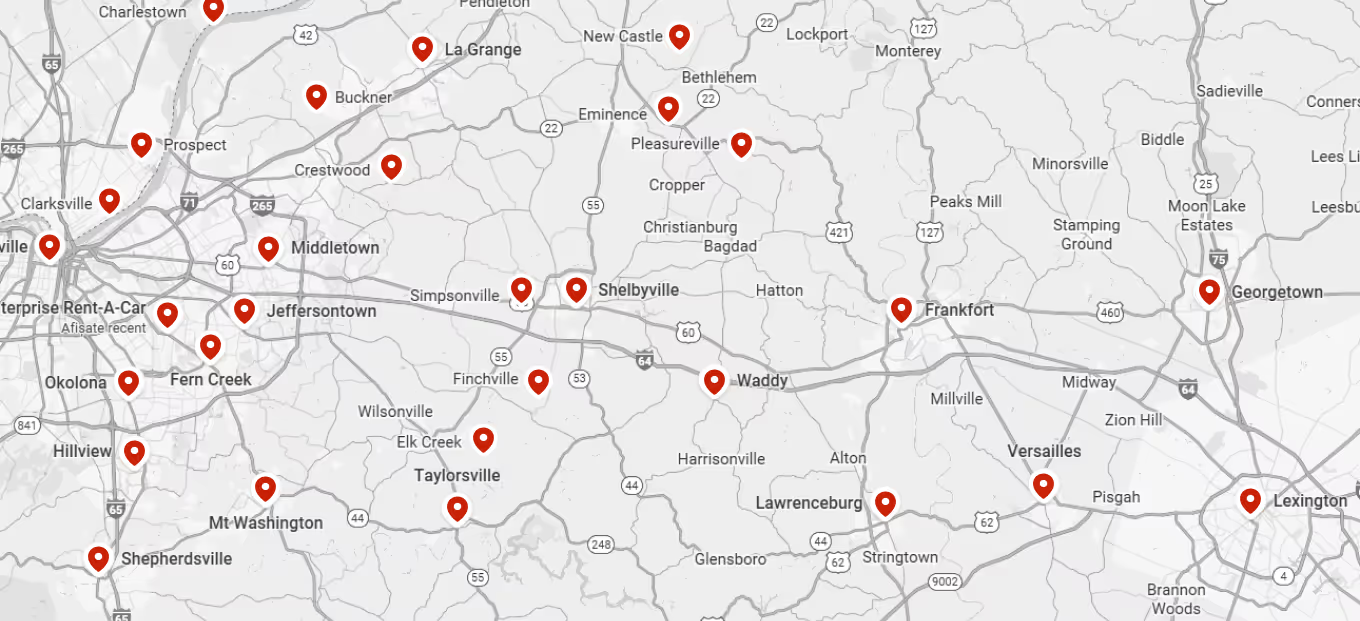
Proudly serving Spencer county, Jefferson county, Bullitt county, and the surrounding areas
Short Heading Goes Here
Sed iaculis aenean sit sed risus arcu vitae integer elit.

