

.svg)


.avif)



5 min read
Repairing a Leaky AC vs. Recharging Refrigerant Annually
The Myth of the Annual AC Refrigerant Top-Off
In our years of serving Taylorsville and the surrounding communities, the team at 3D Heating and Cooling has found that it is a surprisingly common misconception that air conditioners naturally consume or "use up" their charge over time, making a seasonal top-off just another routine part of homeownership. In reality, choosing between repairing a leaky AC vs. recharging refrigerant annually is one of the most critical decisions you will face when limping through the late August Kentucky heat. Your air conditioning system is a closed loop. It does not burn refrigerant like a vehicle burns gasoline. If your system is low on freon, there is only one reason: it has a physical leak.
If you are tired of paying for temporary band-aid fixes and want to permanently solve your cooling issues, exploring professional air conditioning services is the first step toward lasting comfort.
Many homeowners fall into the trap of scheduling a quick recharge at the beginning of the summer, hoping it will hold until fall. This creates a frustrating cycle. You pay for a service call, enjoy a few weeks of cool air, and then slowly watch the indoor temperatures creep back up as the chemical escapes into the atmosphere. The concrete problem isn't just the inconvenience of a warm house; it is the progressive damage being done to the equipment behind the scenes.
The critical decision point:
• Continue paying for temporary band-aids: Opting for an annual recharge treats the symptom while ignoring the disease, leaving your home vulnerable to sudden breakdowns.
• Permanently locate and solve the underlying leak: Finding the source of the lost refrigerant stops the cycle of service calls, restores peak efficiency, and protects the most expensive components of your system from premature failure.
By understanding how your system actually works, you can make an informed choice that protects your home comfort and your equipment during the most brutal stretches of late August Kentucky heat.
Why Your AC Struggles to Dehumidify When Refrigerant Is Low
Air conditioners operate as highly sensitive, closed-loop systems designed to maintain a precise chemical charge. Every component, from the metering device to the compressor, relies on that exact volume of refrigerant to function properly. When you lose even a small percentage of that charge, the entire mechanical balance is thrown off.
One of the first casualties of low refrigerant is your system's ability to remove moisture from the air. In our Taylorsville region, late-summer high humidity makes optimal evaporator coil temperatures absolutely critical for indoor comfort. When humidity levels spike, dropping the temperature on the thermostat isn't enough; the system must extract gallons of water from the indoor air every single day.
The mechanics of dehumidification failure:
• Pressure Drop: As refrigerant leaks out, the pressure inside the system drops significantly.
• Coil Freezing: This pressure drop causes the temperature of the Evaporator Coil to plunge below freezing. Instead of simply condensing water vapor into liquid that drains away, the moisture freezes directly onto the metal fins.
• Airflow Blockage: A solid block of ice forms over the coil, restricting airflow and completely halting the dehumidification process.
The result is a home that feels clammy, sticky, and distinctly uncomfortable, even if the air blowing from the vents feels somewhat cool. This is especially problematic for aging R-410A or older R-22 systems, which already operate at lower efficiency levels than modern units. If you are noticing these symptoms and want to restore proper humidity control, seeking professional AC repair in Bardstown can help identify the root cause of the moisture buildup.
The Mechanical Hazard: What Happens When You Just Recharge?
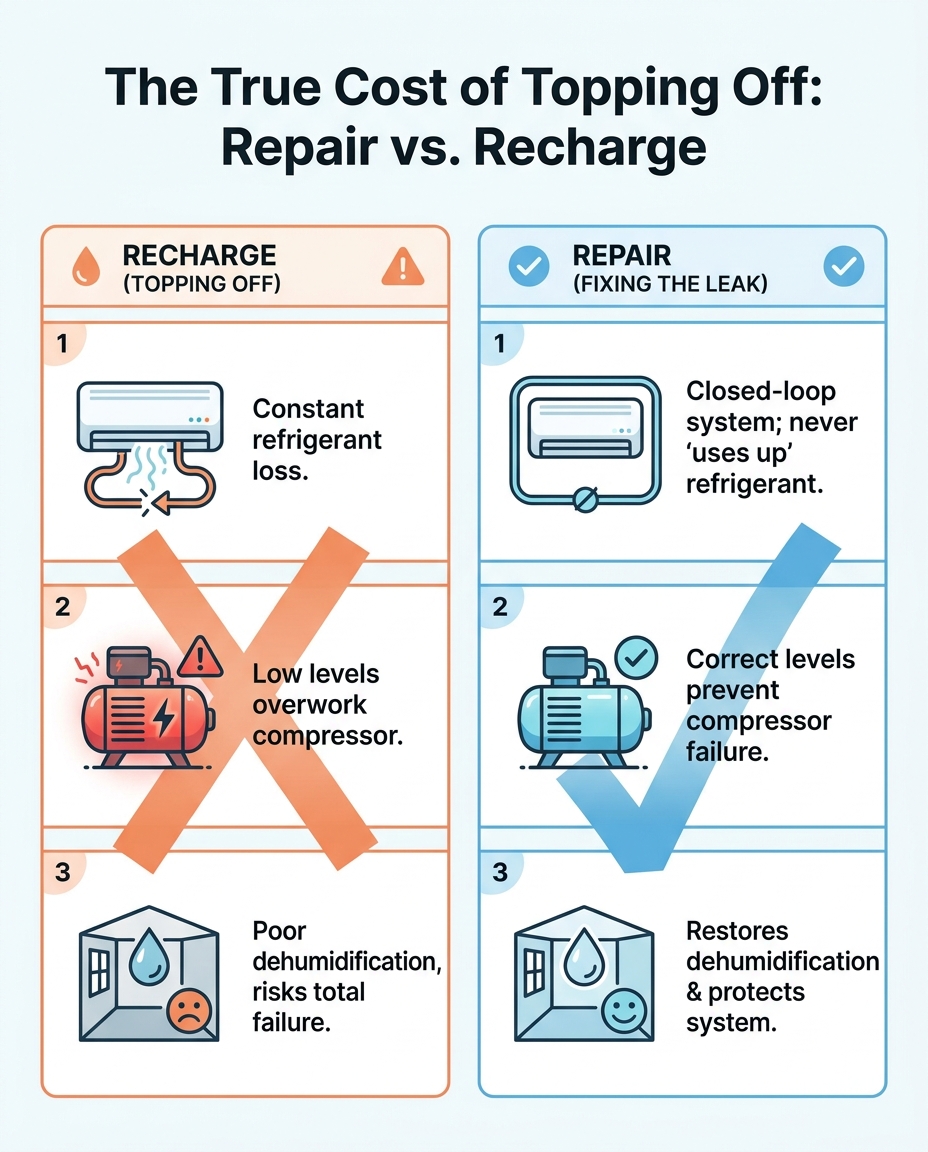
The Problem: Running an air conditioner on a low charge is not just a minor inconvenience; it is a severe mechanical hazard. The heart of your cooling system is the compressor, a heavy-duty motor responsible for pumping refrigerant through the lines. When you ignore a leak and simply recharge the system annually, you force this vital component to operate under extreme, unintended stress.
The Cause: Refrigerant does more than just cool the air inside your home; it also cools the compressor motor itself. Furthermore, the refrigerant carries a specific type of lubricating oil through the closed loop. When the refrigerant level drops, oil gets trapped in the lines instead of returning to the compressor. The motor is suddenly forced to run hotter, work harder, and operate without adequate lubrication. As families transition back to school, late August heatwaves place maximum cumulative stress on the compressor, making end-of-season failures highly likely for systems limping along on a partial charge.
The Solution: Reframing the annual recharge as a progressive mechanical hazard changes how you approach maintenance. Rather than viewing a top-off as a routine chore, recognize it as a warning sign. The only way to save the compressor from catastrophic failure is to find and seal the breach.
The Hidden Dangers of Compressor Strain
Homeowners often do not realize how close their system is to a total breakdown when operating with a leak. The compressor will try to compensate for the missing refrigerant by running longer cycles. You might hear the outdoor unit running continuously for hours during the late August Kentucky heat, struggling to reach the set temperature. This continuous operation draws excessive electrical current, overheats the internal windings, and eventually leads to a burned-out motor. Replacing a burned-out compressor is often so expensive that it forces a complete system replacement, a fate that could have been avoided by fixing the original leak.
The Long-Term Solution: Locating and Repairing the Leak
Finding a microscopic pinhole in hundreds of feet of copper tubing requires specialized training and equipment. It is never a do-it-yourself task. Honest, transparent diagnostics empower homeowners to make cost-effective, long-term decisions rather than falling victim to predatory seasonal band-aids. Professional technicians utilize advanced methods to locate the exact source of the problem.
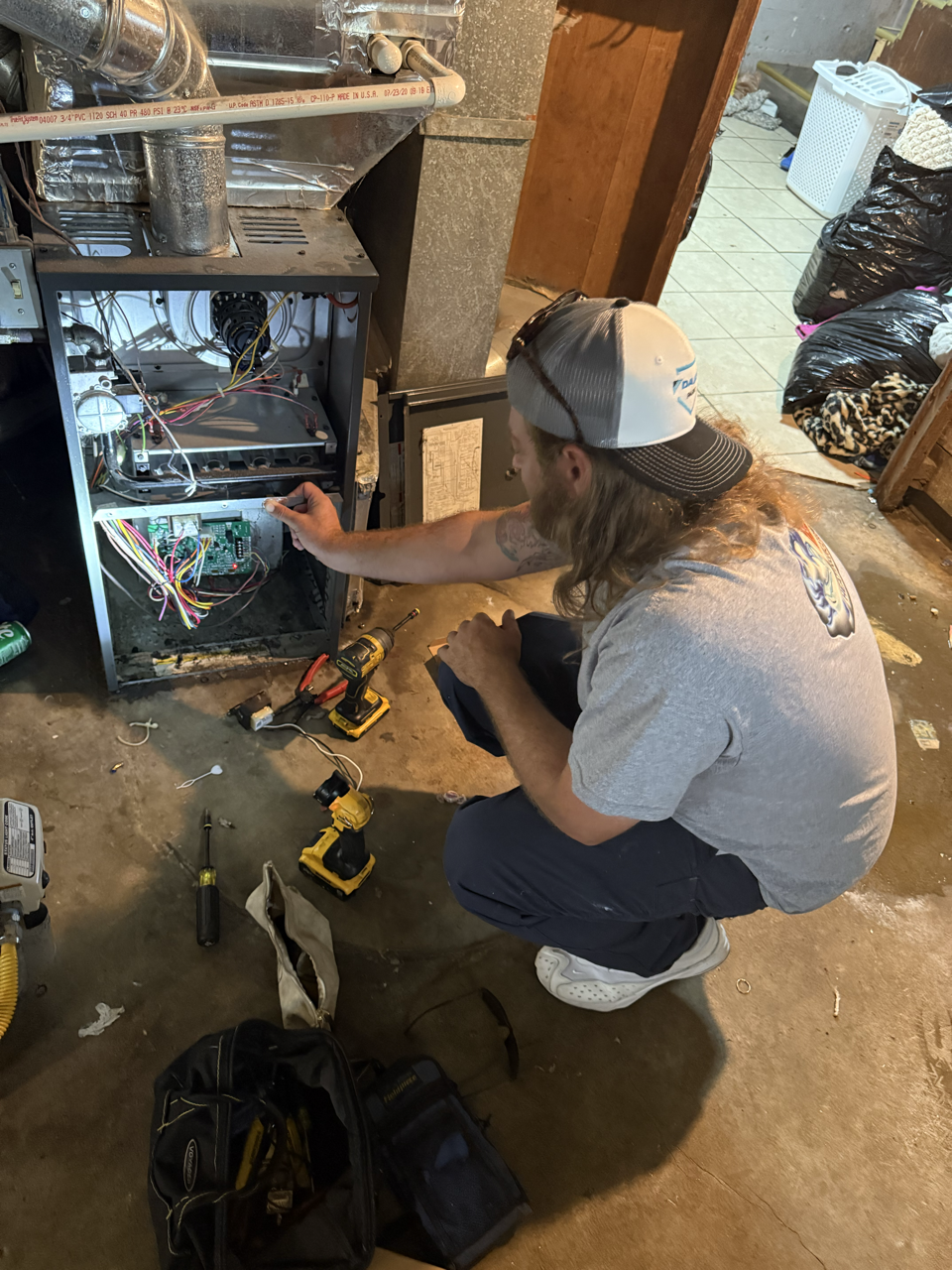
For example, our technicians at 3D Heating and Cooling recently helped a local homeowner who experienced the value of proper diagnostics firsthand when their AC began failing. Our team quickly identified a faulty coil and a unit leak, addressing both issues on the same day. By the time evening arrived, the system was fully repaired and running properly—eliminating the need for a mid-summer emergency call and securing long-term peace of mind.
Professional Leak Detection Methods
1. Electronic Sniffers: Technicians run highly sensitive electronic wands along the copper lines, coils, and weld joints. These devices detect the chemical presence of escaping refrigerant molecules and beep rapidly when they pinpoint the source.
2. Ultraviolet (UV) Dye Injection: A specialized, system-safe fluorescent dye is injected into the closed loop. As the system runs, the dye mixes with the refrigerant and oil. The technician then uses a UV flashlight to illuminate the equipment; any escaping dye glows brightly, revealing even the smallest micro-leaks.
3. Nitrogen Isolation Testing: For severe or hard-to-find leaks, the remaining refrigerant is safely recovered, and the system is pressurized with dry nitrogen. By monitoring pressure gauges and listening for the hiss of escaping gas, technicians can isolate the leak to specific sections of the equipment.
Locating the root cause—whether it is a vibrating copper line that rubbed bare or a deeply corroded evaporator coil—is mechanically superior to a temporary top-off. Properly repairing the leak restores the system's factory efficiency, protects the compressor from premature death, and completely stops the frustrating cycle of mid-summer service calls. If you are dealing with aging R-410A or older R-22 systems and are concerned about the upfront investment of a permanent repair, exploring flexible financing options can make the right mechanical choice much easier to manage.
Side-by-Side: Repairing a Leaky AC vs. Recharging Refrigerant Annually
When our Taylorsville customers are staring down the barrel of the late August Kentucky heat, we know they need clear facts to make the best decision for their home. Comparing the long-term mechanical outcomes of repairing a leak versus the progressive damage of continuous recharging reveals a stark contrast in value, comfort, and reliability.
• Mechanical Impact — Repairing the Leak Permanently: Restores factory pressure, ensures proper oil return, and protects the compressor from overheating. — Recharging Refrigerant Annually (Top-Off): Forces the compressor to overwork, starves the motor of oil, and guarantees progressive mechanical degradation.
• Comfort Level — Repairing the Leak Permanently: Delivers consistent, reliable cooling and powerful dehumidification all summer long. — Recharging Refrigerant Annually (Top-Off): Results in fluctuating temperatures, frozen coils, and sticky, clammy indoor air as the charge inevitably drops.
• Reliability — Repairing the Leak Permanently: Provides peace of mind; the system is sealed and ready to handle peak heatwaves without sudden failure. — Recharging Refrigerant Annually (Top-Off): Leaves you guessing when the system will fail next, often resulting in emergency breakdowns on the hottest days.
• Long-Term Value — Repairing the Leak Permanently: A one-time diagnostic and repair investment that extends the operational lifespan of the entire HVAC system. — Recharging Refrigerant Annually (Top-Off): A recurring, cumulative expense that ultimately ends in a catastrophic compressor failure and forced replacement.
Knowing When to Repair vs. Replace
While fixing a leak is always preferable to a temporary recharge, there is a threshold where repairing a specific component no longer makes mechanical sense. If the leak is located in an easily accessible copper joint, brazing it shut is straightforward. However, if the leak is buried deep within a severely corroded, fifteen-year-old evaporator coil, the repair becomes highly invasive.
At that point, homeowners must weigh the cost of a major component replacement against the remaining lifespan of the unit. Understanding the nuances of repairing vs. replacing an aging AC unit ensures you do not pour significant resources into a system that is already on its last legs. Furthermore, if a replacement is the best route, federal tax credits or local utility incentive programs may apply to qualifying high-efficiency installations. We always advise our customers to verify current programs with their utility provider or a tax professional to maximize their investment.

Environmental Impact and Refrigerant Regulations
Beyond the mechanical risks to your own equipment, continuous recharging carries a heavy environmental burden. The Environmental Protection Agency (EPA) enforces strict regulations regarding the handling, recovery, and intentional venting of refrigerants. Because these chemicals can have significant impacts on the ozone layer and contribute to greenhouse gas emissions, treating your air conditioner like a leaky sieve is highly discouraged by industry standards.
The HVAC industry is currently undergoing massive shifts in refrigerant technology. Older refrigerants like R-22 have already been phased out of production due to their ozone-depleting properties. Now, even R-410A is facing a phasedown to make way for newer, more environmentally friendly alternatives.
Why the Phase-Out Matters to You
If you are operating aging R-410A or older R-22 systems, the availability of these specific chemicals will continue to shrink over the coming years. As supply decreases, the logic of "just topping it off" becomes entirely unsustainable. Connecting environmental responsibility directly with the mechanical necessity of sealing closed-loop systems shows why permanent repairs are the only viable path forward. A sealed system protects the environment from harmful emissions and protects the homeowner from relying on a diminishing supply of outdated refrigerants.
Expert Answers About AC Refrigerant Leaks
Our 3D Heating and Cooling technicians answer questions like these every week. Here are the facts you need to know:
Is it normal to add refrigerant to an AC every year?
No, an air conditioner is a closed system that never consumes its charge. Needing a recharge indicates a physical leak that must be addressed by a professional. If a technician suggests that an annual top-off is just normal seasonal maintenance, they are ignoring a structural failure in your equipment. A healthy system will run for its entire lifespan on the exact same refrigerant it was installed with.
What happens if you run an AC with low refrigerant?
The system rapidly loses its ability to cool and dehumidify your home, resulting in clammy, uncomfortable air. More importantly, the compressor overworks, overheats, and is at high risk of catastrophic failure. Running a system low on charge during the late August Kentucky heat is one of the fastest ways to destroy the compressor motor entirely.
Can a home AC refrigerant leak be fixed?
Yes, professional technicians use advanced tools like UV dye or electronic sniffers to locate the exact source of the escaping gas. Depending on the location—such as a degraded evaporator coil or a loose service valve—the specific part can be repaired or fully replaced. Once the repair is complete, the system is pressure-tested and recharged to factory specifications.
How long does an AC typically run after a refrigerant recharge before failing again?
The timeline depends entirely on the size and severity of the physical leak. A microscopic pinhole might hold a charge for several months, while a larger structural crack could vent the new refrigerant in a matter of days. Because leaks tend to widen over time due to vibration and pressure, each subsequent recharge will leak out faster than the last.
Why is my AC blowing warm air even after a recent service call?
If your system is blowing warm air shortly after a top-off, the leak is likely severe enough that the new charge has already escaped. It can also indicate that the initial low-refrigerant condition caused the evaporator coil to freeze solid, blocking all airflow. In either case, the temporary fix has failed, and a comprehensive diagnostic is required to find the actual breach.
Stop the Cycle of Recharges and Protect Your AC System
Choosing a permanent repair over temporary, damaging fixes is the most logical way to manage your home comfort. By understanding that an air conditioner is a closed loop, you can reject the myth of the routine top-off and recognize a leak for what it truly is: a mechanical failure that demands a real solution. Fixing the underlying issue restores your system's ability to dehumidify, protects the compressor from overheating, and stops the endless cycle of paying for lost chemicals.
Do not let aging R-410A or older R-22 systems limp along until they suffer a catastrophic breakdown. Emphasize long-term mechanical value, restored comfort, and protection against end-of-season failures by taking proactive steps today. Schedule an expert diagnostic with 3D Heating and Cooling to find the leak, review your repair options, and explore routine HVAC maintenance to ensure your system is sealed, efficient, and ready to handle whatever the late-summer weather brings.
Financing

Now Offering Financing Options with Affordable Monthly Payments
where we operate
Service Areas
Proudly serving Spencer county, Jefferson county, Bullitt county, and the surrounding areas

Short Heading Goes Here
Sed iaculis aenean sit sed risus arcu vitae integer elit.

