

.svg)


.avif)



5 min read
Understanding the Role of Your AC's Contactor in Late Summer Breakdowns
The Shocking Reality of Abrupt Late-Summer AC Failures
That sudden silence from your outdoor unit isn't going to resolve itself, and understanding the role of your AC's contactor in late summer breakdowns is the first step toward getting your home comfortable again. You walk inside on a sweltering afternoon, check the thermostat, and realize the temperature is steadily climbing. The fan inside might be blowing warm air, but the heavy lifting of the outdoor compressor has completely stopped. Homeowners often experience this abrupt, unexpected loss of cooling during the hottest weeks of the year, assuming it is a random stroke of bad luck. However, these failures are rarely random.
To get to the bottom of these sudden stops, you need to look at the health of your HVAC systems as a whole, which often points straight to a small but vital component. When you need reliable air conditioning repair, technicians frequently trace the failure back to the contactor.
While it may seem like a mystery, these breakdowns are usually the result of cumulative wear on specific electrical components that have been working tirelessly since spring. One of the most critical and frequently overlooked components in your outdoor cabinet is the contactor. By the time the August late-summer cooling season arrives, this small device has endured massive amounts of electrical stress. Understanding how this component fails helps you make informed decisions about your system's health, rather than attempting dangerous, high-voltage DIY fixes.
What Is an AC Contactor and How Does It Function?
To understand why the system failed, you first need to understand what this part actually does. The contactor acts as a heavy-duty bridge between the thermostat's low-voltage signal and the high-voltage power required to run the compressor and condenser fan. Your indoor thermostat operates on a very low voltage—typically just 24 volts. But the outdoor compressor requires a massive surge of 220 to 240 volts to start up and run.
The Bridge Between Low and High Voltage
When the thermostat senses that the house is too warm, it sends a 24-volt signal outside to the contactor. This small electrical charge energizes an electromagnetic coil inside the component. The magnet instantly pulls a set of heavy metal contacts downward, closing the circuit. Once those metal plates touch, the massive 240-volt current rushes across the bridge, bringing the compressor and the outdoor fan to life.
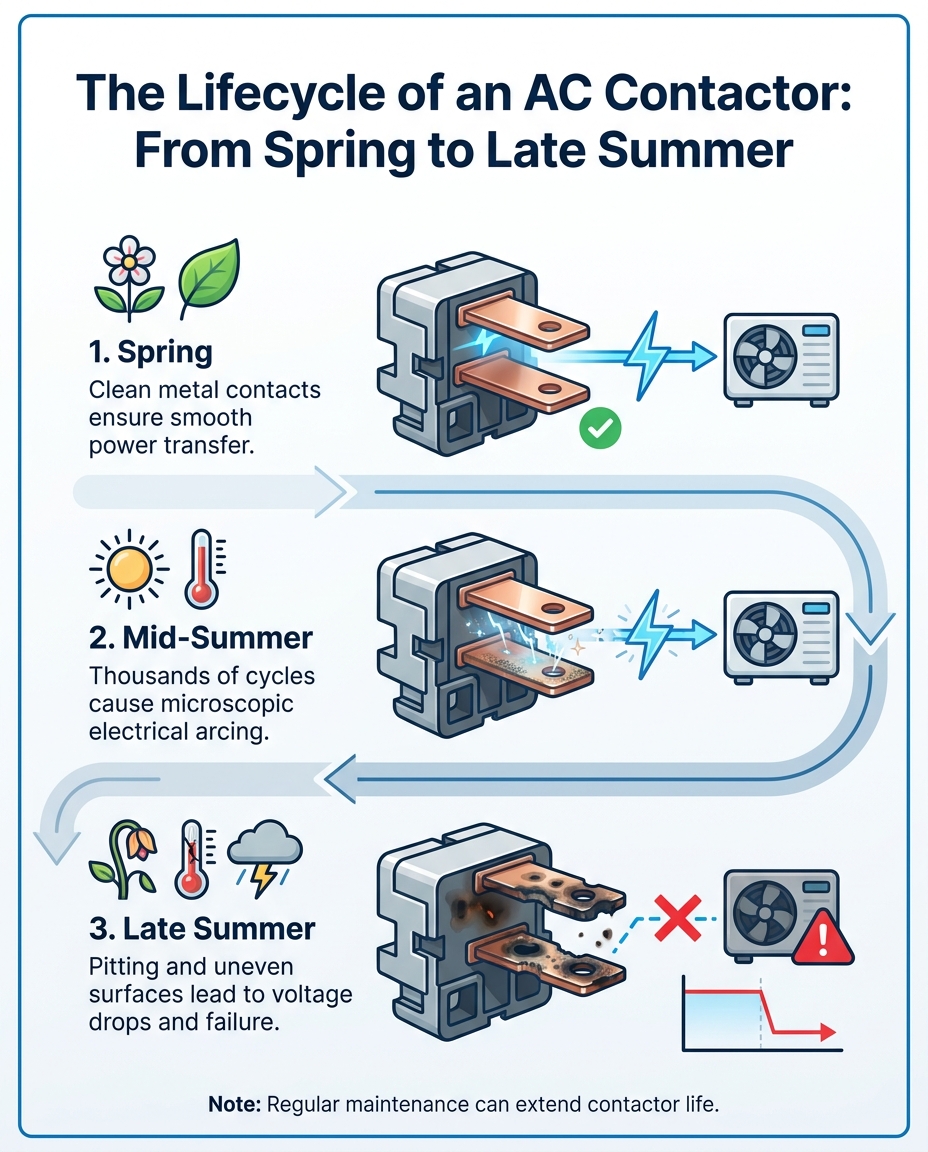
Because this component handles such heavy electrical loads every single time the system turns on, it is highly susceptible to wear over time. The primary enemy of this switch is high-voltage electrical arcing and pitted metal contacts. Every time those metal plates slam together or pull apart under high voltage, they take a tiny amount of damage. Over months of operation, this microscopic damage accumulates, turning a smooth electrical connection into a jagged, unreliable barrier.
The Mechanics of Cumulative Wear: Why August?
The problem: Many homeowners are caught off guard when their air conditioner runs perfectly in June and July, only to fail completely in late August. The timing feels arbitrary, but it is entirely predictable based on mechanical and electrical stress.
The cause: By the time the August late-summer cooling season arrives, an AC unit has typically completed thousands of cycles since the beginning of the year. In our experience serving Taylorsville and the surrounding communities, the team at 3D Heating and Cooling knows firsthand how Kentucky's sustained high heat and humidity require frequent AC cycling to manage latent heat in the air. Your system isn't just lowering the temperature; it is actively pulling gallons of moisture out of the indoor air. This heavy dehumidification demand drastically increases the number of times the contactor must engage and disengage compared to milder, drier climates.
Every single time the system turns on and off, the contactor takes a hit. This continuous mechanical and electrical repetition causes cumulative stress that peaks just as the season draws to a close. This predictable wear pattern is similar to other electrical components, which explains why AC capacitors fail in late August as well. Both components simply reach the end of their tolerance for continuous thermal and electrical strain.
The solution: Recognizing that August breakdowns are a symptom of season-long wear helps you shift from a reactive mindset to a proactive one. Understanding the sheer volume of work your system performs highlights the necessity of end-of-season checkups and professional electrical testing before the component fails entirely.
Pitting and Arcing: The Physics Behind the Breakdown
The actual failure of a contactor comes down to the aggressive physics of high-voltage electricity. It is not just a matter of a part getting old; it is a matter of microscopic destruction happening cycle after cycle.
1. The Electrical Jump: When the metal contacts begin to pull together or pull apart, the 240-volt current doesn't wait for them to touch. The high voltage briefly jumps the tiny air gap, creating a microscopic electrical arc—essentially a miniature lightning bolt.
2. Vaporization of Metal: This intense heat from the arc vaporizes minuscule amounts of metal from the surface of the contacts with every single cycle.
3. The Formation of Pitting: Over months of operation, this repeated vaporization leaves the once-smooth metal surfaces uneven, blackened, and severely pitted. High-voltage electrical arcing and pitted metal contacts are the direct result of thousands of these tiny explosions.
4. Total Connection Failure: Eventually, the pitted surfaces become so jagged and coated in carbon buildup that they can no longer conduct electricity efficiently. The current struggles to cross the gap, causing the system to stutter, hum, or fail completely.
Smooth vs. Pitted Contacts: What Changes?
• New / Smooth — Electrical Flow: Clean, uninterrupted 240V transfer — Impact on Compressor: Starts smoothly, runs at optimal temperature
• Mildly Worn — Electrical Flow: Slight resistance, minor voltage drop — Impact on Compressor: Works slightly harder, draws more amperage
• Severely Pitted — Electrical Flow: Blocked or highly erratic voltage — Impact on Compressor: Risk of overheating, stalling, or permanent damage

An Unexpected Threat: Pest Infiltration in Electrical Panels
While high-voltage electrical arcing and pitted metal contacts are the primary cause of failure, our field technicians at 3D Heating and Cooling frequently discover another surprising culprit out on service calls during the August late-summer cooling season: bugs. The outdoor condenser cabinet is a warm, sheltered environment, making it highly attractive to local pests.
Electrical arcing generates a small amount of heat, and the electromagnetic coil produces a low-frequency hum. This combination of warmth and vibration acts as a magnet for certain pests, particularly ants, earwigs, and sometimes spiders. During late summer, as outdoor food sources shift and temperatures peak, insects often seek shelter inside the outdoor electrical panel.
The danger occurs when these pests crawl between the open contacts while the system is off. When the thermostat calls for cooling, the heavy metal plates slam shut, instantly crushing the insects. Because biological debris is not conductive, the crushed bugs act as a physical insulator between the metal plates. This prevents the high-voltage electricity from flowing, resulting in an unresponsive unit despite a perfectly functioning thermostat. The system tries to turn on, but the power is blocked by a literal bug in the system.
Recognizing the Symptoms Before a Total System Failure
Catching a failing contactor before it completely burns out can save your compressor from severe electrical damage. Because this component degrades over time, our team typically sees it give off warning signs before a total failure during the August late-summer cooling season. Knowing what to listen for is key.
• A loud, continuous humming or buzzing sound: This noise comes from the outdoor unit when the AC is supposed to be running. It usually means the electromagnetic coil is energized, but the contacts are stuck or blocked from closing fully.
• A rapid clicking noise: Often called "chattering," this happens when the contactor is struggling to stay engaged. The magnet rapidly pulls and releases the contacts, creating a fast electrical click.
• The condenser fan runs, but the compressor does not: If only half the system is turning on, the contactor may be sending voltage to the fan motor but failing to pass voltage to the compressor (or vice versa).
• The system refuses to shut off: In rare cases, high-voltage electrical arcing and pitted metal contacts can actually weld the metal plates together. When this happens, the compressor will continue running even after the indoor thermostat has turned off, which can freeze the indoor coil.
Noticing these symptoms early can prevent further damage to the compressor. If you hear loud humming or rapid clicking, we strongly advise turning the system off at the thermostat and securing prompt Louisville cooling services from our experienced team to protect the larger, far more expensive parts of your AC.
Why High-Voltage Components Demand Professional Diagnosis
The problem: When an AC unit stops working, it is tempting to look for a quick fix. However, because the contactor manages 220 to 240 volts of electricity, attempting to inspect, clean, or replace it without proper training poses a severe and immediate electrocution risk.
The cause: The damage caused by high-voltage electrical arcing and pitted metal contacts cannot be repaired with a wire brush or sandpaper. Filing or cleaning pitted contacts removes the thin protective coating applied at the factory and alters the precise physical gap required for safe operation. A "cleaned" contactor is highly likely to stick, weld itself shut, or cause a severe voltage drop that overheats the compressor.
The solution: Fast, reliable professional diagnosis for high-voltage components is necessary to restore comfort safely and efficiently. A professional technician has the specialized multimeters required to safely measure voltage drops across the switch while it is energized. They can visually inspect the severity of the pitting and verify whether the coil is receiving the correct 24-volt signal from the house.
Replacing a damaged contactor completely restores the clean electrical flow necessary to protect the system's most expensive component: the compressor. Furthermore, routine electrical inspections through a preventative maintenance plan can identify early signs of arcing and pitting in the spring, allowing for a safe replacement long before it leads to an abrupt August breakdown.
Frequently Asked Questions About AC Contactors
What happens when an AC contactor goes bad?
The outdoor unit will lose the ability to turn on the compressor, the fan, or both. Because the contactor is the main power gateway, a failure means the high-voltage electricity cannot reach the components that actually cool the air. The system may hum loudly, chatter, or fail to respond to the indoor thermostat entirely.
Is a humming AC unit a sign of a bad contactor?
Yes, a loud buzzing or continuous humming often indicates the electromagnetic coil is receiving power from the thermostat, but the contacts are stuck or failing to close properly. This sound means the system is trying to start but is physically or electrically blocked. You should turn the system off immediately to prevent overheating the coil.
Can a bad contactor damage the compressor?
Absolutely. If a contactor provides uneven or insufficient voltage due to severe pitting, the compressor can overheat or sustain permanent electrical damage. The compressor relies on a full, clean delivery of 240 volts; anything less forces the motor to draw excessive amperage, which degrades the compressor's internal windings over time.
Why did my AC suddenly stop working in August?
Months of continuous summer cycling cause cumulative wear on electrical switches, leading to abrupt failures at the end of the season. By August, the contactor has engaged thousands of times, and the accumulated electrical arcing finally degrades the metal surfaces to the point of failure. It is the peak of mechanical exhaustion for the system.
Can I clean the pitted contacts myself?
No. Filing or cleaning pitted contacts removes the protective coating and alters the precise gap required for safe operation. Altering this gap can cause the contacts to weld shut, running the compressor continuously until it destroys itself. High-voltage components must always be professionally replaced, never repaired.
Restoring Safe and Reliable Cooling to Your Home
An unresponsive AC during the August late-summer cooling season is deeply frustrating, but it is often a straightforward, albeit high-voltage, electrical fix. understanding the role of your AC's contactor in late summer breakdowns helps you make informed decisions about your system's health and longevity. The cumulative wear of the season takes a heavy toll on these electrical gateways. If you notice humming, clicking, or a complete loss of cooling, professional diagnosis is the safest and most effective next step. By relying on expert electrical testing, you ensure your system gets exactly what it needs to safely restore your home's comfort.
Financing

Now Offering Financing Options with Affordable Monthly Payments
where we operate
Service Areas
Proudly serving Spencer county, Jefferson county, Bullitt county, and the surrounding areas

Short Heading Goes Here
Sed iaculis aenean sit sed risus arcu vitae integer elit.

