

.svg)


.avif)



5 min read
Variable-Speed vs. Single-Stage ACs for Managing Late Summer Humidity
Why Your Home Feels Clammy Even When the AC is Running
Are you weighing the pros and cons of Variable-Speed vs. Single-Stage ACs for Managing Late Summer Humidity because your living room feels damp, even though the system is running? Is your thermostat telling you the house is perfectly cool, yet your skin feels sticky? You are not alone. At 3D Heating and Cooling, we field countless calls from Taylorsville homeowners frustrated by a clammy indoor feel even when the thermostat reads 72°F. This disconnect between the temperature on the wall and the comfort you actually feel often traces back to how your specific air conditioning technology handles moisture.
For reliable guidance on your HVAC systems, understanding the mechanics behind this problem is the first step toward true comfort. In our years of servicing local homes, we've found the issue usually stems from a phenomenon called short-cycling, where an air conditioner cools the air too rapidly without taking the time to extract the airborne moisture. Upgrading a struggling single-stage unit to a variable-speed system is a major decision point for homeowners trying to solve persistent indoor humidity issues. To make the right choice, you need to understand exactly how different cooling technologies process both heat and moisture.
The Late August Climate Shift: Temperature vs. Humidity
As the back-to-school season approaches, the weather patterns begin to change. During the late August muggy transition, daytime temperatures might dip slightly from their July peaks, but the dew points remain uncomfortably high. This specific climate shift exposes the hidden limitations of older, less sophisticated cooling systems in Taylorsville and surrounding Kentuckiana area homes. We see this pattern every year: systems that performed perfectly in July suddenly struggle to keep the house dry in late summer.
To understand why this happens, we have to look at the two different types of cooling your air conditioner performs:
• Sensible Cooling: This is the process of lowering the actual temperature of the air. When your thermostat drops from 78°F to 72°F, that is sensible cooling.
• Latent Cooling: This is the process of removing moisture from the air. Lowering the relative humidity from 65% to 45% is latent cooling, and it is what makes a home feel crisp and comfortable.
During peak summer heat, your air conditioner runs for long, uninterrupted cycles to combat the high outdoor temperatures. These long cycles naturally provide excellent latent cooling. However, when the sensible heat (temperature) drops in late summer but the latent heat (humidity) stays high, the system doesn't need to run very long to hit the target temperature. It shuts off quickly, leaving the heavy moisture lingering in the air. Whether you live in a historic neighborhood or a newly built subdivision near Louisville, KY, our team knows firsthand that this seasonal shift proves temperature is not the only metric for indoor comfort.
How Single-Stage ACs Handle (and Mishandle) Moisture
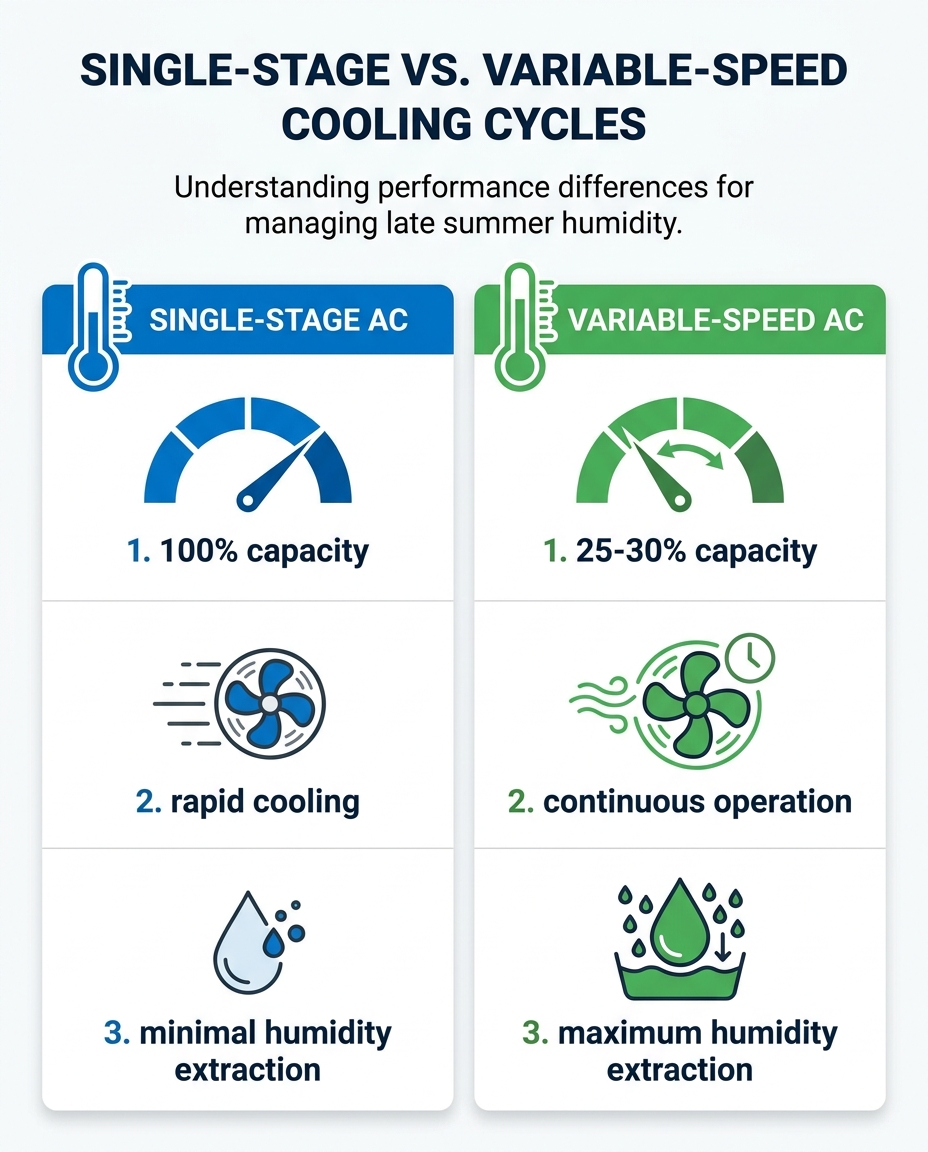
To understand why your house feels like a swamp in late August, you have to look at the operational mechanics of standard cooling equipment. When evaluating service calls across the region, we frequently encounter standard single-stage air conditioners operating at a strict 100% capacity. They have exactly two settings: completely on or completely off. There is no middle ground, no low gear, and no ability to adjust output based on the specific demands of the day.
When a single-stage system kicks on, it blasts cold air at full force. On a moderately warm but highly humid day, this full-blast operation quickly drops the indoor temperature. The thermostat registers that the target temperature has been reached and promptly shuts the system down. The problem? The evaporator coil inside your ductwork needs sustained airflow over a long period to effectively wring moisture out of the air. By shutting down so quickly, the system fails to extract adequate humidity, leading directly to that clammy indoor feel even when the thermostat reads 72°F. If you want to dive deeper into this mechanical limitation, understanding how peak humidity impacts dehumidification limits can shed light on why standard systems struggle.
The Problem with Short-Cycling
This rapid on-and-off pattern is known as short-cycling. In the context of dehumidification, short-cycling is the enemy of comfort. Because the system never runs long enough to pull significant moisture from the air, the relative humidity inside your home continues to climb even as the temperature drops.
Beyond leaving you feeling sticky and uncomfortable, short-cycling is incredibly hard on your equipment. From our perspective as HVAC professionals, we see constantly turning on and off accelerate wear and tear on the compressor, the capacitor, and the contactor. It also spikes your energy consumption, as the system requires a massive surge of electricity every time it re-starts.
The Variable-Speed Advantage for Continuous Dehumidification
This is why we strongly recommend variable-speed technology—it completely changes the way a home is cooled and dehumidified. Unlike a single-stage unit that only knows how to run at full blast, a variable-speed compressor can adjust its output in tiny increments. Depending on the model, these systems can operate at capacities as low as 25% or 30%, ramping up only when the outdoor heat load demands it.
The "Low and Slow" Strategy:
By running continuously at a lower speed, a variable-speed system constantly pulls indoor air over the cold evaporator coil. This low-and-slow operation is the secret to maximum moisture extraction. Because the system isn't blasting freezing air into the room, it avoids overcooling the space. Instead, it runs for hours at a time at a gentle hum, steadily wringing water out of the air and draining it away. This continuous operation aggressively tackles latent heat, completely eliminating the damp, sticky feeling associated with the late August muggy transition.
The benefits extend far beyond humidity control. Because the system runs almost continuously at low speeds, the air in your home is constantly being filtered. This constant circulation significantly improves your indoor air quality by trapping more dust, dander, and allergens in the filter. Additionally, variable-speed units are remarkably quiet. You won't hear the loud, disruptive "clunk" of the compressor kicking on or feel a sudden blast of cold air from the vents—just a steady, silent delivery of crisp, dry air.
Side-by-Side Comparison: Single-Stage vs. Variable-Speed Systems
Choosing the right equipment requires looking at the facts side-by-side. When evaluating these two technologies specifically for their performance during the late August muggy transition, the differences in operational philosophy become very clear to our technicians. The table below breaks down how each system handles the specific challenges of moderate temperatures and high moisture.
• Moisture Removal (Dehumidification) — Single-Stage Air Conditioners: Intermittent and limited. Short cooling cycles leave heavy moisture behind in the air. — Variable-Speed Air Conditioners: Continuous and aggressive. Long, low-speed cycles extract maximum moisture from the air.
• Energy Consumption Profile — Single-Stage Air Conditioners: High operational spikes. Frequent on/off cycling requires massive energy surges at startup. — Variable-Speed Air Conditioners: Highly efficient. Running continuously at 30% capacity uses far less power than constant restarts.
• Temperature Consistency — Single-Stage Air Conditioners: Noticeable temperature swings. Rooms often feel too cold while running, then stuffy when off. — Variable-Speed Air Conditioners: Precise consistency. Maintains the target temperature within half a degree at all times.
• Short-Cycling Risk — Single-Stage Air Conditioners: High risk during moderate-temperature, high-humidity late summer days. — Variable-Speed Air Conditioners: Virtually eliminated. The system adjusts its output to match the exact load required.
While single-stage systems have been the standard for decades, their limitations are heavily exposed during seasonal transitions. Variable-speed technology was specifically engineered to solve the exact comfort problems outlined in the comparison above.

Why Proper Sizing Matters More Than Just Technology
A common misconception we hear among homeowners is that upgrading to a "bigger" air conditioner will automatically solve their cooling and humidity problems. In reality, an oversized air conditioner is the worst possible scenario for indoor comfort. Even if you purchase the most advanced, high-efficiency unit on the market, it will still fail to dehumidify your home if it is too large for the space.
An oversized unit cools the air so rapidly that it short-cycles regardless of the weather. It will blast the home with cold air, satisfy the thermostat in ten minutes, and shut down before a single drop of condensation has formed on the evaporator coil. To truly resolve humidity issues, the equipment must be perfectly sized to match the exact thermal dynamics of your home.
This is where professional load calculations come into play. A proper Manual J load calculation takes into account your home's square footage, ceiling height, insulation levels, window quality, and orientation to the sun. At 3D Heating and Cooling, our team relies on deep local expertise to correctly size and match AC technology to handle Kentucky's specific late-summer humidity challenges. We ensure that Taylorsville and surrounding Kentuckiana area homes receive equipment that is perfectly calibrated to run long enough to dehumidify, without wasting energy. Proper sizing is the foundation of all effective air conditioning solutions.
Frequently Asked Questions About AC and Humidity Control
Why does my house feel clammy when the AC is on?
Your house feels clammy because your AC is cooling the air too quickly without running long enough to remove the moisture. This often happens with single-stage units that short-cycle during moderate weather. The thermostat registers the correct temperature and shuts the system off, but the heavy humidity remains trapped indoors, resulting in a damp, sticky sensation.
Does variable speed AC remove more humidity?
Yes, variable-speed air conditioners remove significantly more humidity than standard units. Because they can operate at lower capacities (often down to 25%), they run for much longer periods without overcooling the house. This constant, low-speed airflow over the cold evaporator coil extracts massive amounts of moisture from the indoor air.
Is a variable speed AC worth the upgrade?
A variable-speed AC is highly worth the upgrade if you struggle with indoor humidity, uneven temperatures, or high energy bills. While the initial investment is different from a standard unit, the profound increase in daily comfort and the reduction in long-term energy usage make it the premier choice for homes in humid climates.
How does a single stage AC work?
A single-stage AC operates at one speed: 100% capacity. When the thermostat calls for cooling, the system turns on at full blast until the target temperature is reached, and then it shuts completely off. It does not have the ability to adjust its output to match milder weather conditions, which often leads to rapid on-and-off cycling.
Can I fix short-cycling without replacing my whole system?
Sometimes short-cycling can be fixed by addressing dirty air filters, frozen evaporator coils, or faulty thermostats. A severely clogged filter can restrict airflow and cause the system to shut down prematurely to protect itself. However, if your system is short-cycling simply because it is oversized or outdated, replacing the equipment may be the only permanent solution for humidity control.
Take Control of Your Late Summer Comfort
You don't have to settle for an uncomfortable, damp home during the late August muggy transition. A clear understanding of how variable-speed technology prevents short-cycling and actively dehumidifies can help you make an informed decision about your home's comfort. By moving away from the limitations of single-stage units, you can achieve a crisp, perfectly balanced indoor environment. If you are tired of feeling sticky in your own living room, reach out to our experts at 3D Heating and Cooling to schedule a professional assessment and find out if a variable-speed system is the right fit for your home.
Financing

Now Offering Financing Options with Affordable Monthly Payments
where we operate
Service Areas
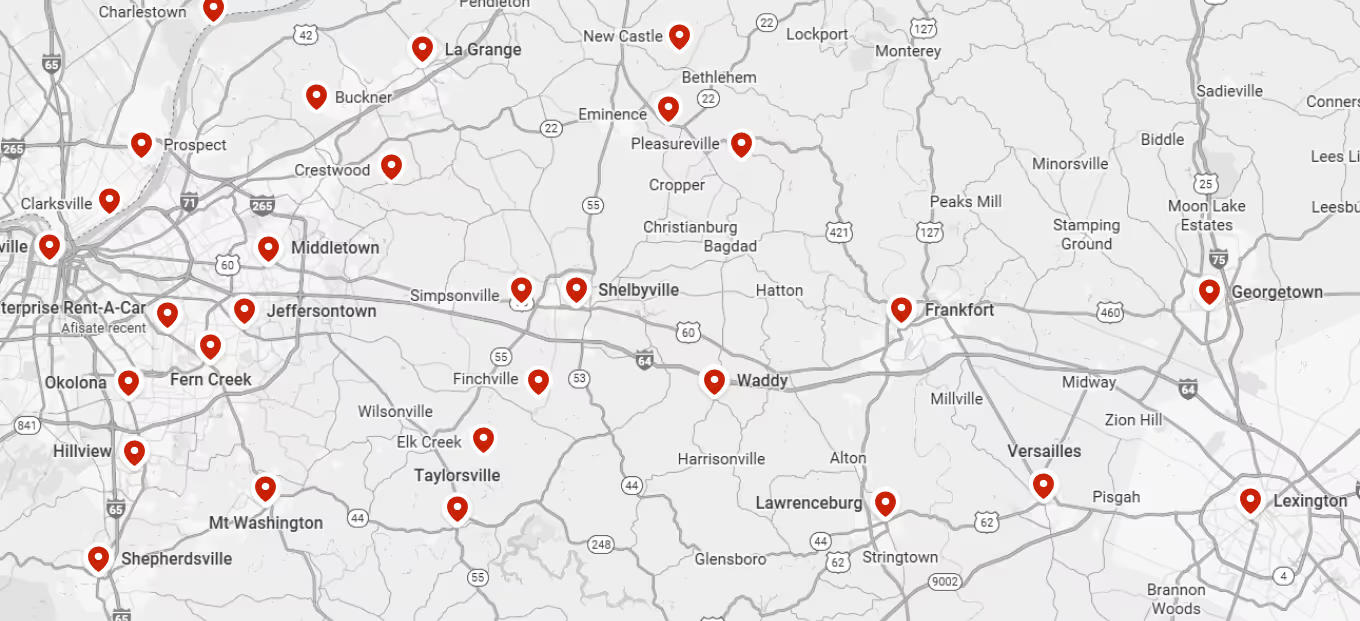
Proudly serving Spencer county, Jefferson county, Bullitt county, and the surrounding areas
Short Heading Goes Here
Sed iaculis aenean sit sed risus arcu vitae integer elit.

