

.svg)


.avif)



5 min read
Why Your Taylorsville, KY Home Feels Stuffy Even When the AC is Running
Diagnosing a Stuffy Home While the AC Runs
You hear the familiar hum of the blower motor and feel cold air coming out of the vents, but you are still left wondering why your Taylorsville home feels stuffy even when the AC is running constantly. You keep lowering the thermostat, hoping for relief, yet that heavy, clammy feeling just hangs in the air. In our years of serving Taylorsville homeowners, we have found this to be an incredibly common and frustrating problem during the peak summer cooling season.
Here is the thing: lowering the temperature on your thermostat only addresses half of your indoor comfort. During peak heat, proper dehumidification is just as important as dropping the temperature. If your air conditioner runs all day but the house still feels like a swamp, your system is failing to remove moisture from the air.
Identifying the root cause of this stuffiness is your next critical step. The problem usually boils down to a mechanical failure, poor ductwork, or an oversized unit that cools the space too rapidly. Because these airflow and sizing issues are largely invisible, diagnosing them often requires professional HVAC services to evaluate the entire system. Understanding how your equipment actually handles humidity will help you determine the right path forward to restore true comfort to your living space.
Sensible vs. Latent Heat: How Your AC Dehumidifies
To understand why your house feels humid, you need to look at how an air conditioner actually operates. An AC unit does not just blow cold air into a room; it actively removes heat and moisture. In the HVAC world, we break this down into two distinct categories: sensible heat and latent heat.
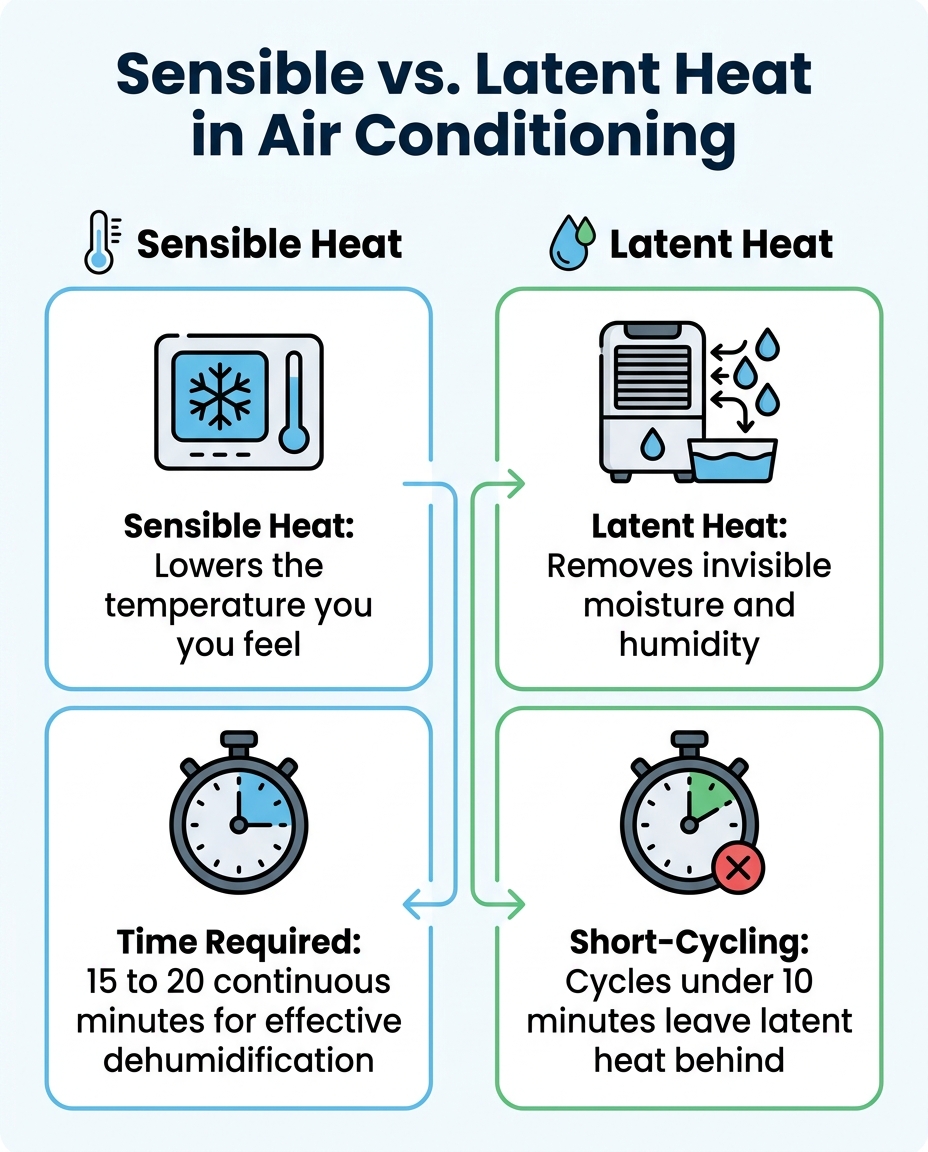
Sensible heat is the actual temperature drop you feel and read on your thermostat. Latent heat refers to the invisible moisture and humidity suspended in the air. As local experts, our team knows firsthand that Kentucky summers are highly humid, which means latent heat removal is often the most critical function of an HVAC system during peak heat in Taylorsville.
Here is a breakdown of how these two types of heat impact your comfort:
• Sensible Heat — What It Affects: Air temperature — How You Notice It: The room feels physically hot or cold. — HVAC Action Required: Lowering the air temperature quickly.
• Latent Heat — What It Affects: Air moisture (humidity) — How You Notice It: The room feels sticky, clammy, or stuffy. — HVAC Action Required: Extracting moisture over a longer cycle.
The mechanical process of removing latent heat relies on your indoor evaporator coil. As warm, humid indoor air passes over this freezing-cold coil, the moisture in the air condenses into water droplets—much like water beading on the outside of a cold glass of iced tea. That condensation then drips into a drain pan and flows safely out of your home.
The 20-Minute Dehumidification Rule
The catch is that this condensation process takes time. According to ASHRAE guidelines on indoor humidity control, an air conditioner typically needs to run for 15 to 20 continuous minutes to effectively extract latent heat from the indoor air. We typically see that the first 5 to 10 minutes of a cooling cycle are mostly dedicated to lowering the sensible heat. If the system shuts off before hitting that 20-minute mark, the sensible heat drops, but the latent heat remains untouched. The result is a cold, clammy, and highly uncomfortable environment.
The Culprit Behind Short-Cycling and Oversized Units
If your system needs 20 minutes to remove humidity, what happens when it only runs for eight minutes at a time? This rapid on-and-off behavior is known as short-cycling, and it is a primary reason homes feel stuffy during the summer cooling season.
Most homeowners assume that a larger, more powerful air conditioner will provide better cooling. The counterintuitive reality is that an oversized AC unit is deeply detrimental to your indoor comfort. An oversized system pumps out a massive volume of cold air, dropping the sensible temperature in the house very quickly. Because the thermostat registers that the target temperature has been reached, it shuts the system down prematurely.
This rapid cooling cycle completely bypasses the dehumidification process. The system simply does not run long enough for the moisture to condense on the evaporator coil. You are left with a house that is 70 degrees but holding 65% humidity.
Signs your unit might be oversized:
• Rapid cycles: The system turns on, blasts cold air, and turns off in under 10 minutes.
• High humidity: The air feels heavy and damp, even when the temperature is low.
• Uneven temperatures: Some rooms are freezing while others remain warm.
• Loud operation: A massive blower motor forces too much air through standard-sized ducts.
Solving this requires proper unit sizing. At 3D Heating and Cooling, a pattern we see often is homes struggling with oversized equipment installed without proper calculations. That is why our team leverages strict Manual J calculations to ensure every system we install is perfectly sized for Kentucky's unique humidity and weather challenges. A properly sized unit will run in longer, steady, energy-efficient cycles that thoroughly wring the moisture out of your indoor air.
Airflow Restrictions and Evaporator Coil Issues
Even if your system is perfectly sized, restricted airflow will completely disrupt the dehumidification process. Your air conditioner needs a specific, consistent volume of air moving across the indoor components to function correctly.
When airflow is choked off, the system cannot capture enough indoor humidity to make a difference in your Taylorsville home. When our technicians are called out to investigate a stuffy house, here is the step-by-step chain reaction we frequently uncover:
1. The return vents pull in warm air: Your system relies on return ducts to pull humid air from your living spaces into the HVAC unit.
2. A dirty filter blocks the path: If your air filter is severely clogged with dust and pet hair, it acts like a wall. The blower motor struggles to pull enough air through the filter, drastically slowing down the air circulation in the house.
3. The evaporator coil starves for heat: The evaporator coil needs a constant flow of warm, unconditioned air to keep it from freezing. When airflow slows down, the coil gets too cold.
4. Dirt insulates the coil: If dust bypasses the filter and coats the wet evaporator coil, it creates a layer of insulation. This grime physically blocks the warm air from touching the cold metal, stopping the transfer of latent heat entirely.
5. The coil freezes over: Eventually, the restricted airflow and dirty components cause the condensation on the coil to freeze into a solid block of ice, shutting down the cooling process completely.
Proactive maintenance is the only way to prevent this chain reaction. Regularly changing your air filters and scheduling professional service for cleaning your AC coils ensures the system can breathe properly and extract moisture at peak efficiency.
Leaky Ductwork Pulling in Unconditioned Air
Sometimes the mechanical equipment is working perfectly, but the distribution system is sabotaging your comfort. Your ductwork is the delivery network for conditioned air, but it can also be a massive source of unwanted humidity if it is damaged.
Your residential HVAC system operates on the principle of pressure. The supply ducts blow conditioned air out (positive pressure), while the return ducts pull stagnant air back in (negative pressure). This negative pressure is where the danger lies during the summer cooling season.
If there are leaks, tears, or disconnected joints in your return ductwork, that negative pressure acts like a vacuum cleaner. In our experience crawling through local attics and crawlspaces, we frequently see these disconnected ducts running through unconditioned spaces—like a sweltering attic, a humid crawlspace, or a hot garage—actively sucking highly humid, 100-degree air straight into the HVAC system.
This constant influx of outside moisture forces the air conditioner to battle a continuous latent heat load. No matter how well the AC runs, it simply cannot dehumidify the air faster than the leaky ducts are pulling new moisture in.
Common signs of severe duct leakage include:
• Excessive dust: Unfiltered air from the attic or crawlspace is being blown directly into your living areas.
• High utility bills: The system runs longer and harder trying to cool outside air.
• Persistent stuffiness: The indoor humidity never drops, regardless of how long the AC runs.
• Hot spots: Certain rooms never seem to get enough airflow.
Evaluating Your Home's Insulation and Thermal Envelope
Beyond the HVAC equipment and ductwork, the physical structure of your Taylorsville home plays a massive role in indoor humidity. We refer to the physical barrier between your conditioned indoor air and the unconditioned outdoor air as the thermal envelope.
A strong thermal envelope keeps cool, dry air inside and hot, humid air outside. When this envelope is compromised, exterior humidity seeps indoors continuously. Moisture naturally moves from areas of high concentration (the humid outdoors) to areas of low concentration (your air-conditioned living room).
Weak points in a thermal envelope include:
• Degraded weatherstripping: Worn seals around exterior doors allow humid air to draft inside constantly.
• Poor attic insulation: Heat and moisture from the roof radiate down through the ceiling if insulation is too thin or compacted.
• Drafty windows: Single-pane glass or failing window caulking provides zero resistance to outdoor humidity.
• Unsealed penetrations: Gaps around plumbing pipes, electrical outlets, and dryer vents act as open highways for outside air.
Even a perfectly sized, well-maintained air conditioner will struggle to dehumidify a home with a heavily compromised thermal envelope. Our team highly recommends taking the time to assess your insulation levels, apply fresh weatherstripping, and seal common air leaks, which will drastically reduce the latent heat load your AC has to handle.
Frequently Asked Questions About AC Dehumidification
Financing

Now Offering Financing Options with Affordable Monthly Payments
where we operate
Service Areas
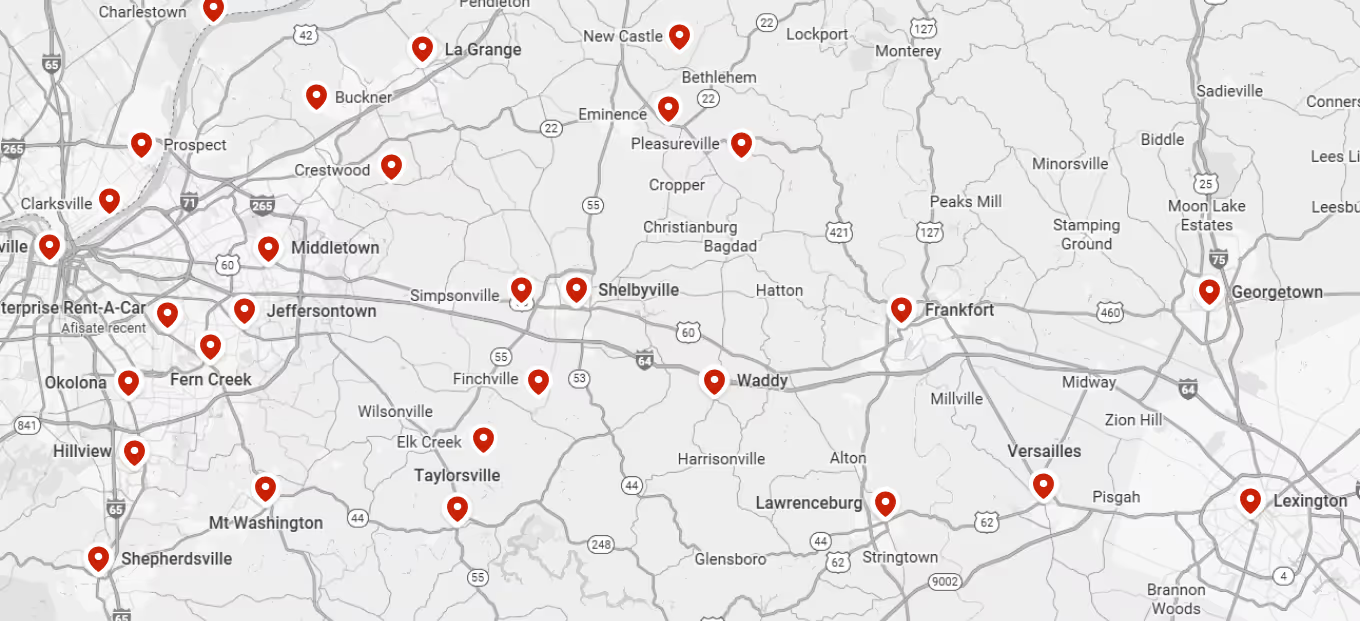
Proudly serving Spencer county, Jefferson county, Bullitt county, and the surrounding areas
Short Heading Goes Here
Sed iaculis aenean sit sed risus arcu vitae integer elit.

