

.svg)


.avif)



5 min read
How Crestwood and Taylorsville Homes With Older Ductwork Handle Modern High-Efficiency ACs
The Hidden Clash Between Modern Cooling Tech and Legacy Infrastructure
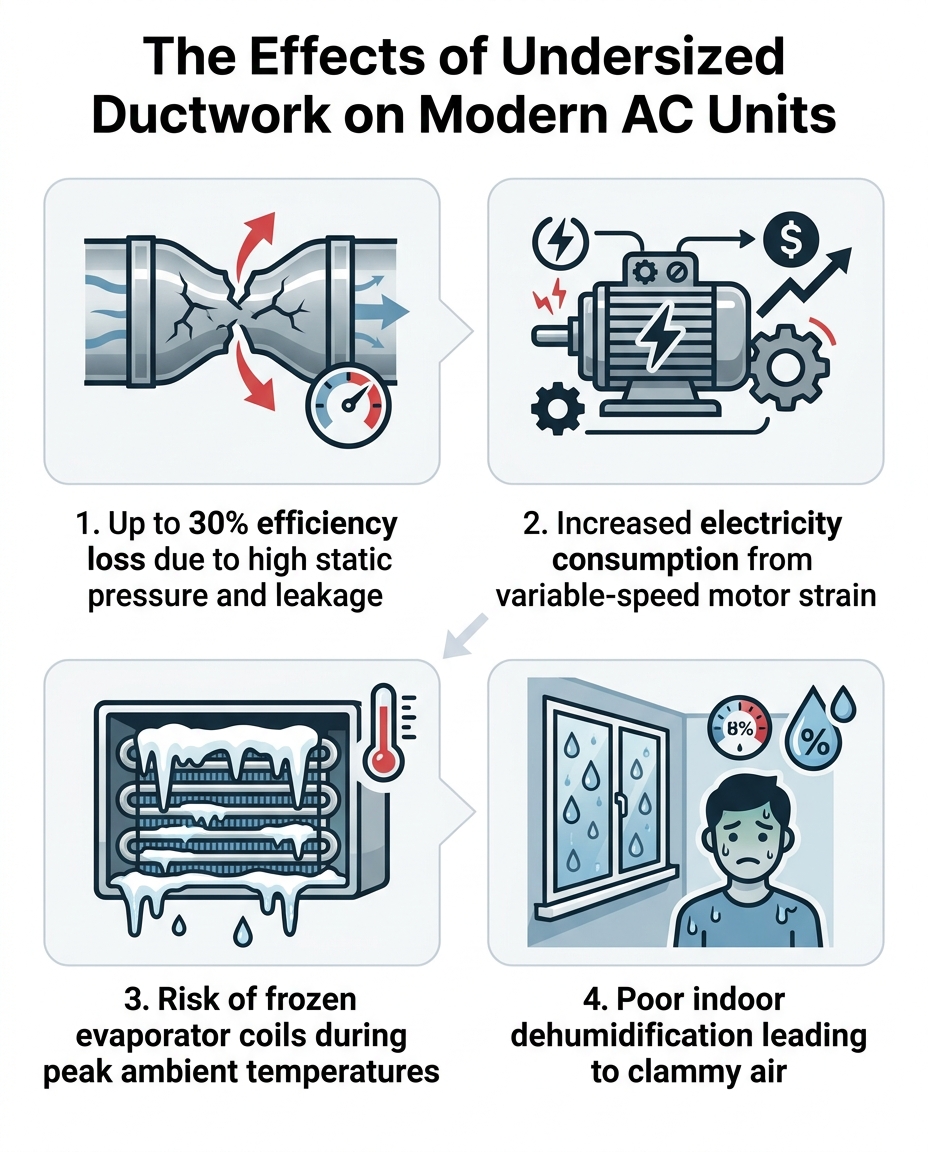
When considering exactly how Crestwood and Taylorsville homes with older ductwork handle modern high-efficiency ACs, a surprising statistic stands out to our team at 3D Heating and Cooling: high static pressure and duct leakage can reduce overall HVAC system efficiency by up to 30 percent. If you are preparing to upgrade the cooling system in a historic or mid-century property, you are likely anticipating lower utility bills, quieter operation, and significantly better indoor comfort. However, we often see that simply attaching advanced cooling technology to an aging, undersized ventilation system creates a severe mechanical conflict.
In our experience, the core problem lies in airflow restriction. Modern high-airflow variable-speed AC units are engineered to push precise volumes of conditioned air throughout your living spaces. When these powerful systems are retrofitted onto legacy ducts that were originally sized for much weaker, single-stage equipment from decades past, the resulting pressure buildup can severely damage the new equipment. It is similar to trying to force a fire hose volume of water through a standard garden hose.
As a homeowner, you face a critical decision point. You must choose between having a professional evaluate and modify your existing ductwork to match the new equipment's requirements, or skipping that step and risking catastrophic system failure during severe summer heat. Taking the time to properly assess the infrastructure ensures that your investment in air conditioning solutions actually delivers the performance and efficiency you expect, rather than creating a new set of mechanical headaches.
Why Variable-Speed Blowers Struggle Against Restrictive Spaces
To understand why new air conditioners frequently clash with older homes, you need to look at the physics of airflow. When our technicians inspect older homes in Crestwood and Taylorsville, we often find ductwork layouts designed in an era when HVAC systems required far less air volume to function. Today's advanced systems rely on variable-speed blowers, which are intelligent motors designed to adjust their speed incrementally to maintain exact indoor temperatures.
When a variable-speed blower detects resistance in the ductwork, its programming tells it to ramp up its revolutions per minute (RPMs) to overcome the blockage and deliver the requested air. In an undersized duct system, this resistance is constant. The motor works harder and harder, drawing excessive electricity and generating significant heat, all while struggling to push air through spaces that are simply too small. This constant strain leads to increased operational noise, whistling return vents, and excessive, premature wear on the blower motor itself. If you are looking for reliable HVAC services in Crestwood, ensuring your ductwork can handle this advanced technology is a mandatory first step.
The Mechanics of High Static Pressure
In the HVAC industry, the resistance to airflow within a duct system is known as static pressure. You can think of static pressure as the friction the air encounters as it travels from the indoor unit, through the supply ducts, into your rooms, and back through the return ducts.
Legacy systems were built for lower-SEER (Seasonal Energy Efficiency Ratio), single-stage equipment. These older units pushed a lower volume of air at a constant, predictable rate. Modern systems require much larger volumes of air to achieve their high efficiency ratings.
• Airflow Volume — Legacy Single-Stage AC: Lower, constant volume — Modern Variable-Speed AC: High volume, dynamically adjusting
• Duct Size Requirement — Legacy Single-Stage AC: Smaller diameter acceptable — Modern Variable-Speed AC: Larger diameter mandatory for optimal flow
• Response to Restriction — Legacy Single-Stage AC: Delivers less air, runs poorly — Modern Variable-Speed AC: Increases motor RPMs to force air through
• Wear and Tear — Legacy Single-Stage AC: Gradual component aging — Modern Variable-Speed AC: Rapid motor burnout from high static pressure
Understanding this shift in mechanical requirements explains why a duct system that perfectly served a house in 1985 might be entirely inadequate for a high-efficiency system installed today.

The Threat of Frozen Evaporator Coils During Severe Weather
The consequences of restricted airflow go far beyond noisy vents and higher electrical consumption. During the intense reality of Kentucky's summer climate, high ambient temperatures put maximum load on your cooling system. In our years of providing emergency repairs, we've found this is exactly when airflow restrictions cause the most catastrophic damage, frequently leading to a frozen evaporator coil.
The evaporator coil, located inside your home, is responsible for absorbing heat from your indoor air. Cold liquid refrigerant pumps through this coil, chilling the metal fins. For the system to work correctly, a constant, high volume of warm indoor air must blow across that coil. The warm air transfers its heat to the refrigerant, and the newly cooled air is pushed back into your living spaces.
When undersized ductwork chokes off the return airflow, there is not enough warm air passing over the evaporator coil to keep the process balanced. The refrigerant continues to chill the metal, causing the temperature of the coil to drop below freezing. Condensation naturally forms on the coil during operation, and without the warm air to regulate the temperature, that condensation turns to solid ice. This is a pattern our technicians see often during peak July summer heat.
Warning signs of a freezing evaporator coil include:
• Warm air from vents: The ice block physically prevents cooled air from entering the supply ducts.
• Excessive water around the indoor unit: As the ice eventually melts, it overwhelms the drain pan and spills onto the floor.
• Unusual hissing or bubbling noises: The refrigerant cycle is struggling against the frozen blockage.
• Constant running: The thermostat never reaches the target temperature, so the system runs continuously.
A completely frozen coil will trigger a total system shutdown, leaving your family without cooling exactly when you need it most. Frustratingly, this failure often occurs even if the air conditioning equipment is brand new, simply because the old ductwork cannot support the necessary airflow.
How High Static Pressure Erases Expected Energy Savings
Most homeowners upgrade their cooling systems with the expectation of significantly lower monthly utility bills. However, our installation crews frequently have to explain that high static pressure can completely erase those anticipated energy savings. According to U.S. Department of Energy data, efficiency losses due to poor duct performance are a leading cause of high residential energy consumption.
When you purchase modern high-airflow variable-speed AC units, you are paying for a specific SEER2 (Seasonal Energy Efficiency Ratio) rating. These high-efficiency ratings are calculated in controlled laboratory environments under optimal, unrestricted airflow conditions. When that same highly rated unit is installed onto restrictive, undersized ductwork, it simply cannot operate at its advertised efficiency.
Because the variable-speed motor is forced to consume significantly more electricity to push air through the tight spaces, the electrical draw of the indoor unit skyrockets. Furthermore, the restricted airflow often leads to a destructive cycle known as short-cycling. Short-cycling occurs when the system turns on, quickly cools the small area immediately surrounding the thermostat, and shuts off prematurely. A few minutes later, the house warms up again, and the system restarts. If you are upgrading to modern HVAC systems, you must ensure the ductwork allows for long, smooth cooling cycles to actually capture the energy savings you paid for.
Humidity Control and Indoor Comfort Challenges
Temperature is only one half of the indoor comfort equation; the other half is humidity. Modern air conditioners are designed to dehumidify your home just as much as they cool it. In a region known for notorious summer humidity like Kentucky, long, unrestricted cooling cycles are absolutely mandatory for proper dehumidification.
As warm indoor air passes over the cold evaporator coil, the moisture in the air condenses into water droplets, which then drain away outside. This process takes time. If your system is short-cycling due to undersized ductwork, it never runs long enough to extract a meaningful amount of moisture from the air. The thermostat might read a comfortable 72 degrees, but the high humidity will make the house feel sticky, warm, and distinctly uncomfortable.
When evaluating older homes in Crestwood and Taylorsville that suffer from mismatched ductwork, our team regularly notes clear signs of poor humidity control. This lack of dehumidification also connects directly to broader indoor air quality concerns. When air stagnates and moisture remains high, your home becomes a breeding ground for trapped pollutants and stale air. Addressing the airflow restriction is often the most effective path toward noticeable indoor air quality improvements, as it allows the system to filter and dehumidify the air as the manufacturer intended.
Evaluating Ductwork Capacity Before Installation
Because the risks of high static pressure are so severe, our standard practice includes a professional assessment of your existing ductwork before installing a high-efficiency air conditioner. We believe skipping this step is a disservice to the homeowner and almost guarantees future mechanical failures during peak July summer heat.
A comprehensive evaluation begins with a static pressure test. This diagnostic procedure requires specialized tools, including a digital manometer, to measure the exact resistance within your supply and return ducts while the current system is running. This data provides a clear, mathematical picture of whether your ductwork can handle the increased airflow demands of a modern unit.
Beyond the pressure test, licensed professionals will visually evaluate the ductwork for proper sizing, logical layout, and significant air leakage. If the existing infrastructure is found lacking, several solutions can be implemented before the new AC is installed. These solutions might include aggressive duct sealing, adding larger return air drops to increase the volume of air reaching the unit, or modifying the supply plenum to smooth out the airflow distribution.
Moving Beyond Generic Equipment Swaps
At 3D Heating and Cooling, our team emphasizes a commitment to custom ductwork evaluation and strict static pressure testing prior to any retrofitting project. We contrast this thorough, diagnostic approach with contractors who merely perform generic equipment swaps. Taking an old box out and putting a new box in without checking the underlying infrastructure is a recipe for failure.
Matching a new, high-efficiency unit to old infrastructure requires precision. By ensuring your ductwork is properly sized and sealed, you protect the blower motor from premature burnout, prevent the evaporator coil from freezing, and guarantee that the system can properly dehumidify your home. This level of professional design is what transforms a standard installation into a reliable, long-term HVAC system upgrades that you can trust for decades.
Frequently Asked Questions About Ductwork and High-Efficiency ACs
What happens if ductwork is too small for an AC?
If your ductwork is too small, the system will suffer from high static pressure, severely restricting airflow. This restriction forces the blower motor to work overtime, leading to increased electricity usage and premature mechanical failure. Additionally, the lack of airflow can cause the indoor evaporator coil to freeze solid, which will completely shut down the cooling process.
Can I use old ductwork with a high-efficiency AC?
You can use old ductwork with a new system, but only if a professional verifies that it meets the airflow requirements of the new equipment. Older ducts were often sized for less powerful systems and may require modifications, such as adding return air drops or sealing leaks, to handle the higher volume of air safely.
Why does my new AC freeze up in the summer?
A new AC usually freezes in the summer because undersized or blocked ductwork prevents enough warm indoor air from flowing over the evaporator coil. Without that warm air, the refrigerant makes the coil too cold, turning normal condensation into a solid block of ice. This issue requires immediate professional diagnosis to prevent permanent compressor damage.
How do professionals fix high static pressure in residential HVAC systems?
Professionals fix high static pressure by first measuring the airflow resistance with a digital manometer to pinpoint the exact bottlenecks. Solutions typically involve enlarging the return air drops, modifying the supply plenum for better distribution, adding additional supply vents, or thoroughly sealing the ductwork to prevent air loss.
Does upgrading to a variable-speed AC always require replacing all my ductwork?
No, a full replacement of all ductwork is rarely necessary. In most cases, targeted modifications to specific areas—such as the main return trunk or the connections directly above the indoor unit—are enough to relieve the static pressure and accommodate the variable-speed technology.
Ensuring Reliable Cooling for Your Historic Property
Understanding exactly how Crestwood and Taylorsville homes with older ductwork handle modern high-efficiency ACs is the key to achieving lasting indoor comfort. The technical clash between restrictive legacy infrastructure and the powerful airflow demands of modern high-airflow variable-speed AC units cannot be ignored. By acknowledging the risks of high static pressure, premature motor wear, and frozen evaporator coils, you empower yourself to make informed decisions about your home's infrastructure.
Proper assessment and targeted modifications satisfy the need for both reliable peak-summer performance and genuine energy savings. You do not have to accept poor dehumidification or noisy vents as a normal part of upgrading your home. We strongly encourage you to speak with our licensed professionals to schedule a comprehensive static pressure test and ductwork evaluation, ensuring your next cooling system operates flawlessly for years to come.
Financing

Now Offering Financing Options with Affordable Monthly Payments
where we operate
Service Areas
Proudly serving Spencer county, Jefferson county, Bullitt county, and the surrounding areas
Short Heading Goes Here
Sed iaculis aenean sit sed risus arcu vitae integer elit.

