

.svg)


.avif)



5 min read
When to Switch Your Thermostat from Cool to Heat in Kentucky
The September Thermostat Dilemma in the Ohio Valley
September in the Ohio Valley brings beautiful foliage, but it also delivers some of the most unpredictable weather of the year. Here at 3D Heating and Cooling, we hear from Taylorsville homeowners every September who are wondering exactly when to switch your thermostat from cool to heat in Kentucky—it is one of the most common regional dilemmas our technicians encounter. The arrival of early fall means daytime heat lingers comfortably, but nighttime temperatures turn suddenly chilly. Homeowners often find themselves caught in a frustrating loop, constantly flipping their thermostats back and forth between air conditioning and heating.
Figuring out the exact right time to transition your HVAC system is a critical decision point. In our years of field experience, we have seen how doing it wrong can cause unnecessary wear and tear on your equipment. During these volatile September transition weeks, your home might experience temperature swings from 80s to 50s within a single 24-hour period. Instead of treating your thermostat like a manual light switch, relying on modern programming and strategic settings can keep your home comfortable without stressing your equipment.
If you are looking to prepare your heating systems for the season ahead, our team provides reliable professional heating services to ensure you stay warm when the real cold arrives.
The Hidden Dangers of the Daily Thermostat Tug-of-War
In our experience servicing local HVAC units, we see firsthand what happens when the outdoor temperature swings wildly. Your first instinct might be to turn on the heat before bed and switch back to the AC the next afternoon. While this keeps you temporarily comfortable, this daily manual tug-of-war introduces significant mechanical strain to your HVAC system. Forcing a system to rapidly switch between cooling and heating in the same 24-hour window prevents the internal components from properly resting, equalizing pressure, and resetting for the next cycle.
Our team often responds to early fall service calls where compressor strain is the culprit behind this manual overriding. The compressor in your outdoor unit works under immense pressure to circulate refrigerant. When you abruptly switch modes, the system does not always have adequate time to depressurize. While modern thermostats often have built-in time delays to protect against immediate restarts, constantly changing the temperature demands manually still forces the equipment to work overtime.
Common signs your system is strained by rapid switching:
• Unusual noises: Grinding or hard-starting sounds from the outdoor unit when the system kicks on.
• Uneven temperatures: Rooms that feel stuffy or fail to reach the desired temperature despite the system running.
• Spiking energy usage: Systems that constantly start and stop require significantly more electrical current than those running steady cycles.
Ultimately, strategic programming is much safer and far more efficient than manual daily adjustments.
What is HVAC Short-Cycling?
Normal HVAC cycles are designed to run long enough to condition the air, remove humidity, and distribute the temperature evenly throughout the house before shutting off. We frequently see short-cycling occur when the system turns on and off too rapidly, never completing a full cycle. Erratic temperature demands—like manually dropping the thermostat ten degrees, then bumping it up five degrees an hour later—interrupt these natural cycles.
• Normal Cycle — Cycle Duration: 15 to 20 minutes — Impact on Equipment: Reaches peak efficiency, properly dehumidifies, and minimizes wear on motors.
• Short Cycle — Cycle Duration: Under 10 minutes — Impact on Equipment: Fails to reach peak efficiency, leaves excess humidity, and burns out capacitors.
When short-cycling happens, your system never reaches peak efficiency. The constant starting and stopping draws massive amounts of electricity, leading to higher utility bills and a shortened lifespan for critical components like the blower motor and compressor.
Mastering the Auto-Changeover and Deadband Settings
To safely navigate unpredictable fall weather, the "Auto" setting on your thermostat is your best tool. Instead of manually selecting "Heat" or "Cool," the Auto setting allows the thermostat to automatically switch between the furnace and the air conditioner based on the indoor temperature. However, for this to work without damaging your system, you must understand how to configure the deadband.
The "deadband" is the temperature gap between your cooling setpoint and your heating setpoint. If you set your heat to turn on at 70 degrees and your AC to turn on at 71 degrees, the deadband is too narrow. A passing cloud or a brief burst of sunshine could cause the system to flip frantically back and forth, essentially making the AC and furnace fight each other. As local climate experts for the Ohio Valley, our technicians at 3D Heating and Cooling recommend specific deadband settings for our region's exact temperature swings from 80s to 50s, rather than generic advice that doesn't account for local humidity and rapid fronts.
How to configure a safe deadband:
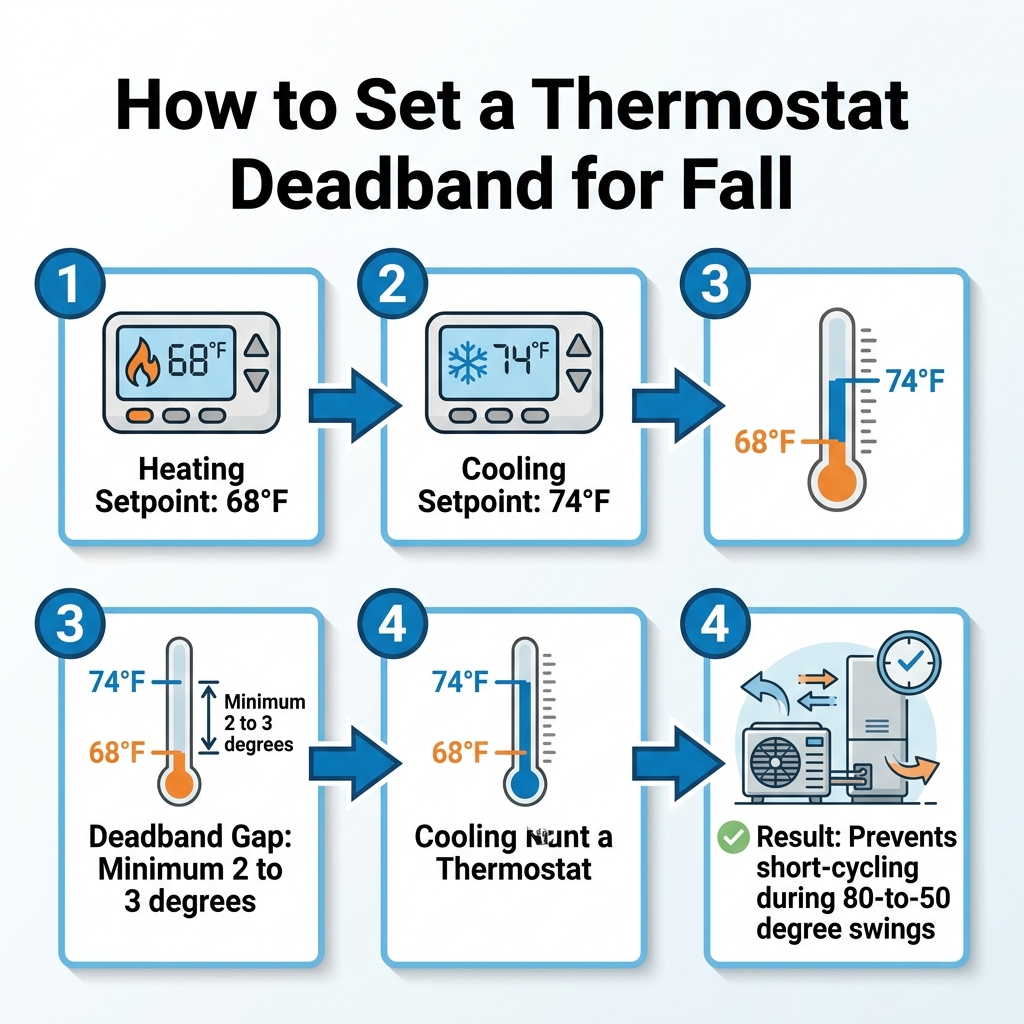
1. Select your base heating temperature: Choose a comfortable baseline for chilly mornings, such as 68 degrees.
2. Set a minimum 3-degree gap: Add at least three degrees (preferably four or five) to establish your cooling setpoint.
3. Select your cooling temperature: Set the AC to engage at 74 degrees.
4. Engage Auto mode: Let the thermostat handle the rest.
With a 68-to-74 degree deadband, your system will remain completely idle as long as the house naturally rests between 69 and 73 degrees. This idle period is exactly what your equipment needs during the fall. Furthermore, managing variable weather with a smart thermostat automates this deadband protection, ensuring your system never short-cycles while you are away at work.

How Heat Pumps Handle the Fall Weather Rollercoaster
If your home utilizes a heat pump rather than a traditional furnace and air conditioning pairing, the fall transition looks a bit different. Heat pump systems are inherently designed to handle both heating and cooling from a single outdoor unit. Instead of burning fuel to create heat, they use a reversing valve to change the flow of refrigerant, pulling heat out of the home during the summer and pulling ambient heat into the home during the winter.
Because they are built for this dual functionality, heat pumps smoothly reverse their operation to accommodate chilly mornings and warm afternoons. They are incredibly efficient during the September transition weeks because there is still plenty of ambient heat in the outdoor air to draw inside. However, even with this advanced technology, heat pumps still benefit heavily from proper deadband settings to maximize energy efficiency.
We recently had a Taylorsville homeowner reach out to our team during a harsh winter storm because they needed a new system installed immediately. Our technicians were able to install a new heat pump cleanly, punctually, and efficiently despite the severe weather. The beauty of these robust systems is that they handle extreme winter storms just as capably as they manage the erratic temperature swings of early fall. By relying on the Auto setting and a proper deadband, you allow your heat pump to seamlessly shift gears without overworking the compressor.
If you are considering upgrading your home's efficiency before winter, modern heat pump systems offer incredible versatility for Kentucky's unpredictable climate.
Finding the Ideal Indoor Temperature for Kentucky Falls
When our customers ask us for advice on finding the perfect balance, we point to authoritative data as an excellent baseline for balancing comfort and efficiency. The Department of Energy recommends setting thermostats to 68 degrees Fahrenheit during waking hours when operating in heating mode. This baseline is warm enough to keep the chill out of the air while minimizing energy consumption.
To create a safe deadband around this 68-degree heating baseline, you need a complementary cooling setpoint. Setting the AC to 74 or 75 degrees creates a comfortable buffer zone. During a classic Kentucky fall day, the morning might drop to 55 degrees outdoors, triggering your heat to maintain 68 indoors. As the sun rises and outdoor temperatures climb into the 80s, the house will slowly warm up. The AC will only kick on if the indoor temperature breaches 74 degrees.
Strategies for nighttime temperature setbacks:
• Lower the heat: When the outdoor temperature drops into the 50s at night, you can safely lower your heating setpoint to 65 degrees while you sleep under blankets.
• Utilize ceiling fans: Keep air circulating to prevent warm air from getting trapped at the ceiling.
• Avoid extreme adjustments: Do not drop the thermostat by ten degrees at night and expect it to recover instantly in the morning. A 3-to-4 degree setback is ideal.
While personal comfort varies, remember that extreme setpoints increase the risk of system strain. The goal during temperature swings from 80s to 50s is to let the house coast naturally in that middle zone for as many hours of the day as possible.
Pre-Winter Safety Checks and Preventative Maintenance
As you shift your focus from behavioral thermostat management to mechanical readiness, it is vital to prepare your equipment for the heavy winter load. The transition weeks of early fall are the critical window for routine HVAC maintenance before freezing temperatures arrive and HVAC companies become fully booked.
After a long summer of heavy AC use, your system has likely pulled a massive amount of dust, pollen, and debris through the ductwork. Changing your air filters is the most important DIY step you can take. A clogged filter restricts airflow, forcing the blower motor to work harder and increasing the likelihood of the system overheating when you finally turn on the furnace.
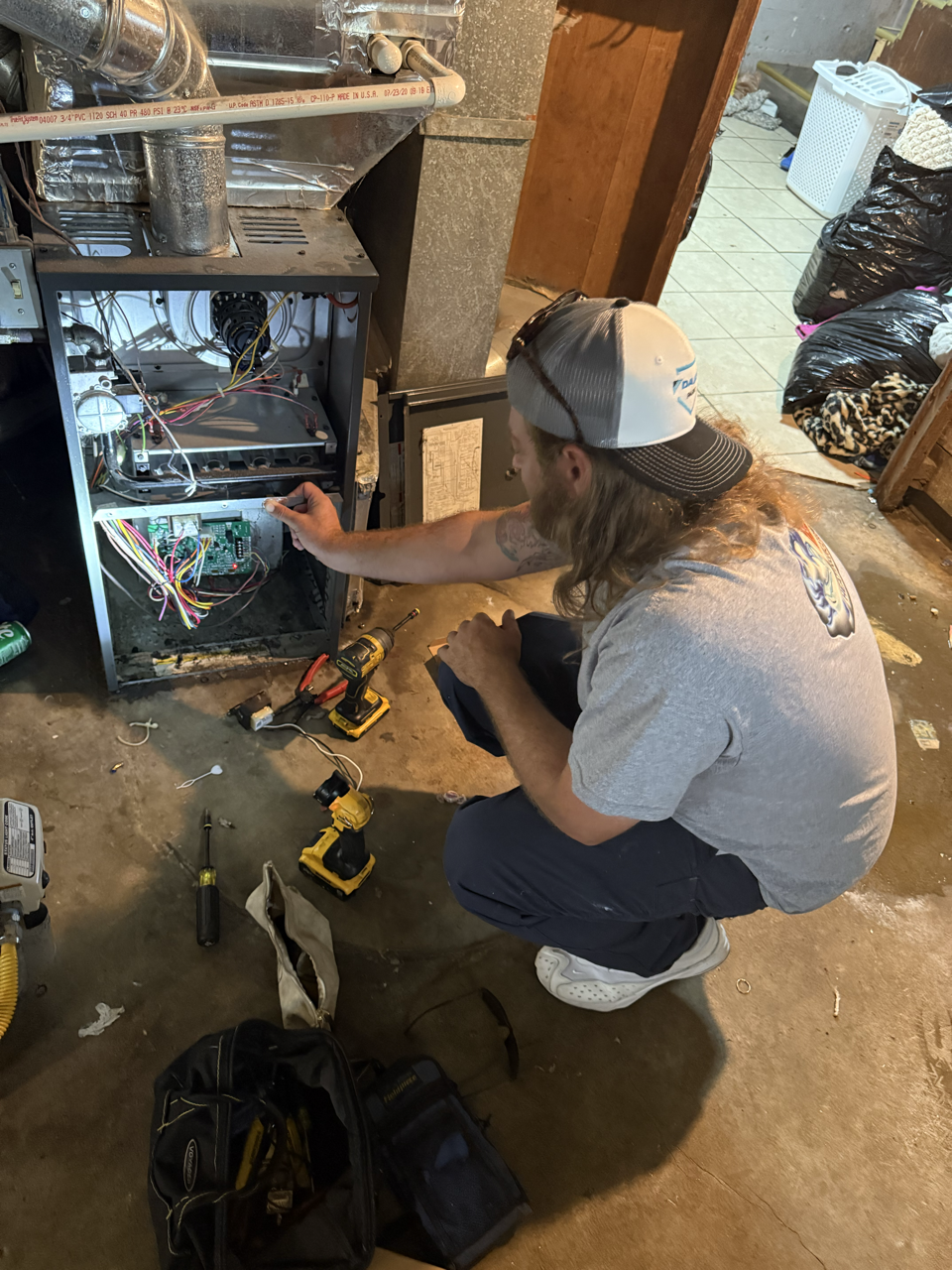
Beyond filters, firing up a furnace for the first time carries inherent safety risks. Over time, metal components expand and contract, which can lead to structural failures. For example, our team responded to a local homeowner last fall whose carbon monoxide detectors kept going off unexpectedly. Our thorough inspection revealed a severe crack in the heat exchanger, which required the safe removal of the old equipment and the installation of a brand-new furnace and AC system. This highlights exactly why a professional inspection is non-negotiable.
What a professional fall inspection covers:
• Heat exchanger integrity: Inspecting for microscopic cracks that could leak carbon monoxide into your living space.
• Burner assembly cleaning: Removing soot and dust that can cause delayed ignition or poor fuel efficiency.
• Electrical connections: Tightening wires and testing capacitors that may have weakened during the summer heat.
• Thermostat calibration: Ensuring your deadband settings and temperature sensors are reading accurately.
Scheduling routine HVAC maintenance verifies that your system is mechanically sound and ready to handle the shift from occasional morning heat to 24/7 winter operation.
Frequently Asked Questions About Fall Thermostat Settings
Is it bad to switch from AC to heat back and forth?
Yes, in our professional experience, manually switching back and forth on the same day can be harmful to your HVAC system. It forces the compressor to start and stop without adequate time to depressurize, leading to unnecessary mechanical strain and short-cycling. Instead of manually flipping the switch, rely on the Auto setting with a proper temperature gap to handle the transition safely.
What temperature should I switch from AC to heat?
There is no single magic temperature, but our technicians use a good rule of thumb: switch to heating when the indoor temperature consistently drops below 68 degrees. During the fall, setting a heating baseline of 68 degrees and a cooling baseline of 74 degrees allows the system to manage itself automatically without overlapping.
How do you set a thermostat for fall weather?
Set your thermostat to Auto mode and establish a deadband of at least 3 to 5 degrees between your heating and cooling setpoints. This ensures that the furnace and air conditioner do not run simultaneously or fight each other as the outdoor temperature swings between cool mornings and warm afternoons.
How do I use the auto setting on my thermostat?
To use the Auto setting, select the "Auto" mode on your thermostat interface, which will prompt you to enter two different temperatures: one for heating and one for cooling. Make sure there is a distinct gap (deadband) between these two numbers so the system has a neutral zone where neither unit is forced to run.
What is a thermostat deadband and why is it important?
A thermostat deadband is the temperature range between the cooling setpoint and the heating setpoint where the HVAC system remains completely idle. It is important because it prevents short-cycling, saves energy, and stops your AC and furnace from fighting each other during unpredictable fall weather.
Keep Your Home Comfortable Through the Fall Transition
Clear, actionable guidelines on thermostat settings are the key to protecting your HVAC system while maintaining indoor comfort. Figuring out when to switch your thermostat from cool to heat in Kentucky doesn't have to be a daily guessing game. By setting a proper deadband and resisting the urge to manually flip switches all day, you can navigate erratic fall weather safely.
Now is the perfect time to ensure your equipment is actually ready for the heavy lifting ahead. Do not wait for the first winter freeze to discover that your furnace is struggling. At 3D Heating and Cooling, we encourage homeowners to schedule their fall tune-ups now to ensure their professional heating services are completed before the severe cold arrives, keeping your family safe, warm, and comfortable all season long.
Financing

Now Offering Financing Options with Affordable Monthly Payments
where we operate
Service Areas
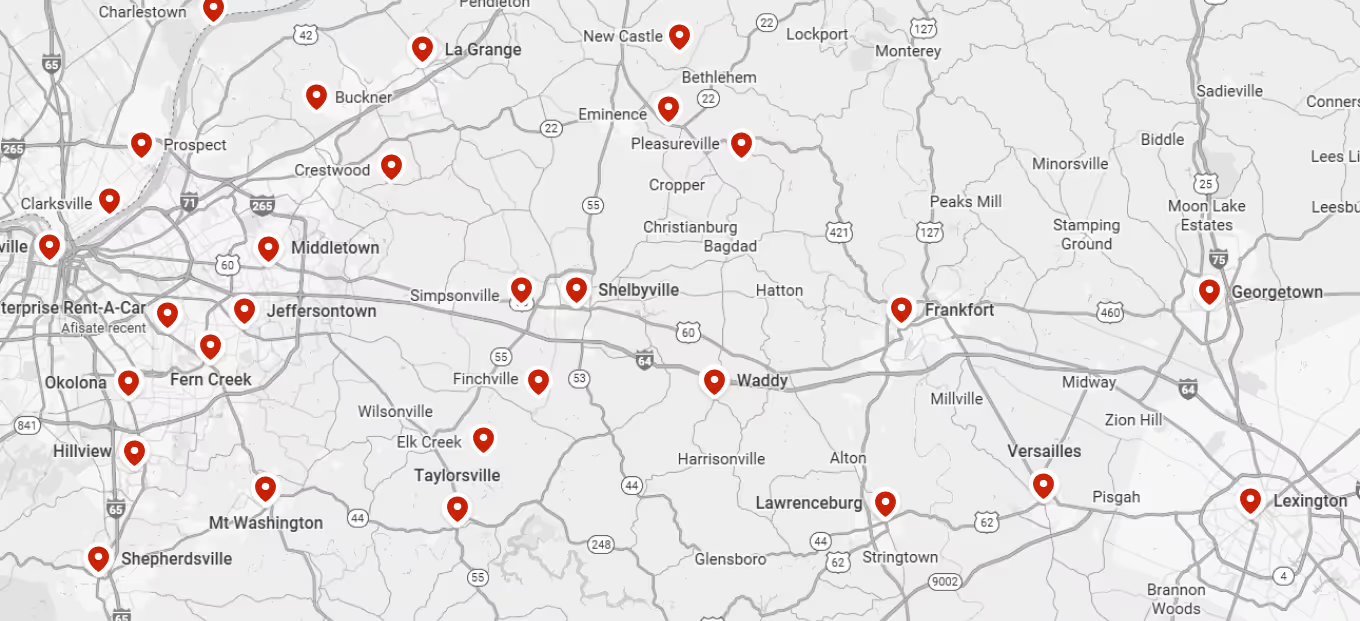
Proudly serving Spencer county, Jefferson county, Bullitt county, and the surrounding areas
Short Heading Goes Here
Sed iaculis aenean sit sed risus arcu vitae integer elit.

