
.svg)


.avif)



5 min read
MERV 8 vs. MERV 11 Filters for Back-to-School Allergen Control
The Late-Summer Filter Dilemma: Airflow vs. Air Quality
Buying the filter with the highest rating on the shelf doesn't automatically mean your home is cleaner—sometimes, it just means your air conditioner is suffocating. When evaluating MERV 8 vs. MERV 11 Filters for Back-to-School Allergen Control, many homeowners operate under the myth that denser filtration is universally better for their home. The truth is much more complicated. At 3D Heating and Cooling, we frequently see homeowners accidentally strain their equipment by upgrading their air filter without considering their system's capabilities, leading to severe mechanical strain, higher energy bills, and completely frozen air conditioners.
This dilemma peaks during the late-summer August back-to-school season. Right as children return to classrooms and begin bringing home new seasonal germs, outdoor temperatures remain dangerously high. You are suddenly faced with a concrete problem: you need to capture more airborne contaminants to keep your family healthy, but your HVAC system is already working overtime to keep the house cool. Choosing the correct filter requires a delicate balance between achieving your indoor air quality goals and respecting the operational limits of your cooling equipment.
The core decision points:
• System breathability: Can your blower motor handle the increased resistance of a thicker filter?
• Contaminant capture: Do you have specific allergy triggers or immune concerns that require trapping microscopic particles?
• Seasonal timing: Is the transition back to school introducing enough new germs to justify a temporary change in your filtration strategy?
Understanding how these factors interact is the key to maintaining a comfortable, healthy home without accidentally destroying your air conditioner in the process.
What Do MERV Ratings Actually Measure?
Before you can make an informed choice about upgrading your home's defenses, you need to understand the terminology printed on the side of the box. MERV stands for Minimum Efficiency Reporting Value. Developed by the American Society of Heating, Refrigerating and Air-Conditioning Engineers (ASHRAE), this rating scale measures a filter's ability to capture airborne particles on a scale from 1 to 16 for residential applications.
To fully grasp what a MERV rating means, you have to look at the size of the particles being captured. These particles are measured in microns (short for micrometers). For context, a single strand of human hair is roughly 50 to 70 microns in diameter. The human eye can only see particles down to about 40 microns. The contaminants floating in your home are significantly smaller than that.
Common household particles and their sizes:
• Standard household dust: 2.5 to 10.0 microns
• Mold spores: 10.0 to 30.0 microns
• Pet dander: 0.5 to 10.0 microns
• Bacteria and sneeze droplets: 0.3 to 5.0 microns
A higher MERV rating indicates that the filter media is woven more tightly, allowing it to trap smaller particles. However, this tight weave introduces a critical mechanical challenge known as static pressure. When the gaps in the filter material are smaller, the blower motor has to work much harder to pull the same volume of air through the system. If you want to explore comprehensive indoor air quality solutions, you have to account for both the MERV 8 and MERV 11 airflow restrictions. Upgrading the filter without verifying the system's static pressure capacity is a recipe for restricted airflow and poor cooling performance.
MERV 8: The Standard for System Breathability
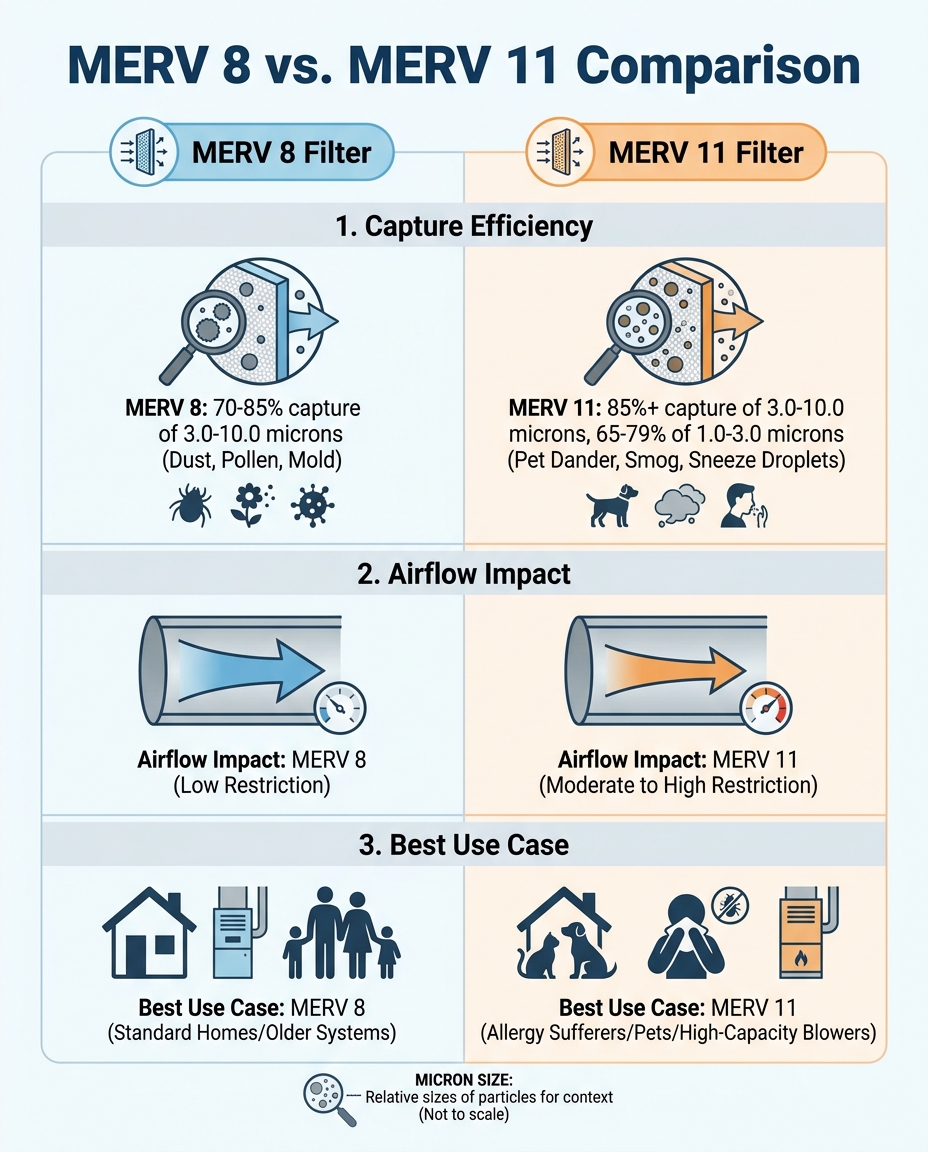
For the vast majority of residential properties, a MERV 8 filter is considered the gold standard. It provides an excellent baseline of protection for both your family's lungs and the internal components of your heating and cooling equipment. According to ASHRAE specifications, a MERV 8 filter successfully captures between 70% and 85% of particles sized 3.0 to 10.0 microns.
This level of filtration is highly effective at trapping the most common household nuisances. A fresh MERV 8 filter will easily pull standard household dust, heavy pollen, dust mites, and mold spores out of the air circulation. More importantly, it achieves this capture rate while maintaining optimal system breathability. Because the synthetic media is not overly restrictive, the blower motor can pull air freely, keeping energy consumption low and preventing unnecessary wear and tear on the moving parts.
In a typical neighborhood in Taylorsville KY, where standard airborne dust and seasonal pollen are the primary concerns, our technicians find that a MERV 8 filter provides the perfect equilibrium. It keeps the indoor air fresh while ensuring the air conditioner can operate at its peak designed efficiency during the hottest parts of the day.
When to Choose MERV 8
Sticking with a MERV 8 filter is usually the smartest financial and mechanical decision in several specific scenarios. If your household does not have severe allergy sufferers or family members with compromised respiratory systems, this baseline protection is entirely sufficient.
Ideal use cases for MERV 8:
• Homes without severe allergies: When basic dust and pollen control is the only requirement.
• Older HVAC equipment: Aging systems with weaker blower motors that cannot handle high static pressure.
• Maximum energy efficiency: Situations where keeping utility bills low and maximizing the cooling output is the absolute top priority.
• Standard residential setups: Homes across the Louisville area that simply need reliable, everyday air filtration.
MERV 11: Stepping Up Allergen and Germ Capture
When the environment inside your home demands a higher level of protection, stepping up to a MERV 11 filter provides a significant boost in particle capture. Based on EPA specifications, a MERV 11 filter captures 85% or better of particles in the 3.0 to 10.0-micron range, and crucially, it captures 65% to 79% of the much smaller 1.0 to 3.0-micron particles.
This ability to trap finer contaminants makes a massive difference when addressing specific air quality threats. A MERV 11 filter is dense enough to capture fine pet dander, smog, auto emissions, and the larger sneeze and cough droplets that carry viruses and bacteria. This increased filtration directly combats the influx of germs during the late-summer August back-to-school transition. As kids return to crowded classrooms and bring seasonal bugs back into the house, a MERV 11 filter acts as a much tighter net, pulling those respiratory droplets out of the air before they can circulate through the ductwork into other bedrooms.
Additionally, late summer triggers massive spikes in ragweed pollen. Because ragweed particles can be incredibly fine, the tighter weave of a MERV 11 filter offers superior relief for families who spend August and September battling itchy eyes, congestion, and asthma flare-ups.
When to Choose MERV 11
Upgrading to a tighter filter media is a deliberate choice that prioritizes air quality over maximum airflow. It should be deployed when specific environmental triggers or health concerns demand it.
Ideal use cases for MERV 11:
• Homes with pets: When multiple dogs or cats are producing high volumes of fine dander.
• Asthma and allergy sufferers: When family members require aggressive removal of microscopic triggers to breathe comfortably.
• High germ transmission periods: During peak pollen seasons or the back-to-school influx of classroom illnesses.
• Verified system capacity: When a technician has confirmed that the HVAC system has a robust enough blower motor to handle the higher static pressure.
The Airflow Trap: Why Higher MERV Ratings Can Threaten Your AC Coils
The greatest risk in upgrading your air filtration is falling into the airflow trap. The denser media of a MERV 11 filter inherently increases the static pressure within your ductwork. When the filter material is tightly woven to catch microscopic sneeze droplets, it also makes it significantly harder for the blower motor to pull air through the return vent.
The problem: If your blower motor is not rated for this level of resistance, the volume of air moving through your system drops dramatically. This restricted airflow sets off a dangerous domino effect inside your air conditioner.
The cause: Your air conditioner cools your home by blowing warm indoor air over a freezing cold evaporator coil. The heat from the air is absorbed by the refrigerant inside the coil. If a restrictive filter slows the airflow down too much, there isn't enough warm air passing over the coil to keep it above freezing temperatures. The coil gets colder and colder until the natural condensation in the air freezes solid against the metal fins.
This risk is heavily amplified by Kentucky's late-summer humidity. In August, AC units run constantly to combat the heat, and they pull massive amounts of moisture out of the humid air. Restricting the airflow with a MERV 11 filter limits the system's ability to properly dehumidify the space. With so much moisture present and not enough warm air moving, the risk of a frozen coil accelerates rapidly compared to drier climates.
The solution: A frozen coil ultimately stops the cooling process entirely and can lead to expensive compressor damage or severe water leaks when the ice eventually melts. When equipment is pushed beyond its operational limits by severe airflow restrictions, the mechanical strain can lead to total system failure. For example, our team at 3D Heating and Cooling recently responded to a local homeowner who experienced a complete furnace failure where the system simply went out and required a full replacement. Our technicians had to quickly install a new unit to restore their comfort. While that specific breakdown happened during the heating season, the underlying mechanical stress is identical to what happens when an AC blower motor fights a restrictive filter all summer long. To prevent this, you must verify your system's capabilities and always maintain clean AC coils to ensure proper heat transfer.
Comparing the Trade-Offs: Which Filter Belongs in Your Home?
Deciding between these two filtration levels ultimately comes down to synthesizing the trade-offs. A MERV 8 filter prioritizes system health, energy efficiency, and maximum airflow, making it the safest choice for the longevity of your equipment. A MERV 11 filter prioritizes superior indoor air quality, capturing the fine allergens and back-to-school germs that cause respiratory distress, but it does so at the cost of increased static pressure.
At 3D Heating and Cooling, our commitment to technical honesty means we want to ensure you don't accidentally damage your AC unit while trying to improve your indoor air quality. In our years of servicing HVAC systems across Taylorsville, we've seen firsthand that family health and system longevity do not have to be mutually exclusive. Before making a permanent jump to a MERV 11 filter, your blower motor capacity must be checked by a professional to ensure it won't buckle under the added strain.
For many homes in Taylorsville KY, the smartest approach is a middle-ground strategy. You can use a MERV 11 filter temporarily during the peak back-to-school germ season or the height of the late-summer ragweed bloom. Once the seasonal threat has passed, you can revert to a standard MERV 8 filter for the rest of the year, giving your blower motor a break and restoring maximum airflow. This strategy works best when paired with routine HVAC maintenance to ensure the system remains balanced and clean.
• Particle Capture (3.0-10.0 microns) — MERV 8: 70% - 85% — MERV 11: 85% or higher
• Particle Capture (1.0-3.0 microns) — MERV 8: Minimal — MERV 11: 65% - 79%
• Primary Contaminants Trapped — MERV 8: Dust, heavy pollen, mold spores — MERV 11: Pet dander, smog, sneeze droplets
• Airflow Restriction — MERV 8: Low (Excellent breathability) — MERV 11: Moderate to High
• Best Use Case — MERV 8: Standard homes, older AC units — MERV 11: Allergy sufferers, peak germ seasons

Common Questions About Upgrading Your Home Air Filter
Is MERV 11 too restrictive for my AC?
It depends entirely on the age and capacity of your specific blower motor. While modern, high-efficiency systems are often designed to handle the increased static pressure of a MERV 11 filter, older units may struggle to pull enough air through the dense media. If you notice your home takes longer to cool down, or if the airflow from your vents feels weak after upgrading, the filter is likely too restrictive. A professional static pressure test is the only way to know for sure.
What does a MERV 11 filter catch that a MERV 8 doesn't?
A MERV 11 filter excels at capturing much smaller microscopic particles that slip right through a standard MERV 8. Specifically, it traps 65% to 79% of particles in the 1.0 to 3.0-micron range. This includes fine pet dander, smog, auto emissions, and the larger respiratory sneeze droplets that commonly spread germs during the back-to-school season.
Can a MERV 11 filter damage my HVAC system?
Yes, if your system is not designed to handle the restricted airflow, a dense filter can cause significant mechanical damage over time. The increased resistance forces the blower motor to run hotter and work harder, which can lead to premature motor failure. Additionally, the lack of airflow can cause the evaporator coil to freeze solid, which may eventually damage the outdoor compressor.
How often should I change a MERV 11 filter in summer?
During the heavy cooling demands of late summer, a MERV 11 filter should be checked every 30 days and replaced at least every 60 to 90 days. Because the filter media is woven tighter to catch more debris, it clogs up much faster than a standard filter. Leaving a dirty MERV 11 filter in place during August will severely restrict your airflow and drive up your monthly energy bills.
Which MERV filter is best for seasonal allergies?
For homes dealing with severe seasonal allergies, a MERV 11 filter is generally the best choice, provided the AC unit can handle it. It effectively traps the fine ragweed pollen and dust mites that trigger asthma and respiratory irritation. Many homeowners choose to run a MERV 11 during peak allergy seasons in the spring and late summer, then switch back to a MERV 8 when pollen counts drop.
Protect Your Family's Air and Your AC System's Lifespan: MERV 8 vs. MERV 11 Filters for Back-to-School Allergen Control
Achieving excellent indoor air quality doesn't have to come at the expense of a healthy, functioning air conditioner. When weighing MERV 8 vs. MERV 11 Filters for Back-to-School Allergen Control, the goal is to find the perfect middle ground for your specific home environment. You want a clear, technical, but accessible solution that keeps late-summer allergens and school germs at bay without suffocating your blower motor.
Before you make a permanent switch to a highly restrictive filter, we encourage you to have your system's static pressure and blower capacity evaluated by a professional. Reaching out for an expert assessment ensures you can breathe clean air confidently, knowing your cooling equipment is operating safely and efficiently.
Financing

Now Offering Financing Options with Affordable Monthly Payments
where we operate
Service Areas
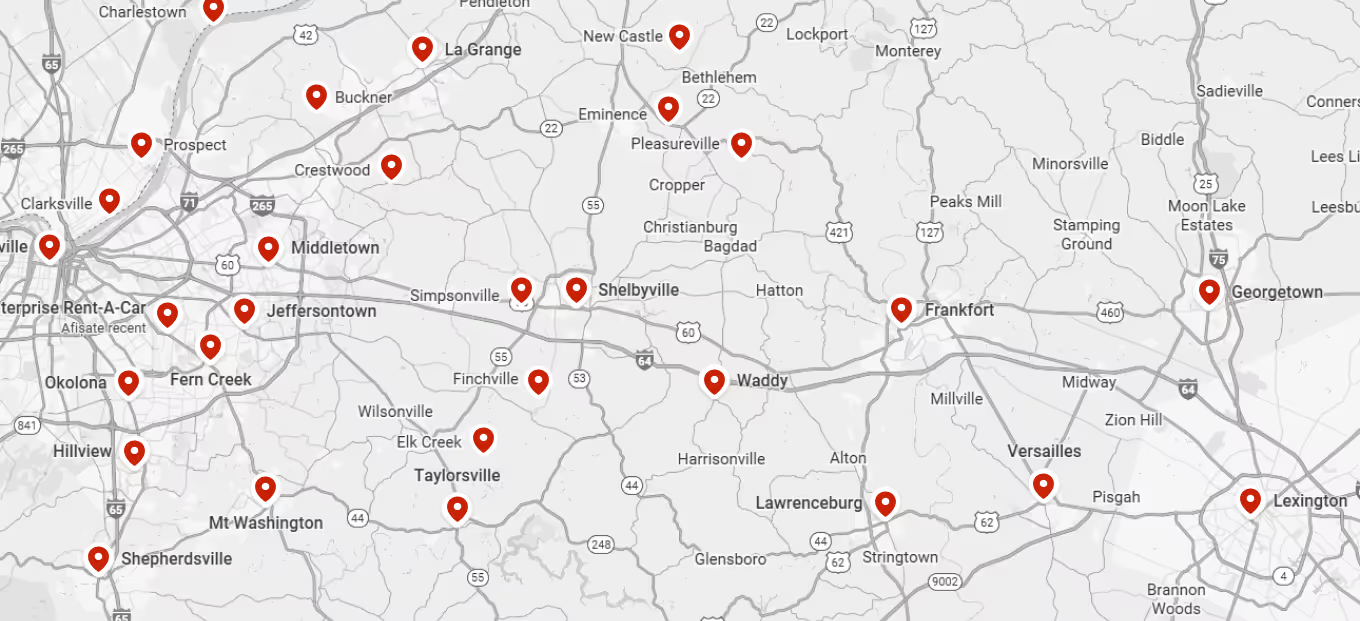
Proudly serving Spencer county, Jefferson county, Bullitt county, and the surrounding areas
Short Heading Goes Here
Sed iaculis aenean sit sed risus arcu vitae integer elit.