
.svg)


.avif)



5 min read
HVAC Commercial Facility Services for Taylorsville Schools and Offices
The Hidden Threat of August Reopening for Commercial Facilities
Your building has been running on low-demand settings for months, but suddenly, the doors are about to open to massive crowds, and you need reliable HVAC Commercial Facility Services for Taylorsville Schools and Offices to handle the surge. During the August late-summer back-to-school transition, our team at 3D Heating and Cooling frequently sees commercial buildings face a severe operational shift. Systems that have comfortably maintained temperature in empty hallways are suddenly forced to cool spaces filled with hundreds of people, operating computers, and constantly opening exterior doors.
This sudden spike in thermal demand creates a phenomenon known as occupancy shock. When a commercial cooling system is pushed from a low-idle state to maximum output overnight, weak components fail, condensation issues multiply, and indoor air quality plummets. Facility managers and school administrators face a critical decision point right now: you can either wait for the inevitable complaints and emergency shutdowns during the first week of reopening, or you can schedule a professional late-summer prep protocol to ensure your infrastructure is ready for the load.
Proactive management is the only proven way to prevent costly downtime during these critical reopening weeks. A system failure in a packed school or busy office building disrupts operations, compromises safety, and forces emergency repair expenditures that ruin quarterly budgets. To avoid these catastrophic failures, building owners must rely on comprehensive commercial HVAC solutions that address the specific engineering challenges of sudden massive load spikes.
Understanding 'Occupancy Shock' in Local Buildings
Occupancy shock occurs when a building transitions from an unoccupied or lightly occupied state to full capacity in a matter of hours. The physical impact of hundreds of people entering a previously empty building fundamentally alters the environmental dynamics of the space. Every human body radiates heat, every flipped light switch adds thermal load, and every opened door introduces unconditioned outside air into the carefully controlled indoor environment.
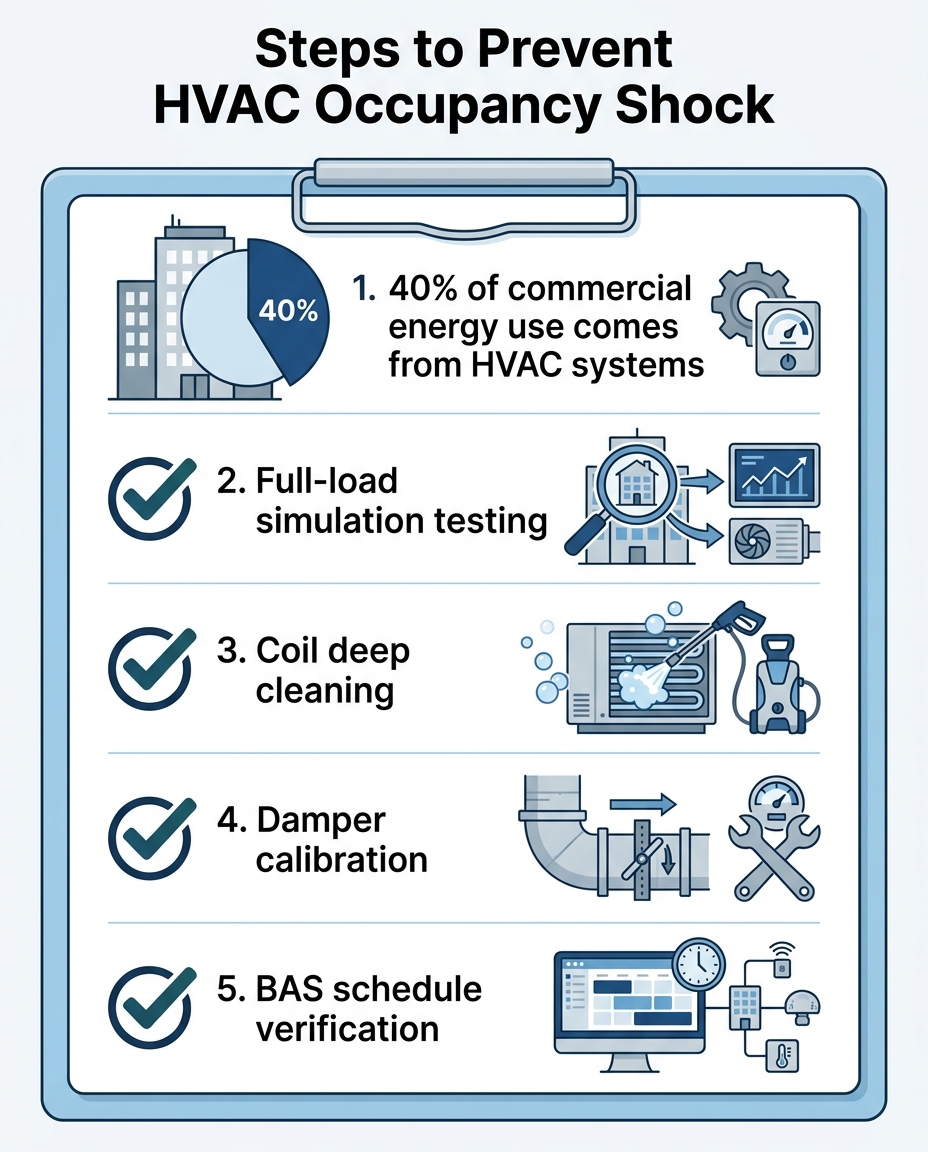
According to data from the U.S. Department of Energy, HVAC systems account for approximately 40% of total energy use in commercial buildings. When Taylorsville KY commercial and educational facilities experience occupancy shock, that energy usage spikes aggressively. In our experience servicing local facilities, if the system is not properly prepped, this inefficient transition results in massive utility bills and extreme wear and tear on critical mechanical components.
The Anatomy of a Sudden Load Spike
To understand why occupancy shock is so dangerous to your equipment, you have to look at the three primary factors that create a sudden load spike:
• Thermal mass of human bodies: A single resting adult generates roughly 350 to 400 BTUs of heat per hour. Multiply that by 500 students or office workers, and your cooling system suddenly has to remove an additional 200,000 BTUs of heat from the building, instantly.
• Lighting and equipment heat generation: Unoccupied summer modes mean computers are off, cafeteria kitchens are dark, and hallway lights are dimmed. Powering up a commercial facility introduces immense electrical heat that the HVAC system must offset.
• Loss of conditioned air through high-traffic entrances: Continuous door openings during morning arrivals and afternoon dismissals destroy the building's static pressure. The HVAC system must run continuously to replace the conditioned air escaping into the parking lot.
When compressors, blower motors, and condenser fans are pushed from idle to maximum output instantly, the risk of system failure skyrockets. Belts snap, aging capacitors blow, and refrigerant leaks that were previously undetectable suddenly cause the system to freeze up entirely.
The Physics of Humidity Control During Back-to-School Transitions
Temperature is only half the battle during the August late-summer back-to-school transition. The intense late-summer heat combined with the notoriously high humidity in the Taylorsville region creates massive condensation challenges for large buildings. When hot, humid outside air floods into an aggressively cooled indoor environment, the physics of condensation take over. Moisture drops out of the air, coating ductwork, ceiling tiles, and evaporator coils in a layer of water.
If your commercial system is only dropping the temperature without actively removing moisture, you are creating a breeding ground for mold and mildew. High humidity severely degrades indoor air quality. Data from the EPA's Indoor Air Quality Tools for Schools program demonstrates that poor indoor air quality is directly linked to decreased cognitive function, lower test scores, and increased absenteeism among students and staff.
Addressing this specific climate challenge requires professional dehumidification strategies rather than simple temperature drops. Commercial systems must be calibrated to run long enough to pull moisture out of the air without overcooling the space. Proper ventilation and humidity control are directly connected to a safer, more comfortable environment. Upgrading or optimizing your indoor air quality systems ensures that the air circulating through your school or office remains crisp, dry, and healthy, even when the humidity outside is suffocating.
Why Standard Maintenance Fails the Reopening Test
Many facility managers assume that if their maintenance team changed the filters and checked the belts in July, the building is ready for August. This is a dangerous misconception. Generic annual maintenance is entirely insufficient for a building about to experience a 100% occupancy increase.
Standard maintenance looks at the system in a vacuum; specialized institutional transition protocols evaluate the system under simulated stress. When preparing Taylorsville KY commercial and educational facilities for reopening, you need a partner capable of executing large-scale, comprehensive strategies tailored specifically to your institutional schedule.
• System Load — Standard Annual Check: Checks components while the system is idling or under low stress. — Institutional Transition Protocol: Tests refrigerant levels and ductwork integrity under simulated full-load conditions.
• Controls & Automation — Standard Annual Check: Verifies the thermostat turns on and off. — Institutional Transition Protocol: Recalibrates building automation systems (BAS) for occupied hours and fresh air intake.
• Airflow Management — Standard Annual Check: Swaps out standard pleated filters. — Institutional Transition Protocol: Adjusts dampers, tests static pressure, and upgrades to high-capacity commercial filtration.
• Coil Condition — Standard Annual Check: Visual inspection for obvious debris. — Institutional Transition Protocol: Deep chemical cleaning of massive commercial evaporator and condenser coils.
As a facility manager, you need the backing of a dedicated commercial maintenance plan. Our team at 3D Heating and Cooling specializes in handling large-scale commercial maintenance plans specifically tailored to local institutional reopening schedules. We advise all our commercial clients that checking a box isn't enough; the system must be rigorously stress-tested before the first bell rings.
Leveraging 3D Facility Services for Proactive Commercial Cooling
Comprehensive 3d facility services go far beyond simple repairs. They encompass a proactive, holistic approach to managing your building's entire thermal envelope. When you leverage specialized commercial services, you are investing in predictive maintenance, rapid diagnostics, and engineered solutions that prevent the panic of mid-August system breakdowns.
During the August late-summer back-to-school transition, the stress on your equipment reveals hidden vulnerabilities. Summer component failures are a pattern we see often when systems are pushed to their limits. For example, during a recent summer heatwave, one local commercial facility called us when they noticed their air conditioning struggling to keep up. A 3D Heating and Cooling technician was dispatched and quickly discovered a faulty coil alongside a refrigerant leak in the unit. Because the facility relied on our dedicated commercial team, both issues were diagnosed and fully repaired on the exact same day, preventing a complete shutdown of operations.
That level of rapid response is exactly why you need a dedicated commercial HVAC partner. When hundreds of people are relying on your building for comfort and safety, you cannot afford to wait days for a residential contractor to source commercial parts. By partnering with our experts for your facility HVAC services, you secure priority response times, specialized commercial diagnostic tools, and the peace of mind that comes from knowing your infrastructure is protected by professionals.
Meeting Institutional Standards for Schools and Offices
Commercial buildings, particularly schools and large corporate offices, are bound by strict regulatory standards regarding ventilation and air quality. Local and federal guidelines dictate specific fresh air intake rates, exhaust requirements, and filtration minimums to ensure the safety of occupants. Failing to meet these standards not only puts occupant health at risk but can also result in compliance violations and liability issues for the property owner.
Proper late-summer preparation ensures that your building remains in full compliance with workplace and educational safety standards. When Taylorsville KY commercial and educational facilities undergo professional transition protocols, our licensed technicians verify that outside air dampers are functioning correctly and that the building is receiving the precise amount of required fresh air per occupant.
Working with licensed commercial HVAC experts also provides critical documentation and reporting benefits. If an air quality complaint arises, having a detailed ledger of professional maintenance, calibration, and compliance testing protects your institution. Attempting DIY maintenance or using uncertified handymen for commercial systems puts this institutional compliance at extreme risk. For a deeper dive into the regulatory side of facility management, reviewing resources on understanding HVAC regulations can help you stay ahead of compliance requirements.
Steps to Prevent HVAC Occupancy Shock in Commercial Buildings
Preparing your facility for the August late-summer back-to-school transition requires a methodical, engineering-based approach. To prevent occupancy shock and ensure a seamless reopening, our licensed commercial technicians handle the following critical steps for your facility:
• Conduct a full-load simulation test: Our technicians manually override the building controls to force the system into maximum output. This stress test reveals failing capacitors, slipping belts, and refrigerant issues before the building is actually occupied.
• Perform deep chemical cleaning of coils: Commercial evaporator and condenser coils move massive amounts of air and collect heavy debris. Deep chemical cleaning restores the heat transfer efficiency required to handle sudden occupancy loads.
• Calibrate economizers and fresh air dampers: Uncalibrated dampers can pull in too much humid outside air or fail to provide enough ventilation. Precise calibration ensures maximum occupancy compliance without overwhelming the cooling cycle.
• Upgrade to high-efficiency commercial air filters: The sudden influx of hundreds of people stirs up dust, allergens, and pathogens. Upgrading your filtration handles the increased particulate load and protects the blower motors from strain.
• Verify building automation system (BAS) schedules: We reprogram the commercial thermostats and BAS to match the new occupancy hours, ensuring the building begins cooling down hours before the first occupants arrive.

Frequently Asked Questions About Commercial HVAC Transitions
How do you prepare commercial HVAC for full occupancy?
Preparing a commercial HVAC system for full occupancy requires a professional full-load simulation test and a complete recalibration of the building automation system. Our technicians chemically clean the coils, check refrigerant charges under heavy load, and ensure that outside air dampers are functioning properly. This proactive stress-testing ensures the system can handle the sudden introduction of body heat and equipment usage without failing.
Why is HVAC maintenance important for schools?
HVAC maintenance in schools is critical because proper temperature and humidity control directly impact student health, cognitive function, and test scores. Taylorsville KY commercial and educational facilities rely on well-maintained systems to filter out airborne pathogens, prevent mold growth in high-humidity environments, and provide the mandatory fresh air ventilation required by educational regulations.
How does occupancy affect HVAC load?
Occupancy drastically increases the HVAC load because every human body acts as a small heater, radiating hundreds of BTUs into the space every hour. Additionally, increased occupancy means more lights are turned on, more equipment is running, and exterior doors are frequently opened, allowing conditioned air to escape. The HVAC system must work significantly harder to offset these massive thermal additions.
What is included in commercial HVAC maintenance?
Comprehensive commercial HVAC maintenance includes deep chemical cleaning of massive evaporator and condenser coils, testing of 3-phase electrical components, and calibration of economizers. It also involves verifying building automation schedules, testing static air pressure, and inspecting heavy-duty blower belts and bearings. This goes far beyond standard filter changes to ensure total system reliability.
Why does late-summer humidity specifically impact Taylorsville commercial buildings?
Late-summer humidity in Taylorsville creates severe condensation risks when hot, moisture-heavy outside air meets the aggressively cooled interior of a commercial building. If the HVAC system is not properly calibrated to dehumidify the air, this moisture drops out of suspension, coating ductwork and ceiling spaces in water. This leads to rapid mold growth, degraded indoor air quality, and uncomfortable, clammy conditions for occupants.
What are 3d facility services and how do they differ from standard maintenance?
3d facility services represent a comprehensive, proactive approach to building management rather than reactive, basic upkeep. While standard maintenance might just involve changing filters and visually inspecting a unit, facility services involve predictive diagnostics, rapid same-day repairs, and engineered solutions tailored to the specific occupancy schedules and regulatory requirements of large commercial institutions.
Secure Your Facility's Late-Summer Transition Today
The August late-summer back-to-school transition does not have to be a period of stress and emergency repairs. By taking a proactive approach to occupancy shock, you secure the peace of mind that comes from knowing your commercial cooling system is fully prepared, tested, and reliable. Don't wait until the hallways are packed and the thermostats are climbing. Consult with our local commercial HVAC experts at 3D Heating and Cooling today to customize a transition strategy that protects your equipment, ensures institutional compliance, and keeps your occupants comfortable from day one.
Financing

Now Offering Financing Options with Affordable Monthly Payments
where we operate
Service Areas
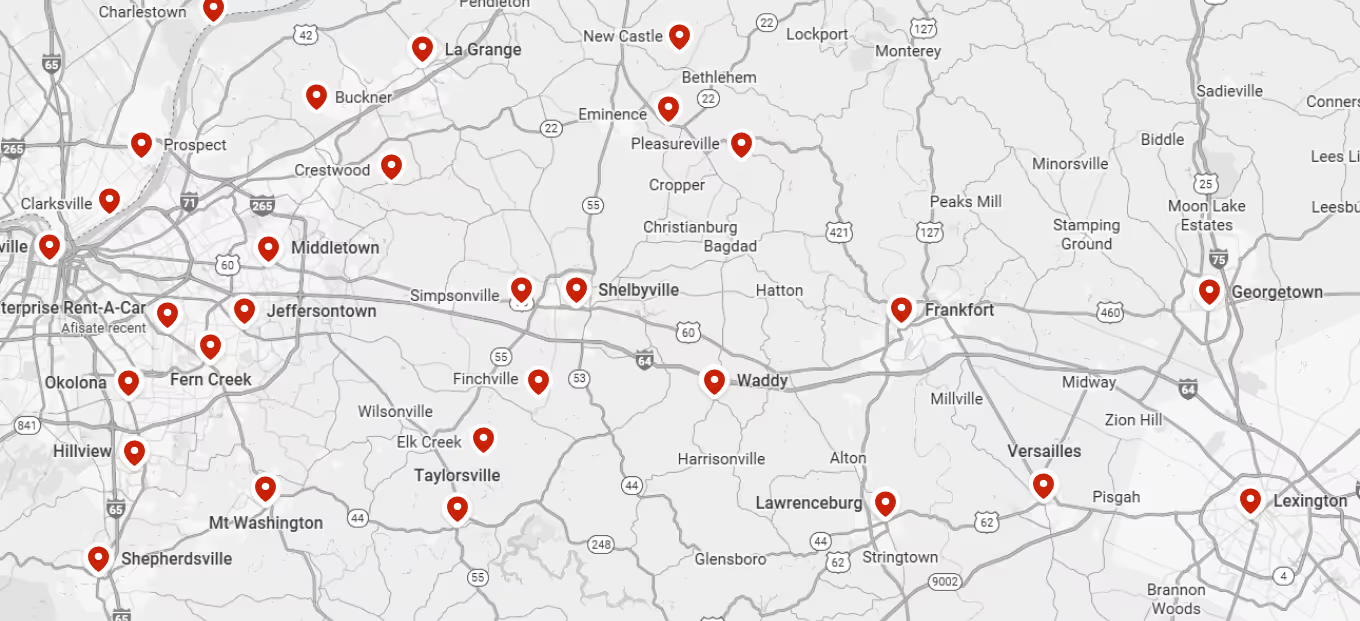
Proudly serving Spencer county, Jefferson county, Bullitt county, and the surrounding areas
Short Heading Goes Here
Sed iaculis aenean sit sed risus arcu vitae integer elit.