

.svg)


.avif)


5 min read
Should I Repair My Broken AC in August or Wait Until Next Spring?
Late Summer AC Breakdowns: To Fix Now or Wait?
The back-to-school transition is stressful enough without your air conditioning system suddenly failing, leaving you searching for answers and wondering: should I repair my broken AC in August or wait until next spring? When a sudden mechanical failure hits just as the worst of the summer heat begins to break, the temptation to simply open the windows and ignore the problem is incredibly strong. You might look at the calendar, see that fall is just around the corner, and decide that dealing with a repair can wait until the weather warms up again.
For professional HVAC services, including expert air conditioning repair, a clear diagnosis helps you make the right choice for your home.
While delaying a repair might seem like a practical way to manage household priorities during the late August / back-to-school transition, modern air conditioning systems are not designed to sit broken and idle. They are complex, pressurized, closed-loop systems that rely on regular cycling to keep internal components lubricated and protected from the elements. Shutting down a compromised system and leaving it exposed to the upcoming winter weather carries severe, hidden mechanical risks.
Making the right choice requires a mechanically-grounded decision framework. Not every breakdown requires an immediate fix, but certain types of component failures will actively destroy your system from the inside out if left unattended for six months. By understanding exactly what happens to a dormant HVAC unit, you can weigh your options safely and avoid turning a moderate late-summer repair into a total system replacement by spring.
The Hidden Mechanical Risks of a Dormant, Broken AC
When an air conditioner breaks down, the underlying cause is rarely just a single part that stops moving. The failure often compromises the sealed environment of the system itself. If you leave a broken unit sitting idle through the off-season, the natural environment begins to interact with those compromised internal components, leading to rapid degradation that outpaces normal wear and tear.
Refrigerant Leaks and Compressor Acid
One of the most dangerous situations for a dormant air conditioner is an unaddressed refrigerant leak. The copper lines that connect your indoor and outdoor units are meant to be a vacuum-sealed loop containing only refrigerant and specialized lubricating oil. When a leak occurs, that pressurized seal is broken.
• The vacuum effect: As the system sits empty over the winter, fluctuations in atmospheric pressure and temperature cause the open line set to draw in outside air and moisture.
• The chemical reaction: Modern refrigerant oils are highly hygroscopic, meaning they absorb moisture like a sponge. When winter moisture mixes with this residual oil, it creates hydrofluoric acid inside the system.
• The fatal outcome: Over the course of a few months, this acidic buildup eats away at the copper windings inside the compressor. By the time spring arrives, the compressor is completely destroyed.
A typical pattern we see in the spring involves homeowners reaching out after their AC fails to start up for the first hot day. In one recent case, a system was diagnosed with a faulty coil and a unit leak that had developed previously. Because a technician was called out, they were able to fix both issues on the same day, restoring the system perfectly. However, if that homeowner had allowed a leak to sit unattended for months, the acidic buildup would have mandated a much larger intervention. This is why understanding the mechanics of repairing vs. replacing an aging AC unit is heavily dependent on how long the system has been compromised.
Seized Motors and Moving Parts
Beyond the chemical dangers of refrigerant leaks, a dormant system suffers from a lack of physical lubrication. The motors, bearings, and fan blades in your outdoor condenser rely on the regular operation of the system to distribute lubricating fluids and prevent rust.
The cascading failure: When a minor electrical issue—like a bad contactor or a blown fuse—causes the system to shut down in late August, the mechanical parts sit motionless for over half a year. Moisture from rain, morning dew, and winter precipitation settles onto these unlubricated metal components. Without the heat of operation to evaporate this moisture, the bearings begin to oxidize and rust. What could have been a simple part swap in the late summer becomes a major mechanical overhaul in the spring because the condenser fan motor has completely seized and locked up.
Why Your Home Still Needs AC for Fall Dehumidification
Another major factor to consider before abandoning your air conditioner for the season is the vital role the system plays in your home's indoor air quality. Air conditioners do not just cool the air; they are the primary dehumidifiers for your entire house. In regions like Taylorsville KY, the weather does not simply flip from hot summer directly into crisp, dry autumn.
Instead, the local climate frequently experiences lingering 80-plus degree days paired with high humidity levels that stretch well into September and even October. During this transitional period, the temperature might feel slightly more tolerable, but the moisture content in the air remains oppressively high.
The dangers of high indoor humidity:
• Mold and mildew growth: The Environmental Protection Agency notes that indoor humidity levels should ideally be kept below 60%. When humidity spikes above this threshold for extended periods, mold and mildew can begin to grow rapidly inside your ductwork, on drywall, and in damp basements.
• Trapped moisture from open windows: Relying solely on open windows during humid, transitional weather can actually make the situation worse. Rather than airing the house out, you are inviting heavy, moisture-laden air into the home, where it becomes trapped in your carpets, upholstery, and wooden structural elements.
• Decreased respiratory comfort: High humidity makes the air feel heavy, clammy, and difficult to breathe, exacerbating allergies and asthma symptoms for your family.
A fully functional air conditioner passes warm, moist indoor air over freezing cold evaporator coils. The moisture condenses on the coils and safely drains away outside, leaving your home filled with crisp, dry, and healthy air. Attempting to tough out the lingering Taylorsville KY humidity without a working AC puts your home's structural integrity and your family's respiratory health at risk long before the true cold weather finally arrives.
Winter Freeze-Thaw Cycles and Exposed Electrical Faults
If your air conditioner's breakdown involves any physical damage to the outdoor unit or exposed electrical components, winter weather will actively accelerate the destruction. The winter climate in Kentucky is particularly harsh on compromised equipment because it rarely stays in a permanent, dry deep freeze. Instead, the region experiences continuous, aggressive freeze-thaw cycles throughout the season.
How freeze-thaw cycles destroy compromised parts:
• Moisture infiltration: If your breakdown was caused by a cracked outer casing, a damaged weather seal, or an exposed electrical panel, rain and melting snow will easily find their way inside the sensitive compartments of the condenser.
• Ice expansion: When temperatures drop below freezing overnight, that trapped moisture turns to ice. Water expands by about 9% when it freezes. This expansion exerts incredible pressure on whatever space the water has occupied.
• Micro-fractures and shorts: The expanding ice forces micro-cracks in wire insulation to widen. It pushes against compromised capacitors and circuit boards, physically breaking delicate solder joints. When the ice thaws the next day, the water seeps even deeper into the newly widened cracks, ready to freeze and expand again the following night.
By the time you begin your heating preparation for the winter, any minor electrical fault left exposed in your outdoor AC unit is already being subjected to this daily destruction. A wire with slightly frayed insulation in August will often be completely severed by rust and ice expansion by March. Leaving exposed electrical faults untreated guarantees that the damage will be significantly worse, and much more extensive to repair, when you finally call a technician in the spring.
Decision Framework: Breakdowns You Must Fix Now vs. Safely Delay
Knowing that hidden mechanical risks and winter weather can destroy a dormant system, how do you decide what to do? The key is understanding that not every breakdown is a catastrophic threat to the system's sealed integrity. Some issues are superficial and can safely wait, while others actively invite corrosion and acid into the core components.
At 3D Heating and Cooling, we believe in providing honest, no-pressure assessments. We want homeowners to have a clear, mechanically-grounded decision framework so they know exactly which category their breakdown falls into. We give you permission to wait on minor issues if it is mechanically safe to do so, while warning you when a delay will cause irreversible damage.
Breakdowns You Must Fix Now
These are failures that compromise the sealed loop of the system or expose sensitive internal electronics to the elements. If you experience these during the late August / back-to-school transition, they must be addressed immediately to save the equipment.
Breakdowns You Can Safely Delay
These are superficial, calibration, or airflow issues that do not break the physical seal of the refrigerant lines or expose the electrical panel to water. If the system is powered off at the breaker, these issues will not worsen over the winter.
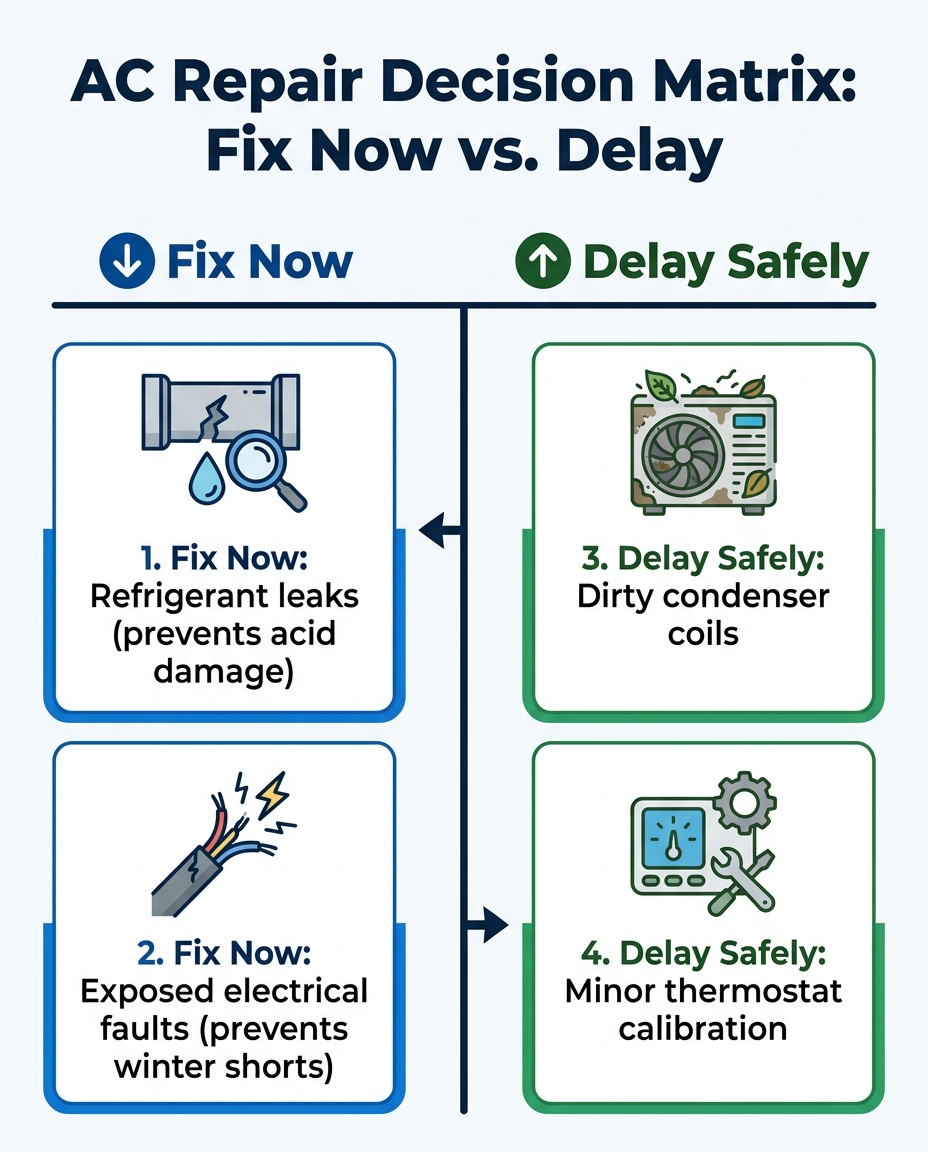
• Refrigerant leaks or frozen coils — Action Required: Fix Now — Mechanical Reasoning: Prevents atmospheric moisture from entering empty lines and creating compressor-destroying acid.
• Exposed electrical shorts / blown capacitors — Action Required: Fix Now — Mechanical Reasoning: Prevents freeze-thaw cycles from pushing ice into micro-cracks and destroying the circuit boards.
• Cracked outdoor casings or fan grilles — Action Required: Fix Now — Mechanical Reasoning: Prevents rain, snow, and debris from settling directly onto unlubricated, unprotected motor bearings.
• Dirty condenser coils or clogged filters — Action Required: Safely Delay — Mechanical Reasoning: Superficial dirt will not degrade the system while it is powered off; can be cleaned in the spring.
• Minor thermostat calibration issues — Action Required: Safely Delay — Mechanical Reasoning: An indoor communication error does not expose the outdoor mechanical parts to the winter elements.
• Noisy but functional fan blades — Action Required: Safely Delay — Mechanical Reasoning: As long as the unit is completely powered off at the breaker for winter, a rattling blade will not worsen.
The only way to know for certain which category your system falls into is to have a professional diagnose the root cause of the failure. An accurate diagnosis allows you to make an informed decision, and if the issue is minor, you can safely roll the repair into your spring HVAC maintenance plan without losing sleep over hidden winter damage.

Frequently Asked Questions About Off-Season AC Repair
Can I leave my broken AC during winter?
It depends entirely on the specific nature of the breakdown. Sealed system issues must be fixed to prevent internal corrosion, while minor superficial issues can wait. If your system suffered a refrigerant leak or structural damage to the casing, leaving it dormant will allow moisture and acid to destroy the internal components. However, if the issue is a dirty sensor or a minor thermostat glitch, shutting the power off at the breaker and waiting until spring is generally safe.
What happens if you don't fix an AC refrigerant leak?
Moisture enters the empty lines, reacting with residual oil to form hydrofluoric acid that destroys the compressor, leading to a full replacement. Because the line set is meant to be a pressurized vacuum, an empty line acts like a sponge for atmospheric humidity. Over a few months of sitting idle, this acidic sludge eats away at the copper windings inside the compressor motor, turning a moderate leak repair into a catastrophic, full-system failure.
Is it cheaper to replace an AC in the winter?
While off-season scheduling can occasionally be more flexible, waiting for winter to replace a unit that failed in August risks secondary damage to paired indoor HVAC components. If your AC and furnace share the same blower motor and indoor air handler, ignoring a severe mechanical failure in the AC side could compromise the heating side just when you need it most. Furthermore, navigating emergency replacements in the middle of a winter storm is far more stressful than handling it proactively in the fall.
Do I need my AC for dehumidification in the fall?
Yes, AC units are critical for removing indoor moisture during humid transitional months to prevent mold growth. In regions like Taylorsville KY, the late summer and early fall frequently feature days with high humidity, even as temperatures slowly begin to drop. Opening windows during these days simply traps heavy moisture inside your home's drywall and carpets, leading to poor indoor air quality and potential structural damage.
Will waiting to fix my AC cause more damage?
If the system has electrical faults or compromised seals, winter weather will actively worsen the damage. Continuous freeze-thaw cycles force expanding ice into micro-cracks in wire insulation and exposed circuit boards, breaking delicate connections. Unlubricated bearings and motors will also rust and seize up if they sit motionless and exposed to winter precipitation for six months, turning a small part replacement into a major overhaul.
How do I protect a broken outdoor unit from snow?
Turn off the breaker to prevent accidental startup, and place a piece of plywood over the top to block falling ice, but avoid wrapping it tightly in plastic which traps moisture. Wrapping an outdoor condenser in a tight tarp creates a greenhouse effect, trapping condensation inside the unit and accelerating rust on the internal components. The goal is to protect the fan grille from heavy debris while allowing the sides of the unit to breathe and evaporate ambient moisture.
Get a Clear Assessment for Your AC This Fall
When your air conditioner stops working during the late August / back-to-school transition, guessing about the severity of the problem is a risk you do not have to take. As we have seen, leaving a compromised system idle over the winter can lead to acidic corrosion, seized bearings, and severe electrical damage from freeze-thaw cycles. Knowing exactly what is wrong is the only way to make a safe, financially sound decision about whether to fix it now or wait until spring.
Before the weather shifts entirely and the lingering humidity takes a toll on your home, we encourage you to schedule a professional inspection. Getting a clear, mechanically-grounded decision framework detailing which types of breakdowns are safe to leave dormant over winter—and which will actively destroy the unit if left unaddressed—will give you the peace of mind to focus on the season ahead. Reach out to the experts today to get the honest assessment your home deserves.
Financing

Now Offering Financing Options with Affordable Monthly Payments
where we operate
Service Areas
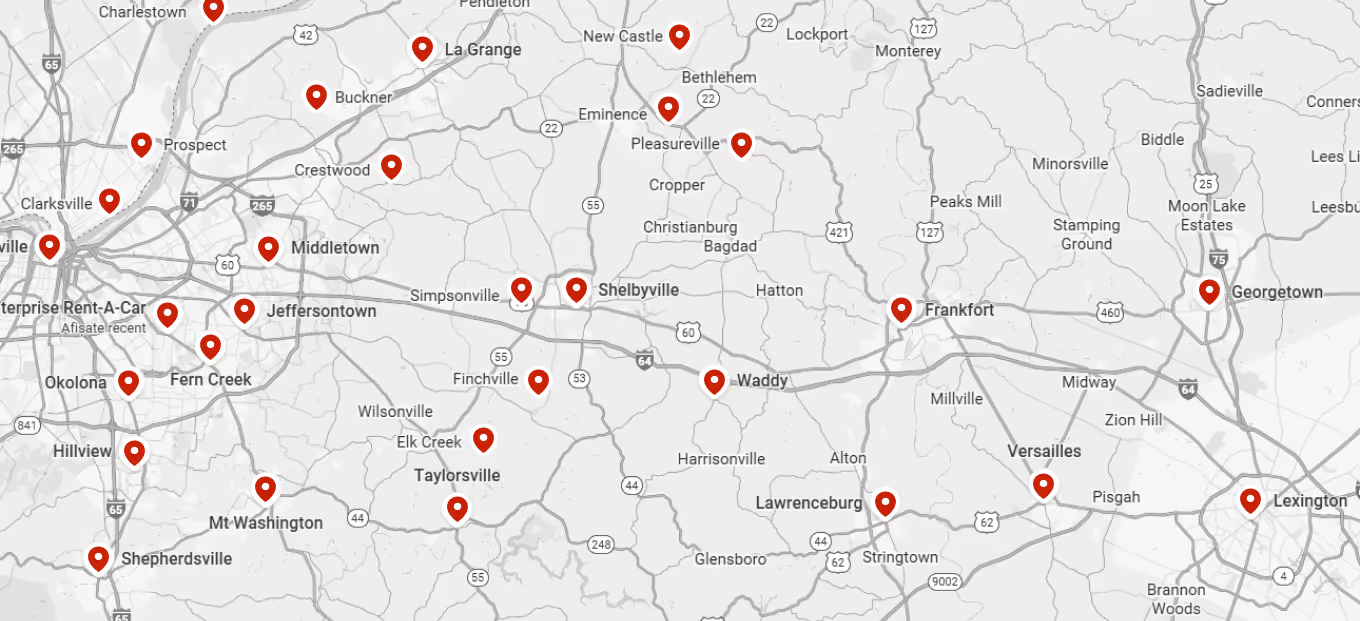
Proudly serving Spencer county, Jefferson county, Bullitt county, and the surrounding areas
Short Heading Goes Here
Sed iaculis aenean sit sed risus arcu vitae integer elit.

