

.svg)


.avif)



5 min read
Why Your Second Floor Is Suddenly Hotter in Late Summer
Are You Waking Up Sweating in Your Upstairs Bedroom This August?
Is your AC actually broken, or is it just struggling to keep up with the late summer heat? If you are trying to figure out why your second floor is suddenly hotter in late summer, you are definitely not the only homeowner asking this question right now. At 3D Heating and Cooling, our team fields countless calls about this exact issue every August. You run your air conditioner all day, the downstairs living room feels like a refrigerator, yet the upstairs bedrooms remain uncomfortably warm. This frustrating imbalance rarely happens in early June. Instead, it typically peaks right around the August back-to-school transition, leaving families tossing and turning in hot, stuffy rooms.
When this happens, you face a critical decision point: determining whether your cooling equipment is actually failing, or if your home's thermal boundary is simply overwhelmed by the prolonged seasonal heat. Often, the central cooling unit is doing exactly what it was designed to do, but the structural heat load has drastically changed. Specialized solutions exist to correct this persistent imbalance without necessarily replacing your entire central unit. When evaluating your home's cooling performance, it helps to understand how your air conditioning systems interact with the structural heat load.
Cumulative Heat Saturation: Why Late Summer Feels Worse
To understand why the upstairs heat problem peaks in August, you have to look at the physics of thermal mass and cumulative heat saturation. Throughout the spring and early summer, your home's building materials—wood framing, drywall, roofing shingles, and attic insulation—absorb solar radiation during the day and release it at night. Early in the season, these materials have plenty of time to cool off after the sun goes down.
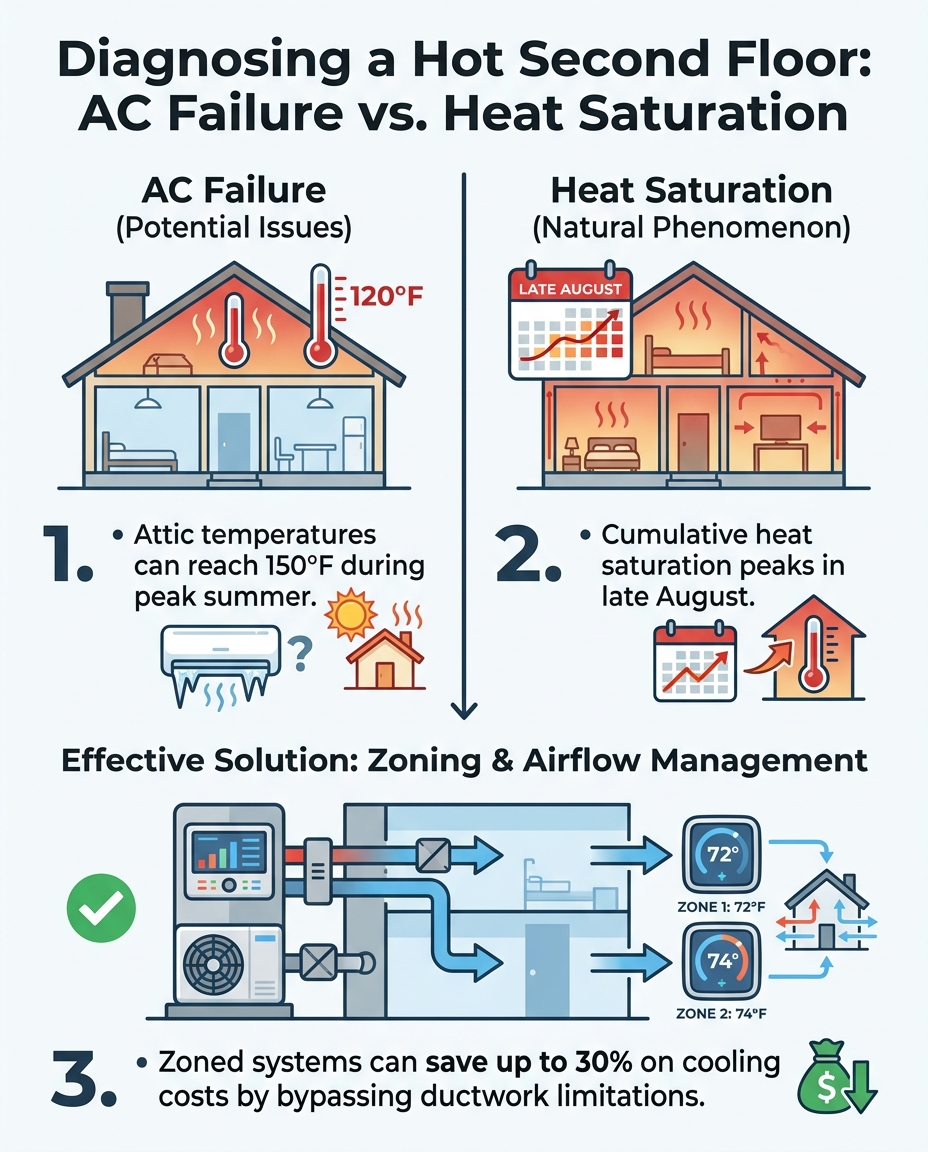
However, as the season progresses, this cycle changes. Sustained high temperatures mean that the structural materials never fully cool down before the sun rises again. By the time late summer arrives, the insulation reaches its maximum thermal mass. It becomes fully saturated with heat and loses its ability to effectively block heat transfer from the roof into your living spaces. Instead of acting as a shield, the saturated insulation begins radiating heat downward. A 150-degree attic can easily overpower the cooling efforts of standard residential HVAC setups, leading many homeowners to mistakenly believe their AC is losing power when, in reality, the heat load has simply drastically increased.
The Difference Between June and August Heat Loads
The core difference between early and late summer lies in overnight recovery. Early summer features cooler nights that allow the attic to reset its internal temperature. The insulation sheds the heat it absorbed during the day. In contrast, Taylorsville KY's hot, humid late summers prevent attics from fully cooling overnight. The humidity traps the heat, compounding the thermal mass saturation day after day. The attic starts the morning already hot, meaning your air conditioner is fighting an uphill battle before noon.
Because of this intense radiant heat, our technicians frequently see Taylorsville KY two-story homes experiencing a massive temperature differential between floors. Desperate for relief, many homeowners try closing vents to redirect cold air upstairs, but this alters the system's internal pressure and often makes the overall cooling performance worse.
Is Your AC Failing, or Is Your Home's Thermal Envelope Overwhelmed?
Before you panic about a total system replacement, it is vital to diagnose whether you need an AC repair or if the system is functioning properly but cannot keep up with the structural heat load. A failing air conditioner behaves very differently than a system fighting an overwhelmed thermal envelope.
If your equipment is failing, you will typically notice warm air coming from the supply vents, strange grinding or squealing noises, or the system short-cycling (turning on and off rapidly). On the other hand, if your thermal envelope is overwhelmed by the August back-to-school transition heat, you will likely feel very cold air blowing from the upstairs registers, but the room temperature simply refuses to drop. The AC is working, but the heat radiating from the ceiling is canceling out the chilled air.
• Air Temperature at Vent — Mechanical AC Failure: Blowing lukewarm or room-temperature air. — Overwhelmed Thermal Envelope: Blowing crisp, cold air as expected.
• Downstairs Comfort — Mechanical AC Failure: Downstairs is also struggling to reach the set temperature. — Overwhelmed Thermal Envelope: Downstairs is freezing cold while upstairs remains hot.
• System Cycling — Mechanical AC Failure: Short-cycling rapidly or completely unresponsive. — Overwhelmed Thermal Envelope: Running constantly without shutting off.
• Airflow Strength — Mechanical AC Failure: Weak, barely noticeable airflow from all vents. — Overwhelmed Thermal Envelope: Normal airflow downstairs, weaker airflow upstairs due to distance.
It is important to note that a sudden, sharp drop in performance can sometimes masquerade as a general heat issue. For example, during a sudden warm spell this past spring, one local homeowner called our 3D Heating and Cooling team because their system abruptly stopped cooling the upper levels. One of our technicians diagnosed a faulty coil and a unit refrigerant leak, fixing both on the same day to restore full performance. Because symptoms can overlap, having a professional assess both the mechanical equipment and the home's structural airflow is crucial. If you suspect mechanical issues, reaching out for professional AC services is the safest next step.

How Attic Insulation and Ventilation Reach Their Breaking Point
To fully grasp why your upstairs feels like an oven, we have to deep dive into the role of the attic in second-floor temperature regulation during peak seasonal heat. The physics of heat rising naturally traps hot air on the second story, but the condition of your attic determines whether that heat escapes or bakes your bedrooms.
When an attic reaches its breaking point, a predictable chain of events occurs in many of the Taylorsville KY two-story homes we service:
1. Radiant Heat Penetration: The sun beats down on the roof all day. Inadequate, settled, or degraded attic insulation allows this intense radiant heat to penetrate directly through the second-floor ceilings. If your insulation is old or unevenly distributed, it offers very little resistance to this downward thermal transfer.
2. Ventilation Bottlenecks: Proper attic ventilation relies on a balance of intake (soffit vents) and exhaust (ridge vents). This system exhausts trapped superheated air out of the top of the house. If insulation blocks the soffit vents, or if the ridge vents are clogged with debris, the hot air has nowhere to go. It expands and pushes down into the living space.
3. Thermal Bypass: Heat always seeks out colder areas. When the attic is 150 degrees and your bedroom is 75 degrees, the heat aggressively transfers through unsealed light fixtures, attic access doors, and ceiling joints.
A word of caution: Always avoid DIY ventilation modifications. Adding a random motorized fan or cutting new vents without understanding the home's designed airflow can accidentally create negative pressure, pulling expensive conditioned air out of your living space and into the attic.
Common Ductwork and Airflow Limitations in Multi-Level Builds
Even if your attic is perfectly insulated, the original HVAC design in many multi-story homes naturally struggles to deliver adequate cooling upstairs by late summer. Moving conditioned air is a matter of physics and fluid dynamics, and second floors present unique challenges.
The Challenge of Static Pressure
Pushing cold, dense air up to a second floor requires significant static pressure. Many single-zone systems installed in standard Taylorsville KY two-story homes simply lack the blower power to push air vertically against gravity while maintaining enough velocity to reach the furthest upstairs bedroom vents. By the time the air travels from the basement or main floor up to the second story, it has lost much of its force.
Long Duct Runs and Thermal Bypass
Upstairs bedrooms are usually located at the very end of the longest duct runs in the house. The longer the ductwork, the more opportunities there are for energy loss. If these ducts run through unconditioned spaces like attics or crawlspaces, thermal bypass occurs. The cold air inside the duct absorbs heat from the hot attic before it ever reaches your bedroom register. Furthermore, leaky ductwork can spill up to 30% of your conditioned air behind the walls.
Thermostat Placement and Neglected Maintenance
Relying solely on a main floor thermostat often leaves the upstairs neglected. Since cold air sinks, the main floor reaches the target temperature quickly, signaling the thermostat to shut the system off before the upstairs ever gets cool. Additionally, dirty air filters severely restrict the critical airflow needed to push air to those distant upstairs vents. Consulting an experienced HVAC company in Louisville can help map out these hidden airflow restrictions and correct the imbalances.
Targeted Cooling Solutions for Persistent Second-Floor Heat
When the primary central AC is already maxed out and the attic is saturated with heat, you need advanced, permanent solutions for cooling the upstairs. A common misconception we hear from customers is that simply upgrading to a larger central AC will solve the problem. In reality, an oversized central unit often leads to short-cycling. It blasts the downstairs with cold air, shutting off too quickly to remove humidity, leaving the whole house feeling cold but clammy.
Instead, ductless systems offer a highly efficient way to bypass existing ductwork limitations entirely. By delivering cooling directly to specific zones, a ductless mini-split eliminates the static pressure loss associated with long duct runs. Zoned cooling allows homeowners to sleep comfortably upstairs without overcooling the empty downstairs during the night. Federal tax credits may also apply to qualifying heat pump installations, making this a smart time to upgrade—though we always recommend verifying current programs with your tax professional.
Addressing these airflow imbalances can significantly improve overall home energy efficiency. Our team at 3D Heating and Cooling specializes in accurately diagnosing multi-level airflow and insulation issues specific to local home builds. This ensures the right solution is applied—whether that means sealing ductwork, addressing ventilation, or adding a supplemental zone—rather than just pushing a generic equipment swap. For many families facing the August back-to-school transition heat, a targeted ductless mini-split installation is the most effective way to guarantee comfort.
Frequently Asked Questions About Second-Floor Cooling
Why is my upstairs so much hotter than downstairs?
Your upstairs is hotter primarily because heat naturally rises, and your roof absorbs intense solar radiation throughout the day. In many Taylorsville KY two-story homes we evaluate, the upstairs bedrooms are furthest from the central blower, meaning they receive the weakest airflow. Combined with cumulative heat saturation in the attic, the second floor simply takes on more heat than the downstairs.
How can I cool down my second floor effectively?
The most effective way to cool down a second floor is to address both airflow and thermal boundaries. Ensure your attic is properly insulated and ventilated to prevent radiant heat transfer. For a permanent mechanical fix, installing a zoned system or a ductless mini-split provides direct cooling to the upstairs without relying on the home's primary ductwork.
Does closing downstairs vents help cool upstairs?
No, closing downstairs vents does not help cool the upstairs and can actually damage your HVAC system. Modern central air systems are balanced for specific static pressure; closing vents increases pressure inside the ducts, which can cause the blower motor to overwork, freeze the evaporator coil, and increase duct leakage.
Is a 10 degree difference between upstairs and downstairs normal?
While a slight temperature variation of 2 to 4 degrees is common in multi-level homes, a 10-degree difference indicates a severe airflow or insulation problem. This extreme gap usually points to inadequate attic insulation, severe duct leakage, or an undersized blower motor that cannot overcome the static pressure needed to reach the second floor.
Will installing an attic fan solve my upstairs heat problem?
An attic fan alone rarely solves an upstairs heat problem and can sometimes make it worse if the home lacks proper intake ventilation. If the attic fan pulls more air than the soffit vents can supply, it will create negative pressure and suck conditioned air out of your living space through tiny gaps in the ceiling.
Are ductless mini-splits a good solution for a single hot bedroom?
Yes, ductless mini-splits are an excellent, highly efficient solution for a single hot bedroom. They bypass the home's central ductwork entirely, delivering targeted, customizable cooling directly to the room that needs it most, which allows you to sleep comfortably without overworking the main central AC. We frequently recommend these for our Taylorsville clients struggling with hot master suites.
Restore Comfort to Your Upstairs Bedrooms Before Summer Ends
A hot upstairs is rarely a simple issue; it is often a complex mix of cumulative heat saturation, thermal boundary limits, and restricted airflow, rather than just a broken air conditioner. As the August back-to-school transition heat pushes your home to its limits, ignoring the problem will only lead to higher energy bills and restless nights.
Understanding why your second floor is suddenly hotter in late summer is the first step, but a professional evaluation is necessary to pinpoint the exact cause of the thermal imbalance. Schedule a comprehensive inspection with 3D Heating and Cooling today to discuss targeted cooling options, ensure your system is operating at peak performance, and finally get the logical explanation and clear guidance you need to sleep comfortably again.
Financing

Now Offering Financing Options with Affordable Monthly Payments
where we operate
Service Areas
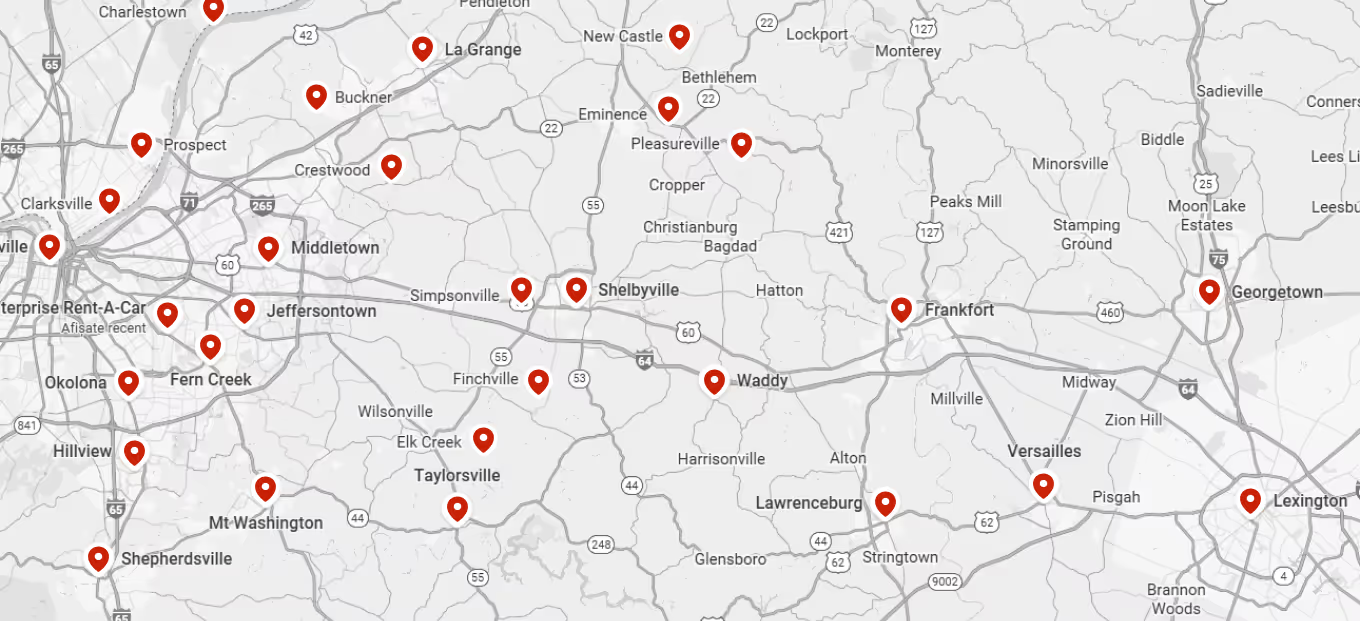
Proudly serving Spencer county, Jefferson county, Bullitt county, and the surrounding areas
Short Heading Goes Here
Sed iaculis aenean sit sed risus arcu vitae integer elit.