

.svg)


.avif)


5 min read
Window Units vs. Portable ACs as Emergency Backup Cooling
Surviving a July Heatwave When the Central Air Fails
Mid-July peak summer heat is already unforgiving, but the situation turns frantic the moment your home's central air stops blowing cold air. It is 4 p.m., the indoor temperature is climbing rapidly, and you know a restless, sweaty night is ahead unless you take immediate action. If you find yourself standing in a hardware store aisle weighing window units vs. portable ACs as emergency backup cooling, you need a fast, decisive answer.
In this high-stress moment, standard appliance buying guides are useless. You are not looking for a ten-year investment to perfectly chill a sunroom. You need immediate, same-day relief for a single room so your family can sleep safely. The goal is simply to bridge the uncomfortable gap until professional air conditioning services and AC repair and replacement can restore your whole-home comfort.
The immediate priority: Getting a temporary unit out of the box, into your house, and blowing cold air as fast as physically possible. To make the right choice, you have to evaluate these backup units based on deployment speed, vehicle logistics, and your specific bedroom windows.
Crisis Deployment: Why Setup Speed Trumps Long-Term Efficiency
Most homeowners make the mistake of reading energy efficiency ratings on the side of the box when buying temporary backup cooling. During a July peak summer breakdown, long-term operating costs are entirely irrelevant. You are buying a short-term stopgap meant to run for a few days, not a permanent fixture.
The real problem you face is the physical reality of crisis deployment. You have to fit the box into your vehicle, carry it inside while already fatigued from the heat, and potentially haul it up a flight of stairs. A unit that takes three hours to properly bracket and seal is useless if you are setting it up alone at dusk. The solution requires prioritizing logistics over standard metrics. You need a unit that can be installed safely without dropping it, and without drilling permanent holes into your window frames or walls just for a few days of use.
The Single-Room Strategy
Temporary cooling only works if you manage your expectations and your square footage. A backup unit cannot cool an entire open-concept first floor.
• Choose a primary space: Focus all cooling power on one enclosed space, usually the primary bedroom, to create a habitable sleeping bunker.
• Seal the envelope: Close the bedroom door, shut the blinds to block solar heat gain, and push a rolled-up towel under the door gap to trap the cold air inside.
• Block unused vents: Though you should never close vents during normal central AC operation, sealing the central return and supply registers in this specific room prevents your temporary unit from pushing cold air back into your home's dormant ductwork.
Window Units: Maximum Cooling Power with Installation Caveats
If raw cooling speed is your only metric, a traditional window air conditioner is usually the superior machine. Because the heat-generating compressor sits entirely outside your window, the unit does not radiate waste heat back into your sleeping space. However, during a July peak summer emergency, the drawbacks of a window unit center entirely around the installation process.
• Pro: Faster temperature drops. By keeping the hot components outside, a window unit delivers colder air directly into the room without fighting its own mechanical heat.
• Pro: Zero floor space required. The unit sits on the sill, keeping your bedroom floor clear of tripping hazards in the middle of the night.
• Con: Dangerous heavy lifting. Window units are notoriously heavy and unbalanced. Trying to balance a 60-pound metal box on a second-story window sill while sweating and fatigued is a significant safety risk.
• Con: Strict window compatibility. These units only work with standard double-hung windows (windows that slide up and down). If your bedroom features casement windows (crank outward) or horizontal sliding windows, a standard window unit is practically useless.
• Con: Temporary securing challenges. You need the unit to stay put without drilling permanent support brackets into your siding or window frame, which often requires improvising with wood blocks.
If you live outside the immediate metro area and are relying on prompt Bardstown AC services, a window unit might provide the strongest cooling while you wait, provided you have a willing helper to lift it safely.
Portable Air Conditioners: Floor Space and Exhaust Hose Realities
Portable air conditioners—the tall, freestanding units on caster wheels—offer a completely different set of compromises. Their primary advantage is setup convenience. Because the heavy compressor sits on the floor, you simply roll the unit into the room and snap a lightweight plastic panel into the window to vent the hot air.
However, the Department of Energy (DOE) notes distinct efficiency drawbacks with portable designs. Because the entire machine sits inside the room, waste heat radiates from the thick plastic exhaust hose back into your living space. Furthermore, single-hose portable models create negative air pressure. As they blast hot air outside, they pull warm air from the hallway under your bedroom door to replace it, making the unit work harder to maintain a cold temperature during a July peak summer heatwave.
Dual-hose models perform better: If you must buy a portable unit, look for a dual-hose model. One hose pulls outside air in to cool the compressor, while the second exhausts the heat, preventing that negative pressure vacuum and cooling the room much faster.
The Exhaust Panel Challenge
While installing a portable AC avoids heavy lifting, the window setup is rarely perfect. The plastic sliders designed to hold the exhaust hose often leave significant air gaps. In an emergency, you will likely need temporary weather stripping, foam pipe insulation, or even duct tape to seal the edges of the plastic panel. The goal is to block hot outdoor air from seeping back in without ruining your window frame's paint job.
Managing High Humidity and Condensation Tanks
One critical factor that generic buying guides miss is regional weather. Air conditioning inherently dehumidifies the air as it cools. That pulled moisture creates condensation, and that water has to go somewhere.
With a window unit, this process is invisible. The water simply drips harmlessly out the back of the unit onto the ground outside. But with a portable air conditioner, the water collects in an internal tank inside the machine.
This becomes a massive problem in Taylorsville KY. The intense summer heat and high humidity levels in the region mean a portable AC will pull massive amounts of water from the bedroom air. On a particularly muggy night, that internal tank can fill up in just a few hours. When the tank fills, a sensor trips and shuts the compressor off to prevent flooding. There is nothing worse than waking up at 3 a.m. covered in sweat because your temporary portable AC turned itself off, forcing you to groggily disconnect the tank and carry it to the bathtub.
The continuous drainage risk: Many portable units offer a continuous drain option where you can attach a garden hose to the back. In an emergency setup, homeowners often run this hose into a five-gallon bucket. If you sleep through the bucket overflowing, you risk severe secondary water damage to your bedroom floors just to stay cool.
Head-to-Head Comparison: Choosing Your Temporary Lifeline
If you are standing in the store trying to make a rapid decision, use this quick breakdown to choose the right temporary unit for a July peak summer breakdown.
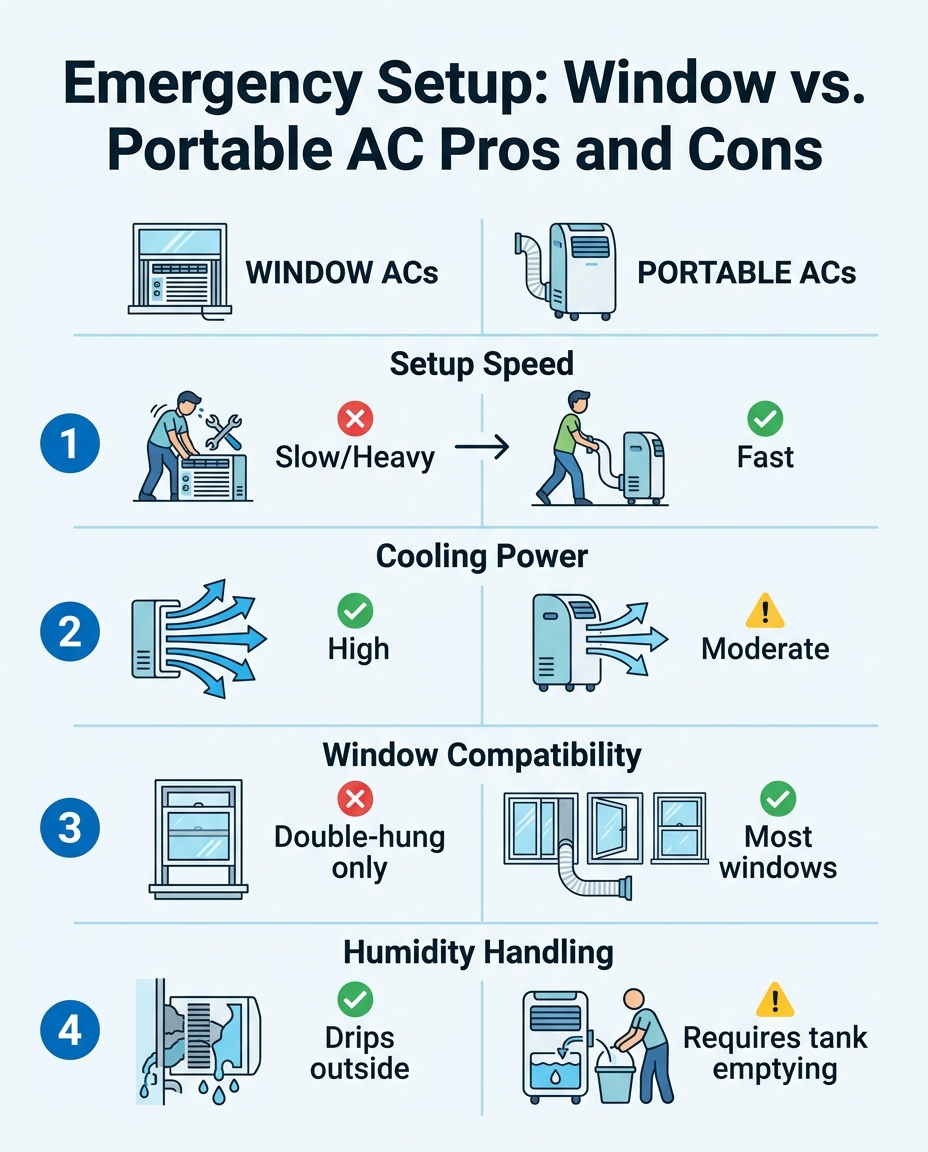
• Installation Effort — Window Unit: High (Heavy lifting, requires two people) — Portable AC: Low (Rolls on wheels, lightweight window panel)
• Cooling Speed — Window Unit: Fast (No waste heat inside the room) — Portable AC: Moderate (Exhaust hose radiates heat back into room)
• Window Compatibility — Window Unit: Double-hung only — Portable AC: Works with most window types, including sliding
• Humidity Handling — Window Unit: Excellent (Drips outside automatically) — Portable AC: Poor (Requires manual tank emptying or a bucket)
• Floor Space — Window Unit: Zero footprint — Portable AC: Takes up floor space, creates tripping hazards
A note on sizing: Always check the BTU (British Thermal Unit) rating on the box against your room's square footage. Buying a 5,000 BTU unit for a large master suite will result in a machine that runs nonstop without ever actually cooling the space down.

Transitioning from Stopgap Cooling to Permanent Restoration
Buying a backup unit provides immediate breathing room, but it is not a permanent solution. Living out of one cooled room while the rest of the house bakes is stressful, and the ultimate goal is getting your central air conditioning back online as quickly as possible.
Once your bedroom is cooling down, your next step is scheduling prompt professional intervention. Ignoring a broken central system can cause minor electrical issues to cascade into major, irreversible compressor failures. This is where relying on a fast-responding local team makes all the difference. With 3D Heating and Cooling's rapid, reliable emergency HVAC service, families in Taylorsville KY will only need to rely on their temporary backup unit for a very short window.
What to Do While You Wait
While you sit in your cooled room, take immediate steps to protect your permanent equipment.
• Turn the thermostat OFF: Do not leave your central thermostat set to "cool." If the system is malfunctioning, letting it continuously try to start up can burn out the motors or fry the capacitors. Switch it completely off.
• Clear the outdoor unit: Ensure there are no branches, debris, or patio furniture blocking your central outdoor condenser unit so the technician has immediate access.
• Read up on the process: Understanding what happens next reduces stress. Review our guide on navigating emergency AC repair wait times to prepare for the technician's arrival and gather any necessary maintenance records.
Frequently Asked Questions About Temporary Backup Cooling
Which is easier to install temporarily: a window or portable AC?
A portable AC is significantly easier to install in an emergency. Because the heavy compressor sits on caster wheels on the floor, you only have to lift a lightweight plastic exhaust panel into the window. Window units require lifting 50 to 80 pounds of dead weight through an open window frame, which often requires two people to do safely.
Do portable ACs work well in high humidity?
Portable ACs struggle with convenience in high humidity because they collect condensation in an internal tank. During a July peak summer heatwave, the air holds a massive amount of moisture, causing that tank to fill up rapidly. If you do not set up a continuous drain hose, the unit will repeatedly shut itself off until you manually empty the water.
How do you cool one room when the central AC is broken?
To effectively cool a single room, you must seal the space entirely to trap the cold air. Close the door, block the gap underneath with a towel, and shut all blinds to block radiant solar heat. Ensure the temporary backup unit is sized correctly (in BTUs) for the square footage of that specific room.
Which cools a room faster, a window unit or portable AC?
A window unit generally cools a room faster than a portable model. Window units keep their hot, heat-generating components outside the house, pushing only cold air indoors. Portable units keep all components inside, and the plastic exhaust hose radiates some waste heat back into the room as it vents.
Do portable ACs use more electricity than window units?
Yes, portable air conditioners typically use more electricity to achieve the same level of cooling. Especially with single-hose models, the unit creates negative air pressure that pulls warm air into the room from the hallway, forcing the compressor to run longer and work harder to maintain a cool temperature.
Can a temporary AC unit damage my window frame?
Yes, improper installation can easily damage window frames. Heavy window units can warp the lower sash or scratch the sill if not properly supported by a bracket or wood block. Portable AC exhaust panels are safer for the frame, provided you use easily removable weather stripping rather than permanent adhesives to seal the gaps.
Restore Your Whole-Home Comfort Faster
A temporary backup unit is a lifesaver during a breakdown, but it is just a bridge to true comfort. You shouldn't have to spend your summer confined to a single chilly bedroom while the rest of your home swelters. Once the immediate crisis is managed, it is time to resolve the underlying failure. Schedule a comprehensive diagnostic inspection to get your central system running efficiently again. A local Taylorsville KY expert is ready to restore your home to normal, so you can pack that temporary unit away for good.
Financing

Now Offering Financing Options with Affordable Monthly Payments
where we operate
Service Areas
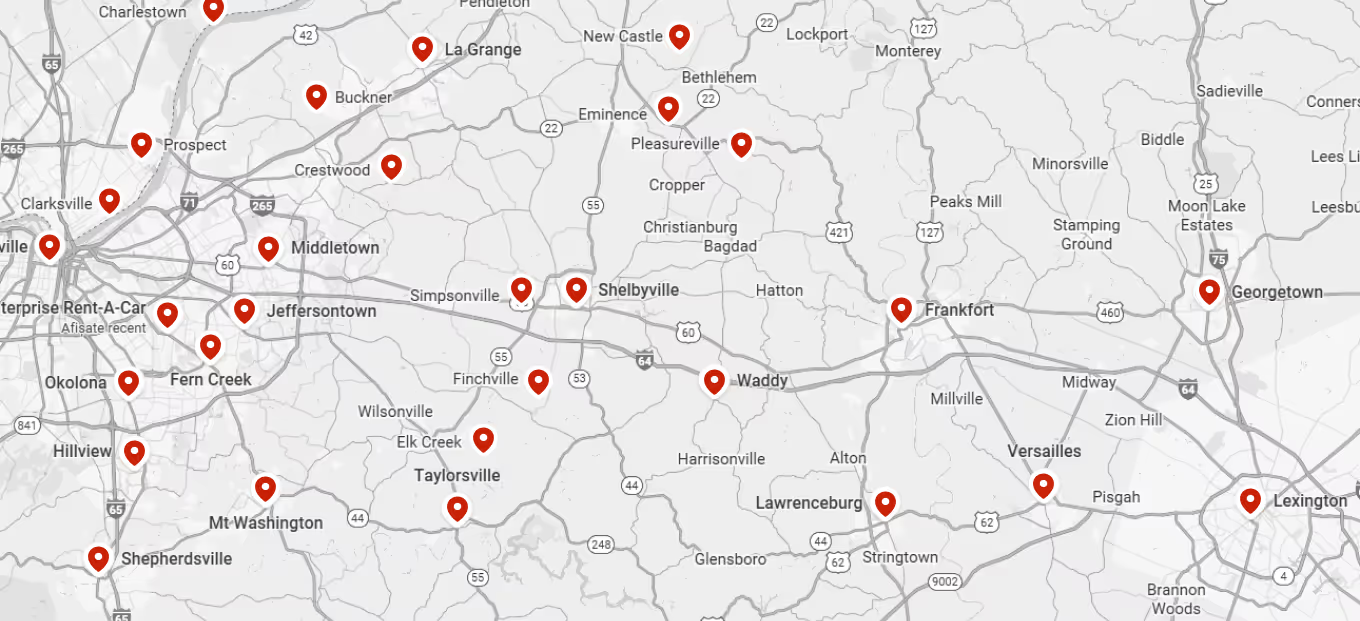
Proudly serving Spencer county, Jefferson county, Bullitt county, and the surrounding areas
Short Heading Goes Here
Sed iaculis aenean sit sed risus arcu vitae integer elit.

