

.svg)


.avif)


5 min read
Serving Elizabethtown KY: Common AC Wear Patterns We See in Late Summer
The Cumulative Toll of August Heat on Elizabethtown AC Units
Your air conditioner has been running continuously since June, but now the house just isn't cooling down like it used to. At 3D Heating and Cooling, when serving Elizabethtown KY: Common AC wear patterns we see in late summer often trace back to this exact kind of cumulative heat fatigue. Many homeowners mistakenly assume their system just needs to limp along for a few more weeks until the fall weather arrives. Unfortunately, our team knows that ignoring a struggling cooling system in late August is one of the most reliable ways to turn a minor component issue into a catastrophic equipment failure.
By the time late summer (August) rolls around, your outdoor unit has endured thousands of hours of continuous operation. Kentucky's lingering high heat and heavy humidity act as a primary catalyst for maximum thermal strain on outdoor HVAC components. The system has to work twice as hard to remove the thick moisture from the air before it can even begin to lower the ambient temperature inside your home. This relentless demand degrades internal components, bakes electrical connections, and pushes aging parts past their breaking point.
From our technicians' perspective, this time of year is highly predictable. The service calls we receive at 3D Heating and Cooling aren't usually for sudden, mysterious breakdowns; they are the direct result of delayed action. We often hear from homeowners who noticed a strange noise or longer cooling cycles in July, but waited until the unit completely stopped blowing cold air in August to call for help. If you want to protect your investment and avoid unnecessary replacements, partnering with our team that provides comprehensive professional HVAC services is the best way to catch these wear patterns before they spiral out of control.
Failing Capacitors: The Most Common Late-Summer Casualty
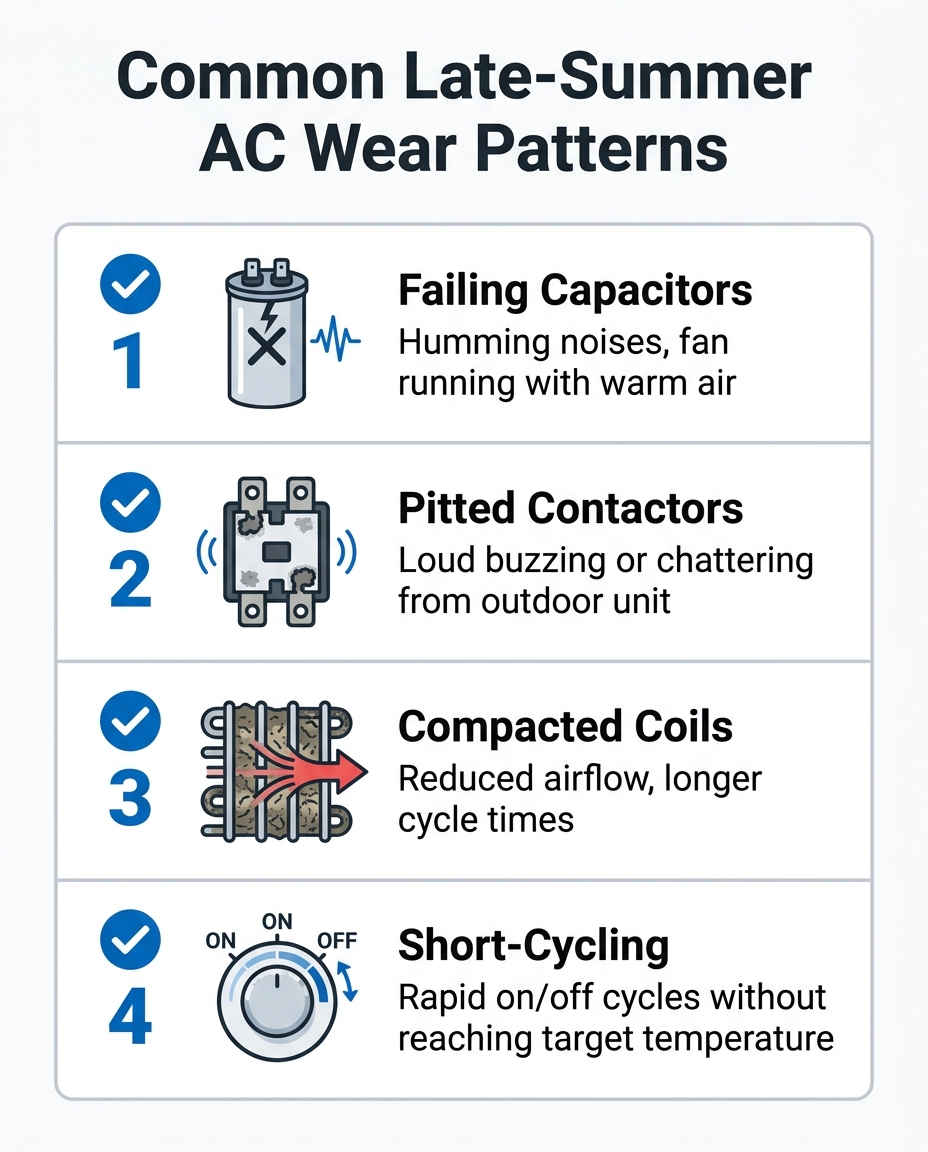
If there is one specific component that falls victim to late-summer heat more than any other, it is the run capacitor. Think of the capacitor as a heavy-duty battery or energy store that kickstarts your compressor and fan motors. Because these motors require a massive jolt of electricity to start spinning—far more than your home's wiring can provide on its own—the capacitor stores energy and releases it on demand. When this component begins to fail, the motors cannot start, and your entire cooling cycle grinds to a halt.
According to general industry data and ASHRAE guidelines, capacitors are highly sensitive to prolonged high temperatures. They are designed to operate within specific thermal limits, but sitting in the direct Elizabethtown KY sun while running continuously for weeks on end pushes them past their design threshold. If you catch a failing capacitor early, it is a relatively straightforward fix for our technicians providing air conditioning repair and maintenance. If you ignore it, the resulting electrical strain can destroy your compressor.
Watch for these progressive symptoms of a failing capacitor:
1. Clicking noises from the cabinet: You may hear a distinct, repetitive clicking sound coming from the outdoor unit when the thermostat calls for cooling. This is the electrical relay attempting to engage a capacitor that no longer holds a charge.
2. A loud humming or buzzing sound: If the motor is trying to start without the capacitor's boost, it will pull high amperage and hum loudly. This is a critical warning sign that the motor is overheating.
3. The fan runs, but the air is warm: Sometimes the fan motor capacitor still works, but the compressor side has failed. The outdoor fan will spin, but the air coming out of your indoor vents will feel lukewarm or humid.
4. Random system shutdowns: As the component loses its ability to hold a steady microfarad rating, the system may start and stop unpredictably.
How Heat Degrades Component Lifespans
To understand why August is so brutal on capacitors, you have to look inside the component itself. Capacitors are filled with a dielectric fluid that helps manage internal temperatures and maintain electrical capacitance. Under extreme, prolonged thermal stress, this fluid begins to break down, expand, and lose its insulating properties. In severe cases, the top of the metal casing will physically bulge or dome outward due to the internal pressure.
Continuous cycling prevents the component from ever cooling down. In a normal season, the AC cycles off long enough for the capacitor to dissipate its internal heat. However, during a late-summer heatwave, the system might run for hours at a time, baking the internal fluid until it completely degrades.

Pitted Contactors and Electrical Strain
While capacitors take the brunt of the heat, the contactor is another critical electrical component that we frequently see fail in late summer (August). The contactor is essentially a heavy-duty mechanical switch located inside your outdoor condensing unit. When your indoor thermostat calls for cooling, it sends a low-voltage signal to the contactor. An electromagnetic coil pulls the contactor closed, allowing high-voltage electricity to flow directly into the compressor and fan motor.
Every time that switch closes, a small electrical arc jumps between the metal plates. Over months of long cooling cycles, this constant arcing burns, scars, and pits the metal surfaces. By the time August arrives, the contact plates can become so coated in carbon buildup that electricity can no longer flow smoothly. This creates immense electrical resistance, forcing the system to pull more amperage and generate even more heat.
The audible warning signs: A failing or pitted contactor usually announces itself before it completely dies. You might hear a loud, aggressive buzzing sound—much harsher than a normal hum—or a rapid "chattering" noise coming from the outdoor unit. This chattering means the electromagnet is struggling to hold the pitted plates together, causing the switch to rapidly bounce open and closed.
A strict safety warning: Electrical diagnostics require a licensed professional. We strongly urge homeowners never to attempt DIY electrical repairs on an HVAC system. The voltage passing through a contactor is lethal, and bypassing or tampering with electrical controls can cause immediate, catastrophic damage to your compressor or spark an electrical fire.
Compacted Coil Dirt and Refrigerant Leaks
Mechanical and electrical components aren't the only parts of your system suffering from heat fatigue. By the time late summer arrives, your outdoor condenser coil has likely been subjected to months of heavy spring storms, flying grass clippings, airborne pollen, and blowing dust. Because the outdoor fan pulls air through these fins to release heat, all that debris gets sucked directly into the coil.
When the delicate aluminum fins become compacted with dirt, the system loses its ability to release heat into the outside air. The heat remains trapped inside the refrigerant lines. This forces the compressor to run longer and harder, driving up the internal pressure of the entire system. Elevated operating pressures combined with the constant vibration of a struggling compressor can easily expose weak joints, creating or worsening refrigerant leaks.
A system suffering from restricted airflow and a refrigerant leak will rapidly lose its cooling capacity. In our experience, prompt service is critical. Our team recently helped an Elizabethtown homeowner who reached out in the spring when their AC started having issues, including a faulty coil and a unit leak. One of our technicians diagnosed and fixed both problems on the same day, getting the system fully repaired and running well. While this happened earlier in the year, we see the exact same scenario play out continuously across Elizabethtown KY in August, often with much higher stakes due to the extreme heat. A unit cannot overcome a dirty coil and a refrigerant leak at the same time—it requires immediate professional intervention.
Short-Cycling vs. Normal High-Heat Operation
As the late-summer heat drags on, many homeowners become hyper-aware of how often their air conditioner is running. It is crucial to understand the difference between a system that is working hard to combat the weather and a system that is actively failing.
Normal Operation: Long cooling cycles are actually expected and necessary during late summer. Kentucky's high humidity forces the compressor to work harder to remove moisture from the indoor air (latent heat) before the thermostat can even register a drop in the actual room temperature (sensible heat). If your system is running for 30 to 45 minutes at a time but the house feels comfortable and the humidity is low, the system is operating normally for the climate.
Short-Cycling: This is a highly destructive wear pattern where the system turns on, runs for a very brief period (usually under 10 minutes), and shuts off abruptly without ever reaching the set thermostat temperature. The system will then turn back on a few minutes later, repeating the rapid loop.
The Department of Energy (DOE) notes that short-cycling destroys energy efficiency and accelerates mechanical wear. Every time the compressor starts up, it draws a massive surge of power and experiences sudden mechanical stress. Doing this dozens of times an hour will quickly burn out the motors.
• Cycle Length — Normal High-Heat Operation: 30–45+ minutes during peak heat — Short-Cycling (Warning Sign): Under 10 minutes, shutting off abruptly
• Indoor Comfort — Normal High-Heat Operation: Consistent temperature, low humidity — Short-Cycling (Warning Sign): High humidity, hot and cold spots
• System Rest Time — Normal High-Heat Operation: Stays off until temperature rises naturally — Short-Cycling (Warning Sign): Turns back on almost immediately
• Primary Causes — Normal High-Heat Operation: High outdoor ambient temperatures — Short-Cycling (Warning Sign): Overheating compressor, severe airflow block
Common triggers for short-cycling in late summer (August) include an overheating compressor shutting itself down on a thermal overload limit, or a severe airflow restriction causing the indoor evaporator coil to freeze solid.
Why Ignoring Minor Noises Leads to Total Compressor Failure
The biggest mistake our technicians see homeowners make in late summer is treating a strange noise as an annoyance rather than a warning. The components in your HVAC system are deeply interconnected. When a minor part fails, the larger, more expensive parts are forced to compensate.
Consider the failing capacitor discussed earlier. A relatively inexpensive neglected capacitor forces the compressor to pull lethal amounts of amperage just to start turning. The compressor is the undisputed heart of your cooling system. It is a hermetically sealed pump responsible for circulating refrigerant through the entire home. If the compressor burns out because it was constantly starved of electrical support, the entire outdoor unit is compromised.
Waiting until the unit completely dies during a late-August heatwave is a massive financial and comfort risk. A total compressor failure often forces a difficult conversation about whether an aging, failing system is worth repairing or if replacement is the safer long-term bet. If your system is already out of warranty and showing signs of severe heat fatigue, you may need to evaluate repairing vs. replacing an aging AC unit. Catching the small issues—like a pitted contactor or a humming capacitor—prevents you from being backed into a corner when the compressor finally gives out.
Troubleshooting: Filter Change or Professional Diagnosis?
When your system starts struggling in late summer (August), there are a few safe, actionable steps you can take before calling in our professionals at 3D Heating and Cooling. The goal is to rule out basic airflow restrictions without putting yourself at risk of electrical shock or voiding your warranty.
Safe Homeowner Checklist:
• Verify thermostat settings: Ensure the thermostat is set to "Cool" and the fan is set to "Auto." Sometimes, a bumped setting can cause the fan to run continuously without the compressor, mimicking a breakdown.
• Clear outdoor debris: Walk outside and inspect the condensing unit. Gently remove any heavy brush, tall grass, or leaves resting against the metal grilles. Ensure the unit has at least two feet of clearance on all sides to properly exhaust heat.
• Change the indoor air filter: This is the most critical homeowner task. A completely clogged air filter will suffocate the indoor blower motor. This lack of airflow prevents the system from absorbing heat, which can cause the indoor coil to freeze solid and trigger short-cycling. A dirty filter perfectly mimics severe heat fatigue.
Once you have verified that the filter is clean and the outdoor unit is clear of debris, you have reached the boundary of safe homeowner troubleshooting. If the system is still making strange noises, blowing warm air, or short-cycling, it is time for a professional diagnosis.
Our local technicians who provide Elizabethtown, KY HVAC services are incredibly familiar with the specific architectural layouts and neighborhood-level HVAC setups in the area. We understand exactly how the local late-summer climate impacts these specific systems, allowing our team to diagnose heat fatigue symptoms quickly and accurately without guesswork.
Protecting Your Investment with End-of-Season Maintenance
The most effective way to prevent cumulative seasonal wear from destroying your system is to adopt a proactive approach. End-of-season maintenance evaluates the toll the summer heat has taken on your equipment before it transitions into heating mode for the winter.
During a comprehensive late-summer tune-up, a 3D Heating and Cooling technician will open the outdoor cabinet and test the exact components that we know are most likely to fail. We will use a multimeter to test the capacitor's microfarads, ensuring it still holds a full charge. We will visually inspect the contactor for pitting and carbon buildup, replacing it if the electrical resistance is too high. Finally, our team will measure the refrigerant levels and clean the compacted dirt out of the condenser coils.
Routine care extends the overall lifespan of the equipment and maintains the energy efficiency ratings you paid for when the system was installed. Rather than crossing your fingers and hoping the AC survives until September, enrolling in a routine AC maintenance plan provides structured, predictable defense against cumulative seasonal wear. It ensures a professional set of eyes evaluates your system in Elizabethtown KY exactly when it is under the most stress.
Frequently Asked Questions About Late-Summer AC Issues
Why is my AC struggling in late summer?
Your AC is struggling because it has endured months of continuous thermal stress. By late summer, components like capacitors and contactors have degraded from heat fatigue, and outdoor coils are often compacted with dirt and debris. This cumulative wear forces the system to work harder, reducing its overall cooling capacity.
Can heat cause an AC capacitor to fail?
Yes, extreme heat is the primary cause of AC capacitor failure. Capacitors rely on internal dielectric fluids that break down when exposed to prolonged, intense temperatures. When the system runs continuously during late-summer heatwaves, the capacitor never gets a chance to cool off, leading to rapid degradation.
Why is my AC running constantly but not cooling?
If your system runs constantly without dropping the temperature, it usually indicates a severe airflow restriction or a refrigerant issue. A clogged air filter, compacted outdoor coils, or a slow refrigerant leak will trap heat in the system and prevent it from properly conditioning the indoor air.
What are the signs of a failing AC capacitor?
The most common signs include a loud humming or buzzing noise coming from the outdoor unit, clicking sounds from the cabinet, or the outdoor fan running while the air inside feels warm. You may also notice the system struggling to start up or randomly shutting down mid-cycle.
Why is my AC making a humming noise in late summer?
A loud humming noise from the outdoor unit usually means the compressor or fan motor is trying to start but lacks the electrical power to do so. This is almost always caused by a failing capacitor or a pitted contactor that is restricting the flow of electricity to the motors.
Should I fix a struggling AC at the end of summer?
Yes, you should always fix a struggling AC immediately, regardless of the season. Ignoring a minor issue like a weak capacitor in late summer forces the compressor to take on massive electrical strain, which can easily result in a total, irreversible compressor failure before the season ends.
Securing Your Home's Comfort Before the Cooling Season Ends
Addressing minor wear patterns now is the only reliable way to prevent major breakdowns later. The cumulative toll of running a cooling system through June and July leaves vital electrical and mechanical components highly vulnerable by the time August heatwaves arrive. When you hear humming, clicking, or notice the system short-cycling, your equipment is actively asking for help.
Do not wait for a struggling system to completely fail in the Elizabethtown KY heat as families prepare for the back-to-school transition. Take the proactive step to protect your home's comfort and your financial investment. Schedule a professional inspection with our local 3D Heating and Cooling experts today to ensure your system is safe, efficient, and ready to keep you comfortable through the rest of the season.
Financing

Now Offering Financing Options with Affordable Monthly Payments
where we operate
Service Areas
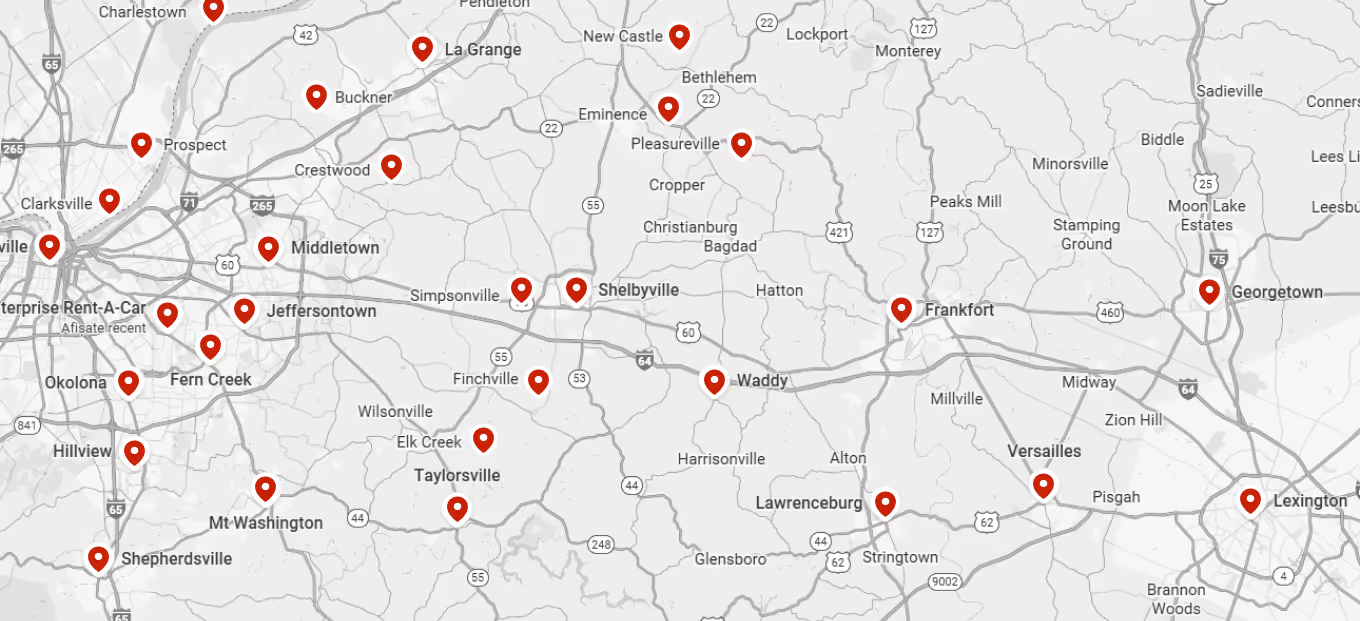
Proudly serving Spencer county, Jefferson county, Bullitt county, and the surrounding areas
Short Heading Goes Here
Sed iaculis aenean sit sed risus arcu vitae integer elit.

