

.svg)


.avif)



5 min read
Smart Thermostats vs. Programmable Models for Managing Variable August Weather
Surviving the August Shift: When Constant Thermostat Adjustments Become a Chore
August weather in Kentucky brings a distinct brand of unpredictability, making the choice between Smart Thermostats vs. Programmable Models for Managing Variable August Weather a highly practical decision for your daily comfort. The late-summer heat is rarely just a steady, predictable burn. Instead, scorching afternoon temperatures often give way to suddenly cooler evenings, creating a daily battle right at your wall unit. At 3D Heating and Cooling, we hear from frustrated homeowners every late summer who find themselves constantly walking over to bump the temperature up or down because the house feels too stuffy or surprisingly freezing. If that sounds familiar, your current controls are likely falling behind the weather.
Relying on static, pre-set schedules often leads to significant over-cooling and wasted energy during unexpected temperature drops. When a traditional thermostat expects a 95-degree afternoon but a storm front rolls in, the air conditioner keeps running its heavy cycle, leaving your living room feeling like an icebox. This brings up a core decision for many of our customers: is it time to replace that rigid, set-schedule unit with an adaptive learning model? Matching the right thermostat technology to your home HVAC systems is the key to maintaining a consistent indoor climate without the constant manual intervention.
The daily frustration:
• Morning chills: Waking up freezing because the overnight schedule didn't account for a sudden cool front.
• Afternoon stuffiness: Returning home to a sweltering house because the schedule assumed you would be at work or picking the kids up from school, but your plans changed.
• Evening battles: Constantly overriding the system as late-summer August volatile weather swings shift the outdoor temperature by twenty degrees in just a few hours.
Upgrading your thermostat is about more than just adding a digital screen to the wall. It is about bridging the gap between the unpredictable weather outside and the expensive climate control equipment inside your home.
The Limits of Rigid Routines: Why Programmable Thermostats Struggle in Late Summer
Traditional programmable thermostats were a massive leap forward from old manual dials, but they operate on strict, unforgiving assumptions. They rely entirely on the data you punch into them—usually a rigid 9-to-5 schedule that assumes every Monday is exactly the same, and every afternoon requires the exact same amount of cooling power. When the weather shifts unexpectedly, these rigid routines completely fall apart.
The 9-to-5 Trap
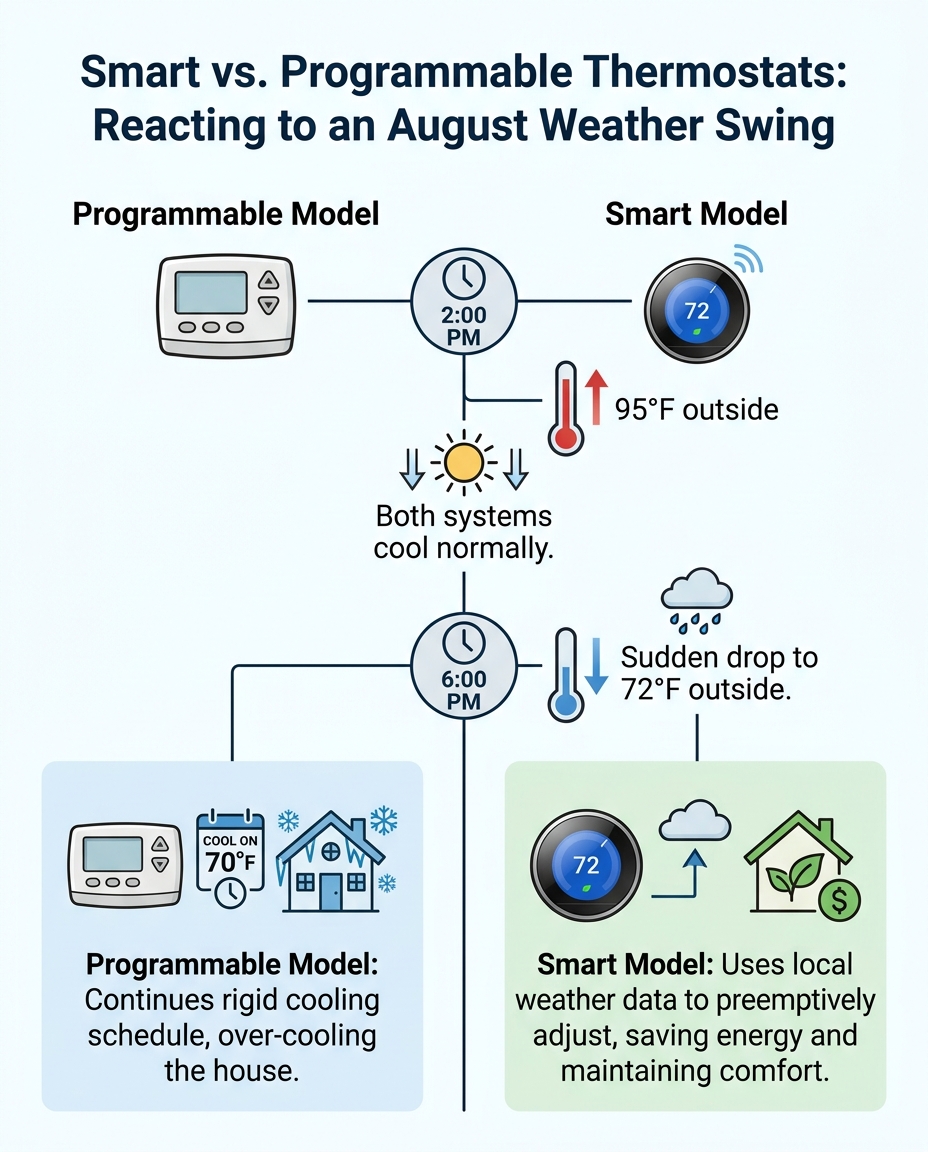
A standard programmable model does not know if it is raining, cloudy, or experiencing a sudden heat wave. It only knows what time it is and what temperature you told it to target at that specific hour. Working throughout the Taylorsville KY and surrounding Kentuckiana areas, our team sees firsthand how local weather patterns are notorious for high afternoon humidity that abruptly breaks into sudden evening temperature drops. A programmable thermostat cannot see that evening drop coming. It will continue to blast cold air based on its afternoon programming until the indoor temperature finally hits the target, often overshooting the actual comfort level you need.
The Cost of Constant Overrides
When the schedule fails, homeowners are forced to step in. You walk over to the wall, hit the "hold" button, and manually adjust the temperature. While this solves the immediate discomfort, it completely destroys the energy-saving benefits the thermostat was supposed to provide. In fact, Department of Energy (DOE) data indicates that programmable models often fail to save energy precisely because of frequent user overrides. When you manually force the system to run a heavy cooling cycle during an unexpectedly cool evening, you waste energy and create a clammy, uncomfortable indoor environment.
If you are already considering air conditioning upgrades this season, pairing new equipment with an outdated, rigid programmable thermostat will only bottleneck your system's efficiency. The equipment will constantly start and stop based on flawed schedule assumptions rather than actual environmental needs.
The Mechanics of Adaptive Learning in Smart Thermostats
To understand why newer controls handle unpredictability so much better, we have to look under the hood at how adaptive learning algorithms actually function. A smart thermostat goes far beyond simple Wi-Fi connectivity or a smartphone app. It acts as an active, localized brain for your entire HVAC system.
Reading the Home's Thermal Envelope
In our experience servicing homes of all ages and styles, we know that every house absorbs and loses heat differently—a concept known as the thermal envelope. A poorly insulated home facing the afternoon sun will heat up much faster than a well-insulated home shaded by mature trees. Smart thermostats actively monitor how long it takes your specific house to cool down and heat up. By learning your home's unique thermal envelope, the thermostat knows exactly when to start the cooling cycle to reach your target temperature by the time you walk through the door, rather than just guessing based on a rigid clock.
Preemptive Weather Data Integration
One of the most powerful features of an adaptive model is its ability to pull local weather data in real-time. If the forecast predicts late-summer August volatile weather swings with a massive temperature drop at 4:00 PM, the smart thermostat will preemptively adjust the cooling cycles. It will scale back the air conditioning effort before the cool front even hits your neighborhood, preventing the house from becoming uncomfortably cold and saving significant energy in the process.
Learning Your Real Routine
Instead of forcing you to build a schedule, adaptive models learn your actual habits. They use motion sensors, geofencing (tracking when your smartphone leaves or approaches the house), and manual adjustment history to build a dynamic profile. If you come home early on a Friday, the system automatically adjusts. This active learning process is highly effective; smart thermostats that earn the ENERGY STAR label are independently certified to deliver actual field data energy savings, proving that adaptive algorithms outperform strict schedules.
Head-to-Head Comparison: Smart vs. Programmable Models
When our customers weigh the decision to upgrade, seeing the differences side-by-side helps clarify exactly what they are getting. Here is how the two technologies stack up against each other, particularly when dealing with late-summer August volatile weather swings.
• Response to Weather Changes — Programmable Thermostat (Rigid Schedule): Blind to outside weather; follows the clock regardless of sudden temperature shifts. — Smart Thermostat (Adaptive Learning): Integrates local weather data to proactively adjust cooling cycles before a storm hits.
• Manual Intervention Required — Programmable Thermostat (Rigid Schedule): Frequent daily overrides needed when the pre-set schedule doesn't match reality. — Smart Thermostat (Adaptive Learning): Virtually none; the system learns your habits and adjusts dynamically.
• Energy Efficiency Optimization — Programmable Thermostat (Rigid Schedule): Highly dependent on user discipline and perfectly predicted schedules. — Smart Thermostat (Adaptive Learning): Optimized dynamically based on real-time data, often earning ENERGY STAR certification.
• Handling Sudden Evening Cool-Downs — Programmable Thermostat (Rigid Schedule): Continues heavy over-cooling until manually stopped or the next scheduled block begins. — Smart Thermostat (Adaptive Learning): Preemptively scales back cooling effort, saving energy and maintaining comfort.
• Learning the Thermal Envelope — Programmable Thermostat (Rigid Schedule): Assumes every house heats and cools at the exact same rate. — Smart Thermostat (Adaptive Learning): Calculates exactly how long your specific home takes to reach target temperatures.
The core takeaway we share with homeowners is that a programmable thermostat waits for you to tell it what to do, while a smart thermostat anticipates what the house needs before you even feel uncomfortable.

Tackling Late Summer Humidity with Advanced Climate Control
Temperature is only half the battle when managing indoor comfort. In the Taylorsville KY and surrounding Kentuckiana areas, the high afternoon humidity typical of late summer drastically changes how the air inside your home actually feels. High humidity levels prevent sweat from evaporating off your skin, making a 75-degree room feel clammy and uncomfortably warm.
The Dry-Bulb Dilemma
Our technicians frequently encounter what HVAC professionals call the "dry-bulb dilemma" in local homes. Basic programmable thermostats only read the dry-bulb temperature—the raw heat of the air without factoring in moisture. Because they cannot read humidity, they often leave the home feeling sticky. Homeowners usually react by cranking the temperature down to 68 degrees just to force the air conditioner to run longer and pull more moisture out of the air. This wastes a tremendous amount of electricity and turns the house into a refrigerator.
Smart Dehumidification Communication
Advanced smart thermostats solve this by actively monitoring indoor humidity levels. They communicate directly with your advanced HVAC equipment to optimize dehumidification cycles. If the house is at the correct temperature but the humidity is too high, the smart thermostat can instruct a variable-speed air handler to run at a lower speed. This moves air over the cold evaporator coil more slowly, extracting maximum moisture from the air without overcooling the room.
By connecting your thermostat to comprehensive indoor air quality control systems, you ensure that your home feels crisp and comfortable at 74 degrees, eliminating the need to freeze yourself just to escape the late-summer mugginess.
Why Expert Calibration is Crucial for Your Thermostat Upgrade
It is tempting to view a new thermostat as a simple weekend DIY project. You buy the unit, match the colored wires, and mount it to the wall. However, a smart thermostat is only as effective as its integration with your specific HVAC equipment. Treating it like a plug-and-play gadget often leads to significant performance issues down the road.
Avoiding the DIY Short-Cycle Trap
Modern HVAC systems, especially two-stage or variable-speed units, require precise communication from the thermostat to stage their cooling cycles correctly. Improper DIY installation frequently leads to short-cycling—a condition where the air conditioner turns on and off rapidly. This fails to dehumidify the home, spikes your energy bills, and puts immense wear and tear on the compressor. If the thermostat is not configured to recognize the exact type of heating and cooling equipment you have, it will default to basic single-stage commands, completely bypassing the advanced features you paid for.
Regional Calibration Matters
Every region has unique climate demands. Configuring the thermostat to account for regional climate variables and the specific thermal envelope of your house requires professional insight. When our team at 3D Heating and Cooling handles an installation, we ensure thermostat upgrades are perfectly calibrated to handle Kentucky's unique late-summer temperature swings for optimal efficiency. We verify that the C-wire (common wire) is providing consistent power to the unit, that the staging thresholds are set correctly, and that the humidity controls are communicating with the air handler.
Connecting a proper initial setup with a long-term preventative maintenance plan ensures your system runs efficiently year after year, drastically reducing the likelihood of unexpected breakdowns during peak weather events.
Frequently Asked Questions About Thermostat Upgrades
Before making the jump to new technology, it is completely normal to have questions about how these systems actually operate in the real world. If you are looking for more strategies on managing late summer humidity, understanding your thermostat's capabilities is the first step. Here are the most common questions our team at 3D Heating and Cooling hears from local homeowners regarding thermostat upgrades.
Is it worth upgrading from a programmable to a smart thermostat?
Yes, the upgrade generally pays for itself in energy savings and increased comfort. Programmable models rely on rigid schedules that force you to manually intervene when your routine or the weather changes. Smart thermostats learn your habits, adjust dynamically, and prevent the system from overworking when you are asleep or away from home. The elimination of daily frustration alone makes the switch worthwhile for most households.
Do smart thermostats adjust to outside weather?
Absolutely. Most smart models connect to your home Wi-Fi and pull real-time, localized weather data. If a heat wave is rolling in, the thermostat can preemptively start the cooling cycle to keep the house comfortable without stressing the equipment. Conversely, if a cool front arrives, it will scale back the AC output, saving you money while keeping the indoor climate perfectly balanced.
Why is my programmable thermostat cooling when it's cold outside?
Your programmable thermostat is strictly following the clock, entirely blind to the actual weather outside. If you programmed it to cool the house to 70 degrees at 5:00 PM, it will execute that command even if a sudden storm has already dropped the outdoor temperature to 65 degrees. It lacks the sensors and data integration required to realize that heavy cooling is no longer necessary.
What is the difference between a smart and programmable thermostat?
The short answer is active learning versus passive execution. A programmable thermostat only does exactly what you tell it to do, at the exact times you specify, regardless of changing conditions. A smart thermostat actively monitors your habits, your home's thermal envelope, and outside weather data to make independent, energy-saving adjustments without requiring you to touch the dial.
How do adaptive thermostats help manage rapid late-summer temperature swings?
Adaptive thermostats excel during late-summer August volatile weather swings by using predictive algorithms. When the scorching afternoon heat suddenly breaks into a cool evening, the thermostat detects the shift through weather integration and indoor sensors. It immediately adjusts the cooling stage and manages dehumidification, ensuring your home stays comfortable without over-cooling the space or wasting electricity.
Take Control of Your Home's Comfort This August
Dealing with late-summer August volatile weather swings shouldn't mean spending your evenings walking back and forth to adjust the wall dial. Upgrading from a rigid programmable model to an adaptive smart thermostat eliminates the daily frustration of manual adjustments and keeps your home comfortable no matter what the forecast does. By actively reading your home's thermal envelope and responding to real-time weather data, these advanced units protect your equipment from unnecessary wear while optimizing your energy use. Reach out to our team at 3D Heating and Cooling for a professional consultation today to find the perfectly calibrated smart thermostat for your system, and finally take the guesswork out of your indoor comfort.
Financing

Now Offering Financing Options with Affordable Monthly Payments
where we operate
Service Areas
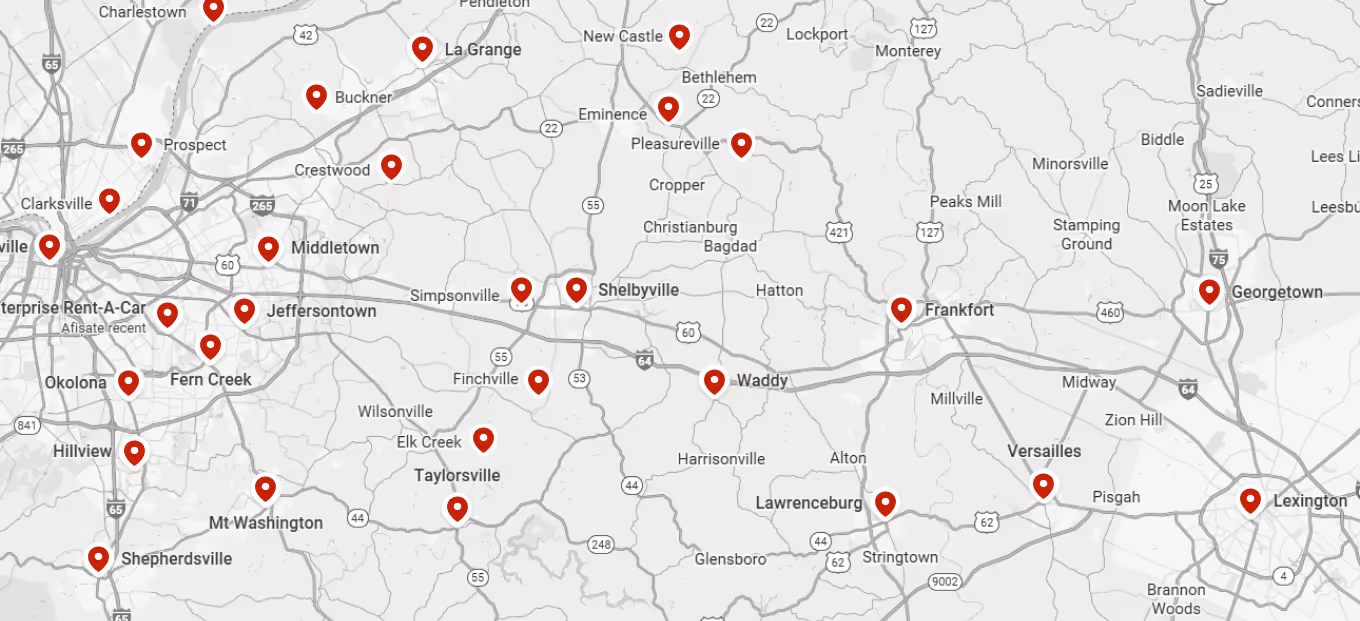
Proudly serving Spencer county, Jefferson county, Bullitt county, and the surrounding areas
Short Heading Goes Here
Sed iaculis aenean sit sed risus arcu vitae integer elit.

