

.svg)


.avif)



5 min read
The Relationship Between Your AC's Airflow and Indoor Dust Accumulation
Why Am I Dusting So Much? The Hidden Link Between Late-Summer AC Use and Indoor Dust
As families gear up for the back-to-school transition and the August heat lingers, you might wipe down your living room furniture on Tuesday, but by Thursday, the surfaces are coated in gray fuzz again—a frustrating cycle that perfectly highlights the relationship between your AC's airflow and indoor dust accumulation. When you are constantly battling airborne particles, it is easy to blame open windows, shedding pets, or simply not cleaning often enough. However, excessive household dust is rarely a housekeeping failure. More often than not, it is a clear indicator of degraded HVAC performance.
By the time late summer rolls around, your cooling equipment has been running almost non-stop for months. This heavy, continuous operation takes a toll on the internal components that circulate air throughout your rooms. When a cooling system struggles to move enough air, it loses its ability to filter out the microscopic particulates floating in your living space. Instead of getting trapped in the filter, that debris simply drops onto your floors and electronics.
At 3D Heating and Cooling, our team has seen firsthand how a healthy AC doesn't just cool the air; it actively protects your indoor air quality. Over our years of serving local families, we have found that a system working at peak efficiency acts as a whole-home air purifier. When that efficiency drops, you are faced with an important decision point: determining if this sudden late-summer increase in dust requires a simple filter change or deeper diagnostic work on your air conditioning system.
The Physics of Air Velocity: How Your HVAC System Captures Suspended Particulates
To understand why your home gets so dusty in late summer, you have to look at the physical mechanics of how air moves. A standard residential cooling system relies on a delicate balance of air pressure and velocity. When that balance is maintained, your equipment actively manages airborne dust without you ever lifting a microfiber cloth.
The 3 to 5 Cycles Per Hour Rule
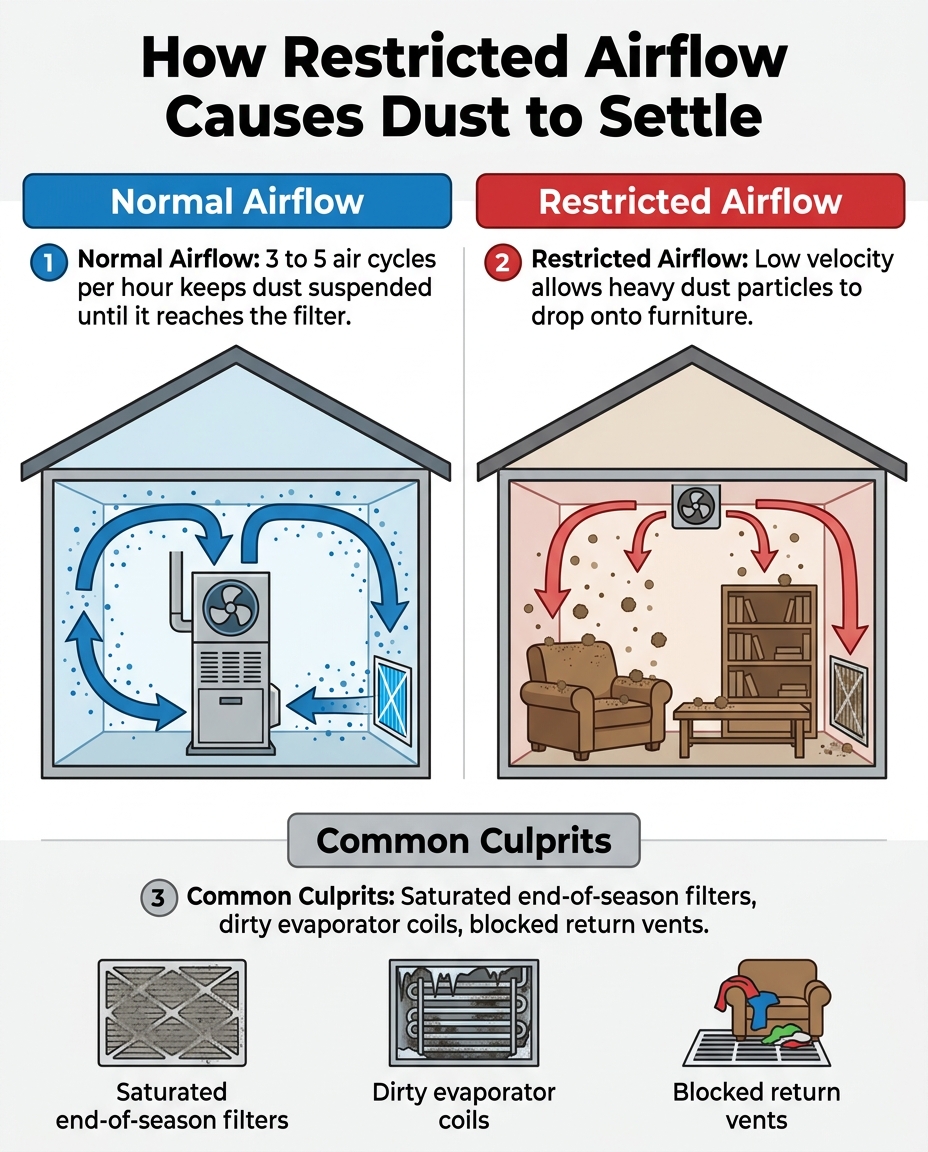
When our technicians evaluate a home, the baseline expectation we look for is a healthy residential HVAC setup that cycles the entire volume of air in your home three to five times per hour. This continuous turnover acts as your primary defense against airborne allergens, pet dander, and fabric fibers. As the blower motor pushes conditioned air into the rooms, it creates a gentle but persistent current. This steady air velocity keeps lightweight dust particles suspended in the air. As long as the particles remain suspended, they are actively moving toward the filtration point.
The Crucial Role of the Return Duct
While the supply vents push cold air into the room, the return vents pull the existing air back into the system. This is where the actual cleaning process begins. The air must possess enough kinetic energy to carry suspended dust all the way across the room and into these intakes. If the velocity drops, the dust never makes it to the filter. Effective filtration is entirely dependent on your system's ability to maintain strong, consistent airflow. Without adequate suction at the return vents, even the most expensive indoor air quality solutions cannot do their jobs effectively.
Comparing Airflow States in Taylorsville KY Homes:
• Healthy Air Velocity — Dust Suspension: Particles remain airborne — Filtration Effectiveness: High (pulled into return vents) — Surface Accumulation: Minimal (normal weekly dusting)
• Degraded Air Velocity — Dust Suspension: Particles drop rapidly — Filtration Effectiveness: Low (air cannot reach the filter) — Surface Accumulation: Heavy (requires dusting every few days)
What Happens When Airflow Drops: The Settling Effect
The Problem: You notice a thick layer of dust settling rapidly on your ceiling fan blades, bookshelves, and television screens, especially as August drags on. No matter how long the AC runs, the air inside feels heavy, and the dust keeps returning.
The Cause: When your blower motor cannot push or pull enough air through the ductwork, the air velocity in your living space plummets. The air becomes stagnant. Stagnant air lacks the physical force required to keep heavier dust particles, skin cells, and pollen suspended. This creates what HVAC professionals call the "settling effect." Without a strong current to carry them to the return vents, particulates simply drop out of the air due to gravity. They land on your furniture, floors, and electronics long before they ever reach the filtration media.
The Solution: Running your AC for longer periods will not fix this issue if the underlying air velocity is compromised. A system with restricted airflow just wastes electricity while failing to clean the air. The only way to stop the settling effect is to identify and remove the restriction that is choking the blower motor, restoring the powerful air currents needed to capture the dust.

The First Culprit: Saturated Air Filters After Months of Heavy Cooling
A pattern we see often on late-summer service calls is a sudden spike in household dust caused by a saturated air filter. By August, an air filter has likely captured months' worth of dust, spring pollen, and summer pet dander. As the filter fills up, the tiny pores that allow air to pass through become entirely blocked.
A severely clogged filter acts exactly like a solid wall inside your ductwork. It forces the blower motor to work incredibly hard while moving significantly less air. The less air the blower can pull through the filter, the less air it can push into your living room, immediately causing the settling effect described earlier.
It is also important to consider the type of filter you are using. Many homeowners purchase filters with very high MERV (Minimum Efficiency Reporting Value) ratings, assuming a denser filter will catch more dust. However, overly restrictive filters can inadvertently cause dust to settle. If your blower motor is not rated to handle the thick material of a high-MERV filter, the filter itself creates an airflow restriction. Finding the right balance is critical, which is why choosing the right air filter for allergen control matters so much for your system's performance.
Checking and changing your air filter should always be your immediate first step when you notice a sudden increase in dust accumulation.
Deeper Restrictions: How Dirty Evaporator Coils and Blocked Vents Trap Air
If installing a fresh filter does not solve your dust problem, the restriction is likely buried deeper inside the system. These deeper issues physically choke off the air supply, and they require professional HVAC services to correct safely.
Evaporator Coil Sludge
The evaporator coil is the part of your AC that actually removes heat from the air. Because it gets very cold, it naturally produces condensation. In our experience dealing with Taylorsville's humid late summers, we frequently encounter heavy condensation on evaporator coils, which acts as a magnet for any bypass dust that slips past the filter. When moisture mixes with dirt, it creates a thick, restrictive sludge that coats the microscopic fins of the coil. This sludge blocks air from passing through, severely dropping your air velocity. Cleaning a delicate evaporator coil requires specialized chemicals and tools, and it must never be attempted as a DIY project.
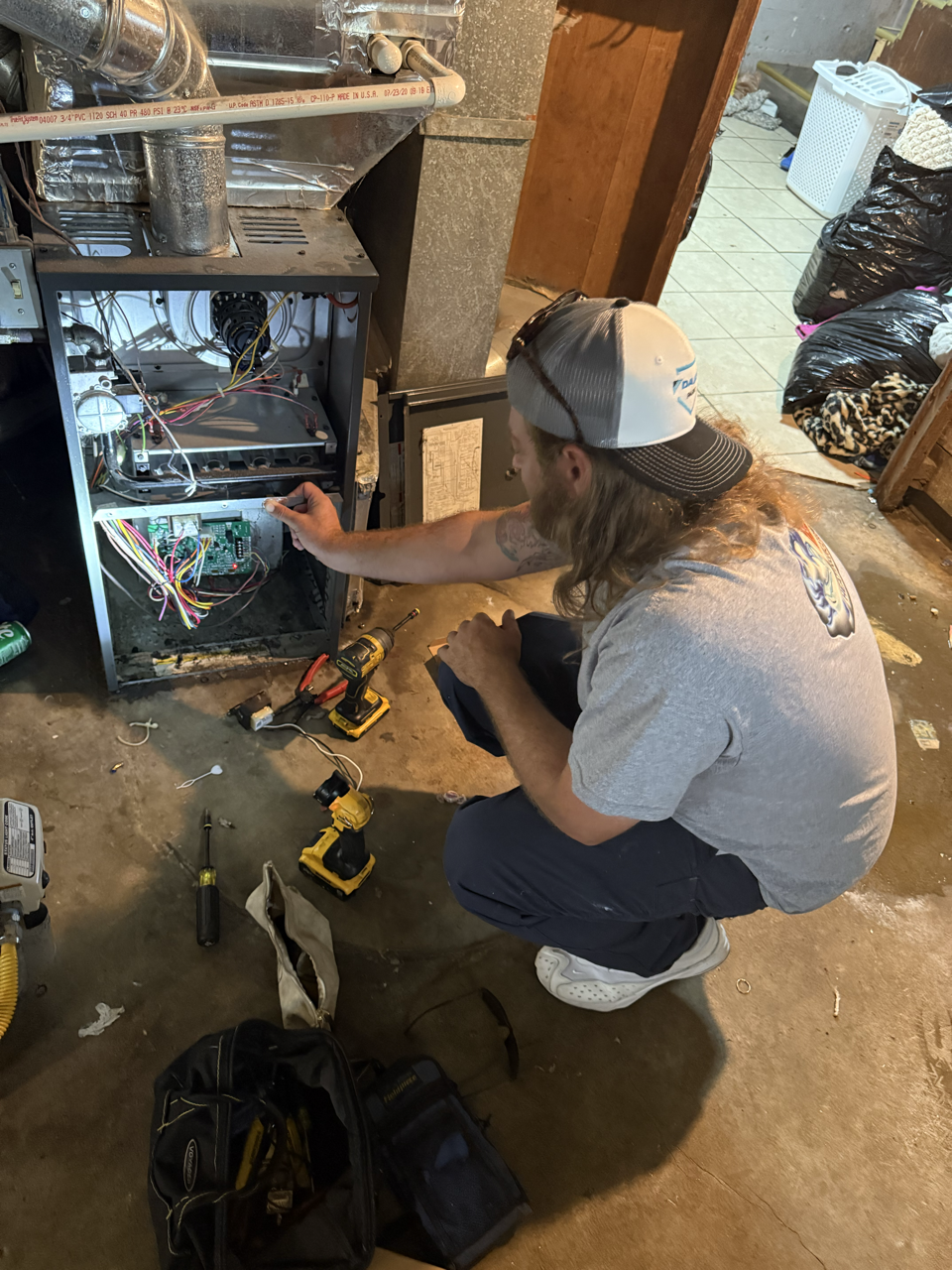
A faulty or leaking coil is a frequent culprit behind sudden system degradation. For example, our team recently responded to a local homeowner who noticed a massive spike in household dust. Our technician arrived, diagnosed a faulty coil and a unit leak, and fixed them on the same day, getting the system fully repaired and running properly. Catching these coil issues early prevents massive airflow drop-offs.
Ductwork Leaks and Pressure Imbalances
Your home relies on carefully balanced air pressure. When you close supply vents in unused rooms, or if furniture blocks a return vent, you disrupt this balance. Furthermore, leaky ductwork in unconditioned spaces like attics or crawlspaces can wreak havoc on your air quality. If a return duct has a tear, the system creates negative pressure, actively pulling raw, unfiltered dust and insulation fibers from the attic directly into your living areas while simultaneously reducing the airflow meant for your rooms.
Key Indicators That Compromised Airflow Is Causing Your Dust Problem
How do you know if your late summer dust is an airflow issue rather than just normal household dirt? Look for these physical signs that your system is struggling to move air:
1. Weak air at the supply registers: Place your hand over the vents while the system is running. If the air feels like a weak trickle rather than a steady breeze, your velocity has dropped significantly.
2. Longer-than-normal cooling cycles: If your AC runs for an hour but the room temperature barely drops, the system is not moving enough conditioned air to satisfy the thermostat.
3. Hot and cold spots: Uneven temperatures throughout the house indicate that conditioned air lacks the force to circulate properly into the furthest rooms.
4. Strange whistling noises: A high-pitched whistle near the return vent usually means the system is starved for air and is trying to pull it through a clogged filter or a tiny gap in the ductwork.
5. Dust building up on the vent grilles: If you see thick gray dust clinging to the slats of your supply vents, it means the air is moving so slowly that dust is dropping out of the current the moment it enters the room.
Actionable Steps to Restore Airflow and Improve Indoor Air Quality
If you suspect restricted airflow is the reason you are dusting every other day in August, our team recommends these safe steps you can take immediately, as well as clear boundaries for when to call an expert.
• Perform a visual vent inspection: Walk through every room in your Taylorsville KY home and check the supply and return vents. Ensure that no rugs, heavy curtains, or pieces of furniture are blocking the grilles. Open any vents that were closed in unused rooms to restore pressure balance.
• Install a fresh, properly rated filter: Remove your current filter and hold it up to a light. If you cannot see light passing through the material, it is fully saturated. Replace it with a fresh filter that matches your system's recommended MERV rating.
• Avoid DIY deep cleaning: Never attempt DIY coil cleaning, blower motor dismantling, or internal duct repairs. The aluminum fins on an evaporator coil bend easily, and using the wrong brush can permanently damage the equipment and cause refrigerant leaks.
• Schedule a professional evaluation: The greatest long-term value comes from having a professional evaluate the blower motor's amp draw, verify the coil's cleanliness, and measure the static pressure. Enrolling in a routine HVAC maintenance plan ensures these deep restrictions are caught before they turn your home into a dust trap.
Frequently Asked Questions About AC Airflow and Household Dust
Why is my house so dusty even with the AC on?
If your house is dusty while the AC runs, your system likely lacks the airflow velocity needed to pull particulates into the filter. When an AC runs with a clogged filter or a dirty coil, the air moves too slowly to keep dust suspended. Instead of traveling to the return vents, the dust simply drops onto your floors and furniture. Restoring proper airflow is the only way to get the system cleaning the air again.
Can poor AC airflow cause more dust to settle on furniture?
Yes, poor airflow is a leading cause of rapid dust settling. Healthy air velocity creates a current that carries lightweight particles across the room and into the filtration system. When airflow drops, that current disappears, and gravity takes over. The dust drops out of the stagnant air and lands directly on your household surfaces.
Does running the AC fan continuously reduce household dust?
Running the fan continuously can help reduce dust, but only if the system has strong airflow and a clean filter. If the filter is already saturated or the blower motor is weak, running the fan 24/7 will just circulate stagnant air without actually filtering it. Furthermore, running the fan continuously in humid climates can sometimes pull moisture back off the evaporator coil, increasing indoor humidity.
Can a dirty AC filter cause a dusty house?
Absolutely. A dirty AC filter acts like a wall that blocks air from circulating through your home. Because the blower motor cannot pull enough air through the clogged material, the overall air velocity in your house drops. This low velocity allows dust to settle on your furniture rather than being pulled into the ductwork to be trapped.
How do I stop my AC from blowing dust into my rooms?
To stop dust from blowing out of your vents, start by changing your air filter and ensuring all return vents are unblocked. If the problem persists, you may have leaky ductwork pulling dirt from your attic or a heavily soiled evaporator coil. Both of these deeper issues require a professional inspection to properly clean the system and seal any ductwork breaches.
What MERV rating is best for balancing airflow and dust reduction?
For most standard residential systems, a MERV 8 to MERV 11 filter offers the best balance between capturing household dust and maintaining safe airflow. Filters rated MERV 13 or higher catch smaller particles, but they are incredibly dense. If your blower motor is not specifically designed to handle that level of resistance, a high-MERV filter will severely restrict your airflow and actually cause more dust to settle in your rooms.
Protect Your Home's Air Quality and System Efficiency
As we transition out of the cooling season, excessive late-summer dust in your Taylorsville KY home is a clear signal from your HVAC system that it needs attention. It is not a sign that you need to clean more often; it is a sign that your equipment is struggling to breathe after months of heavy use. When air velocity drops, the settling effect takes over, leaving your surfaces coated in the debris your filter was supposed to catch.
Restoring proper airflow does more than just cut down on your weekly dusting chores. It protects the lifespan of your cooling equipment by reducing strain on the blower motor, and it safeguards your family's respiratory health by actively filtering out allergens. If a simple filter change does not resolve the settling dust, do not ignore the warning signs. Seek professional guidance to clear out the deeper restrictions and get your home's air flowing powerfully and cleanly once again.
Financing

Now Offering Financing Options with Affordable Monthly Payments
where we operate
Service Areas
Proudly serving Spencer county, Jefferson county, Bullitt county, and the surrounding areas

Short Heading Goes Here
Sed iaculis aenean sit sed risus arcu vitae integer elit.

